
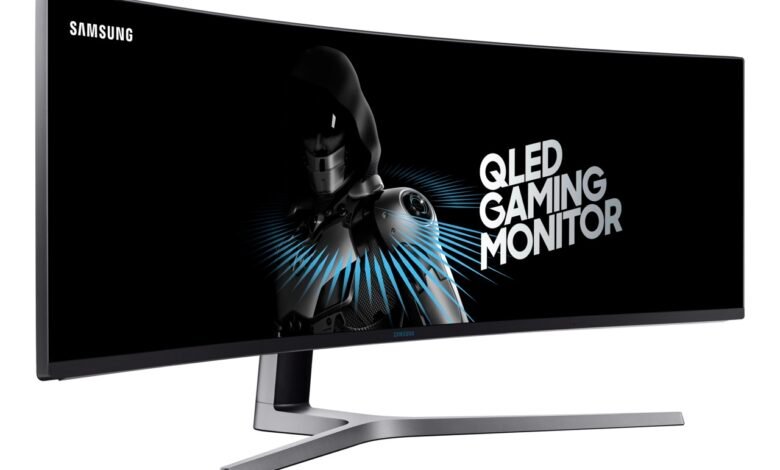

Samsung has held the number one position in the global gaming monitor market for the seventh consecutive year. That streak, which began in 2019, is now backed by fresh data from research firm International Data Corporation (IDC), placing Samsung at an 18.9% share of worldwide gaming monitor revenue for 2025.
The company also retained its lead in the OLED gaming monitor segment for the third year running, claiming a 26% share. On the surface, it is a convincing show of dominance. But the numbers deserve a closer look because they are moving in the wrong direction.
The gap is shrinking
In 2024, Samsung commanded 21% of the overall gaming monitor market. That figure dropped to 18.9% in 2025. Its OLED share fell even more sharply, from 34.6% in 2024 to 26% in 2025. So while Samsung still leads, the lead is narrowing at a noticeable pace.
The reason? OLED gaming monitors are no longer a premium niche. They have entered the mainstream, and that has opened the door for aggressive competitors. ASUS, LG, and MSI have all expanded their OLED lineups significantly. TrendForce reported in November 2025 that ASUS had actually surpassed Samsung in OLED monitor shipments during Q3 2025, taking a 21.9% share by volume compared to Samsung’s 18%. ASUS achieved this by flooding the market with a wide range of OLED models targeting both gamers and content creators across multiple price tiers.
Samsung’s lead, it is worth noting, is measured by revenue rather than units shipped. That distinction matters. It means Samsung is selling fewer monitors than some competitors, but at higher prices. The premium positioning props up its market share when counted in dollars but masks the volume gains its rivals are making.
What Samsung is betting on next
Samsung showcased its 2026 Odyssey lineup at the Game Developers Conference (GDC) in San Francisco earlier this year. The product range is designed to push the boundaries of what gaming monitors can do, and it gives a clear sense of where the company thinks its competitive advantage lies: technology that nobody else is shipping yet.
The headline product is a 27-inch Odyssey 3D monitor with glasses-free 3D capability. It uses advanced eye-tracking to create depth without requiring any special eyewear. Samsung says its Odyssey 3D Hub will support over 120 compatible game titles by the end of 2026, with confirmed games including Hell is Us and Cronos: The New Dawn.
Then there is the 32-inch Odyssey G8, which Samsung calls the industry’s first 6K gaming monitor. It runs at a native 165Hz refresh rate and includes a Dual Mode feature that can push the resolution down to 3K while doubling the refresh rate to 330Hz. That kind of flexibility is aimed at gamers who want the option to choose between visual fidelity and buttery-smooth motion depending on what they are playing.
For the OLED side, the 32-inch Odyssey OLED G8 features a 4K QD-OLED panel running at 240Hz. Samsung has equipped it with its OLED Safeguard+ technology, a suite of burn-in prevention features that have become increasingly important as more gamers leave their monitors on for extended periods with static interface elements.
Samsung is also going after the competitive esports crowd. The 2026 lineup includes a monitor capable of reaching 1,040Hz, which would make it the fastest gaming display on the market by a significant margin. At those refresh rates, the screen updates more than a thousand times per second, offering motion clarity that is measurably beyond what the human eye can fully distinguish but that competitive players insist makes a difference at the highest levels.
A growing market
The broader gaming monitor market continues to expand. Industry estimates peg its value at around $12.97 billion in 2024, with projections pointing towards $18.25 billion by 2032. The OLED segment within that is growing even faster, rising from $2.18 billion in 2025 to a projected $3.48 billion by 2032.
Several factors are driving this growth. Console prices have risen significantly in recent years, pushing more players towards PC gaming where hardware can be upgraded piece by piece. Esports viewership continues to climb globally, normalising high-refresh-rate displays as an essential part of the competitive setup. And remote work has meant that many people already have a capable PC at their desk, making a gaming monitor a single-purchase upgrade rather than a full system overhaul.
Samsung is clearly aware that holding the number one position will require more than just brand recognition. Hun Lee, Executive Vice President of Samsung’s Visual Display Business, pointed to partnerships with game studios as a key part of the company’s strategy. Those partnerships are particularly important for the glasses-free 3D play, which requires developers to actively support the format.
The bigger picture
Samsung’s 100-inch Neo QLED TV launch in Kenya last year already demonstrated the company’s intent to push premium display technology into new markets. The gaming monitor business follows a similar logic: lead with the most advanced hardware, price it at a premium, and use that positioning to sustain revenue share even as competitors match older specifications at lower prices.
But the TrendForce data on ASUS overtaking Samsung in OLED monitor shipments should be a wake-up call. Revenue leadership is sustainable only as long as consumers are willing to pay the premium. If ASUS, LG, and MSI continue to deliver comparable OLED quality at more accessible prices, Samsung’s lead will continue to erode regardless of how many industry-first specifications it introduces.
For now, though, seven years at the top remains a significant achievement. No other brand in the gaming monitor space has managed anything close to that kind of sustained dominance. Whether Samsung can make it eight will depend on how quickly its glasses-free 3D and 6K bets translate from spec-sheet novelties into features that gamers actually want to pay for.