
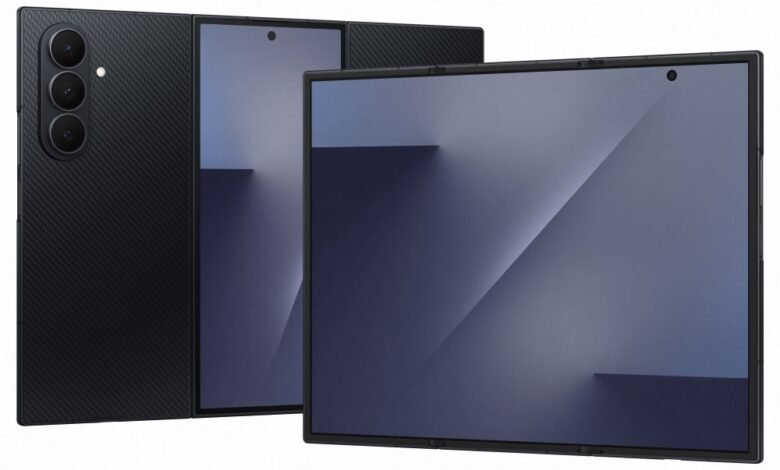
Samsung Electronics has officially unveiled the Galaxy Z TriFold, the company’s first triple-folding smartphone. Entering a market segment pioneered by Huawei just three months prior, Samsung’s offering arrives with a strategic price tag of approximately $2,500 (approx. KES 330,000 excluding taxes), significantly undercutting the Huawei Mate XT Ultimate while delivering a crucial advantage: global availability with full Android support.
Launch sales begin in South Korea on December 12, with a U.S. and global rollout planned for Q1 2026.
The Engineering Marvel: Durability First
Unlike Huawei’s “Z-shape” design which leaves part of the screen exposed, Samsung has opted for a symmetrical inward-folding “gatefold” design. When closed, the massive 10.0-inch main display is completely protected inside, while a separate 6.5-inch cover screen handles standard smartphone tasks.
Despite housing two complex hinge mechanisms, the device measures just 3.9mm at its thinnest point when unfolded, collapsing into a pocketable (but chunky) 12.9mm thickness.

Full Specifications
| Feature | Specification |
|---|---|
| Main Display | 10.0-inch QXGA+ Dynamic AMOLED 2X (2160 x 1584), 120Hz, 1600 nits peak |
| Cover Display | 6.5-inch FHD+ Dynamic AMOLED 2X (2520 x 1080), 120Hz, 2600 nits peak |
| Processor | Snapdragon 8 Elite Mobile Platform for Galaxy (3nm) |
| RAM / Storage | 16GB RAM / 512GB or 1TB Storage (No microSD support) |
| Battery | 5,600mAh (Split across three cells) |
| Charging | 45W Wired (Adapter Included) / 15W Wireless |
| Rear Cameras | 200MP Main (f/1.7, OIS), 12MP Ultrawide, 10MP Telephoto (3x Optical) |
| Front Cameras | 10MP (Cover) + 10MP (Inner) |
| Dimensions | Unfolded: 159.2 x 214.1 x 3.9mm – 4.2mm / Folded: 159.2 x 75.0 x 12.9 mm |
| Weight | 309g |
| IP Rating | IP48 (Water Resistant up to 1.5m; NOT Dust Tight) |
| OS | Android 16 with One UI 8 |
| Connectivity | 5G, Wi-Fi 7, Bluetooth 5.4 |
| Colours | Crafted Black |
The Buyer’s Reality Check: What the Specs Don’t Tell You
Before dropping KES 300k+ on this device, there are four critical “user experience” realities to consider that go beyond the spec sheet:
- The “Brick” Factor (Weight): At 309g, the Z TriFold is significantly heavier than the Galaxy Z Fold 6 (~239g) and the Galaxy S25 Ultra (~219g). It approaches the weight of a small tablet. Single-handed use will likely cause wrist fatigue quickly; this is a two-handed device by design.
- The Aspect Ratio Issue: The 10-inch screen has a boxy 4:3 aspect ratio. While perfect for spreadsheets and documents, it is less ideal for modern 16:9 video content. Watching Netflix or YouTube will result in substantial black bars (letterboxing) at the top and bottom, meaning the actual video size isn’t drastically larger than on a standard foldable.
- The Box Surprise: In a rare reversal of recent trends, Samsung has included a 45W Charger and a specialised Protective Case in the box. This adds significant value (approx. KES 15,000) and acknowledges the unique charging needs of the split-battery system.
- Silicon Timing: The device runs on the Snapdragon 8 Elite (2025 architecture). With the Galaxy S26 series expected to launch in Jan/Feb 2026 with next-gen silicon, early adopters are technically buying “last year’s chip” at a premium price point, though performance differences will likely be negligible for most users.
The Critical Compromises: Dust & S-Pen
While the engineering is impressive, Samsung has made two significant trade-offs to achieve this form factor:
- No S-Pen Support: To achieve the 3.9mm thinness, the digitiser layer required for the S-Pen was removed. This is a purely touch-based tablet.
- IP48 Rating (The Dust Trap): The device is water-resistant (submersion up to 1.5m), but the “4” rating means it only blocks objects larger than 1mm (like wires or screws). It is NOT dust-tight. Sand or pocket lint could potentially enter the hinge mechanism, making this risky for beach trips or dusty environments.
Software: The “Killer App” is DeX
The strongest argument for the Z TriFold is software. It launches with Standalone Samsung DeX, allowing the 10-inch screen to function as a desktop environment without needing an external monitor. Users can run up to four workspaces simultaneously, transforming the device into a legitimate laptop replacement for mobile professionals.
Comparison: Samsung Z TriFold vs. Huawei Mate XT
| Feature | Samsung Galaxy Z TriFold | Huawei Mate XT Ultimate | The Verdict |
|---|---|---|---|
| Fold Style | Inward (Protected) | Z-Shape (Exposed) | Samsung wins on long-term durability. |
| OS | Android 16 (Google Play) | HarmonyOS (No Google) | Samsung wins for global usability. |
| Charging | 45W Wired / 15W Wireless | 66W Wired / 50W Wireless | Huawei wins by offering significantly faster charging. |
| Camera | 200MP Main / 3x Zoom | Variable Aperture / 5.5x Zoom | Huawei wins on optics; Samsung wins on resolution. |
| Price | ~$2,500 (KES ~330k) | ~$3,500+ (Import) | Samsung is cheaper offering a better value option. |


Pricing & Availability
- South Korea: Dec 12, 2025 (~3.59m KRW).
- USA/Global: Q1 2026.
- Kenya/Africa: No official launch date confirmed. Based on previous flagship rollouts, expect grey imports by Q2 2026.
Estimated Local Pricing: While the direct conversion is approx. KES 325,000, with import duties and VAT, local retailers will likely list the device between KES 390,000 and KES 500,000.
The Bottom Line
Samsung has successfully turned the “Tri-Fold” concept from a fragile prototype into a usable product. By prioritising screen protection and software productivity (DeX) over pure thinness or charging speed, the Galaxy Z TriFold is the pragmatic choice for power users – provided they can stomach the price and keep it away from sand.