

In the world of tablets, there is a simple rule: if you want a screen bigger than 12 inches, you usually have to pay a premium. Apple’s 13-inch iPad Pro starts at over KES 100,000. Samsung’s Galaxy Tab S9 Ultra is even pricier.
Infinix wants to break that rule.
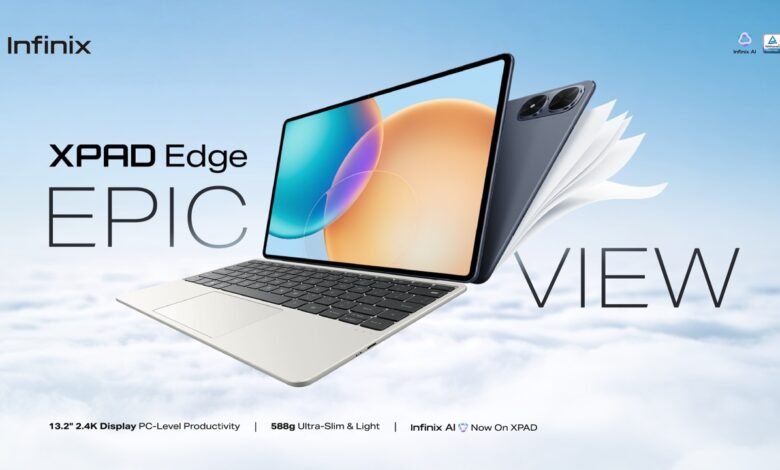
The company has officially unveiled the Infinix XPAD Edge in Malaysia, a device that brings a massive 13.2-inch display to the budget segment. It is sleek, it is huge, and on paper, it looks like the productivity companion many Kenyans have been waiting for. But dig a little deeper into the spec sheet, and you’ll find a device that is surprisingly compromised – and in some ways, weaker than its smaller, cheaper sibling.
The Screen: Size vs. Speed
The XPAD Edge is defined by its display. At 13.2 inches, this panel is larger than many laptops (like the Dell XPS 13 or MacBook Air). For users who live in split-screen mode – documents on one side, research on the other – this is a dream. The 2.4K resolution (2400 x 1600) ensures text remains crisp, and the 3:2 aspect ratio is perfect for reading; it’s taller than a standard wide-screen tablet, showing you more of a website or document at once.
The Engine Room:
The XPAD Edge is powered by the Qualcomm Snapdragon 685. While the “Snapdragon” name carries weight, the 685 is effectively a budget 4G chip optimized for battery life, not raw power. Crucially, it is often outperformed in gaming and heavy lifting by the Helio G99 – the very chip found in the smaller, cheaper standard XPAD.
This creates a strange hierarchy where the “Edge” model is physically larger but technically slower. If you are buying this thinking the bigger body houses a bigger engine, think again. This tablet is built for light productivity – WPS Office (which comes pre-installed), emails, and streaming video. It is not a gaming machine.
Battery Life: The Marathon Runner
The chassis houses an 8,000mAh battery, which, when paired with the power-sipping Snapdragon 685, should easily deliver multi-day battery life.
However, refueling that tank will be a test of patience. The device supports 18W wired charging. In an era where Infinix phones like the Note series charge at 45W, 68W, or even 100W, capping a productivity tablet at 18W is disappointing. Expect a 0-100% charge time to hover around the 3-hour mark.
Software: The “PC” Pitch
Infinix knows that hardware alone won’t sell this device, so they are leaning heavily into software. Running on Android 15 (XOS), the XPAD Edge features Infinix’s “Folax” AI assistant and a suite of “PC-Level” continuity features.
If you own an Infinix smartphone, the “InSync” ecosystem allows for seamless file drag-and-drop and hotspot sharing. The interface also supports floating windows and a taskbar, attempting to mimic a Windows desktop experience. It’s a valiant effort to make Android useful on a 13-inch canvas, though the hardware limitations may make heavy multitasking feel sluggish.
Pricing & Verdict: The Kenyan Context
The XPAD Edge has launched in Malaysia for RM 1,299 (approx. KES 38,000).
It has not yet launched in Kenya.
If and when it arrives, taxes and duties will likely push the retail price to between KES 42,000 and KES 48,000.
This places it in a dangerous position. At ~KES 45k, it sits uncomfortably close to the Xiaomi Pad 6, which offers a 144Hz screen and a flagship-grade Snapdragon 870 chip. The Xiaomi is smaller (11 inches), but it is infinitely faster.
The Bottom Line: The Infinix XPAD Edge is a niche device for a specific person: someone who needs a laptop-sized screen for reading and typing but cannot afford a laptop. If size is your only metric, this is a steal. For everyone else, the smaller, smoother standard XPAD – or a competitor like Xiaomi – remains the smarter buy.