

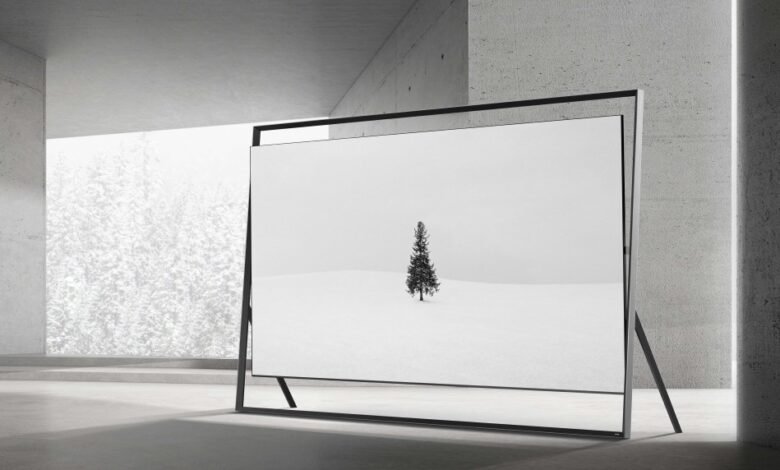

If you have a living room the size of a small warehouse and a nostalgia for experimental industrial design, Samsung has a new halo product for you. At CES 2026, the company just pulled the wraps off the R95H, a colossal 130-inch “Micro RGB” TV that doesn’t mount on your wall—it stands on the floor.
“Micro RGB represents the peak of our picture quality innovation, and the new 130-inch model takes that vision even further,” said Hun Lee, Executive Vice President of the Visual Display Business at Samsung Electronics.
The R95H represents a significant pivot in Samsung’s ultra-premium strategy. While recent years have focused on making screens disappear (like the transparent Micro LED demos of yesteryear), this new model demands to be seen. It resurrects the “Timeless Gallery” aesthetic first seen on the S9 UHD TV back in 2013. That design featured a screen floating inside a massive industrial frame, looking more like a painter’s easel than a television.
Samsung claims this “Timeless Frame” creates an “immersive window” effect. It is a bold, perhaps polarising, choice. In an era where bezels are shrinking to near-invisibility, Samsung is bringing back the bezel as a piece of furniture.
It’s not Micro LED; it’s “Micro RGB”
The terminology shift here is important. Samsung is marketing this as the world’s first 130-inch Micro RGB display. It is crucial to distinguish this from “Micro LED” (the six-figure, self-emissive tech found in The Wall).
Contrary to what the name might suggest, Micro RGB is closer to Mini-LED technology than true Micro LED. It’s still an LCD panel with a backlight—but with a crucial difference. Instead of using standard white or blue Mini-LEDs in the backlight, Micro RGB uses microscopic individual Red, Green, and Blue LEDs, each measuring less than 100 micrometers. This RGB backlight architecture allows for more accurate color reproduction compared to traditional Mini-LED panels.

According to SamMobile’s technical breakdown, because these RGB LEDs are significantly smaller than standard Mini-LEDs, Samsung achieves “even better control over local dimming, thereby producing deeper blacks and virtually eliminating the blooming issue usually found in full-array local dimming (FALD) LED-backlit LCD TVs and Mini-LED TVs”. The result is “almost OLED and Micro LED TV-like control over local dimming” but at a fraction of the cost—approximately one-fifth the price of a comparable Micro LED display.
The headline benefit of this RGB backlight architecture is color purity. Samsung claims the R95H hits 100 percent of the BT.2020 colour space, a metric often chased but rarely caught in consumer displays. For context, most high-end OLEDs and QD-OLEDs struggle to cover 90 percent of BT.2020. If accurate—and Samsung says this is certified by the VDE (Verband der Elektrotechnik) for precise Micro RGB color reproduction —this means the R95H can display a range of saturated greens, cyans, and reds that literally cannot be reproduced by current standard televisions.
The Verge notes that this technology positions Micro RGB as “a middle ground between traditional Mini-LED displays and the ultra-premium Micro LED lineup”, offering significantly improved color accuracy and local dimming performance without the six-figure price tag of true Micro LED panels.
This is achieved via the “Micro RGB Precision Colour 100” engine and a new AI processor stack:
- Micro RGB AI Engine Pro: The orchestrator for local dimming and tone mapping.
- Micro RGB Color Booster Pro: Enhances dull tones in real-time.
- Micro RGB HDR Pro: Refines contrast across bright and dark scenes.
Audio Gets the “Eclipsa” Treatment
Beyond picture quality, Samsung is introducing Eclipsa Audio—a 3D spatial audio technology co-developed with Google specifically for this generation of devices.
Based on the open-source IAMF (Immersive Audio Model and Formats) standard, Eclipsa allows the frame-integrated speakers to adjust sound location, intensity, and “spatial reflections.” This is Samsung and Google’s direct answer to Dolby Atmos, designed to make audio feel like it’s tracking objects moving across that massive 130-inch canvas.
The AI War comes to your remote
Hardware is only half the story at CES 2026. The R95H is one of the first devices to sport Samsung’s “Vision AI Companion.” We have moved past simple voice commands; this TV integrates Microsoft Copilot and Perplexity directly into the OS.
Theoretically, this allows for conversational search (“Find me that sci-fi movie where the guy fights aliens on the sun”) and proactive recommendations. The suite includes:
- AI Football Mode Pro: Optimises motion handling for fast-moving sports.
- Live Translate: Real-time language translation (currently limited to 7 languages including English, French, and Korean).
- Generative Wallpaper: Uses GenAI to turn the screen into digital art when idle.
The Technical Nitty-Gritty
For the pixel peepers, the R95H includes:
- HDR10+ ADVANCED: The first implementation of this next-gen standard, likely adding dynamic metadata for higher brightness peaks to combat Dolby Vision IQ.
- Glare Free Tech: Essential for a screen this size, as a 130-inch mirror would be unwatchable in a lit room.
Samsung has not released pricing yet, but if history is any guide, “Micro RGB” sits in a unique spot between flagship 8K LEDs and ultra-luxury Micro LEDs. The 115-inch predecessor (Model MR95F) launched at roughly $30,000 (~KES 3.9M). With the jump to 130 inches and the new easel design, expect the R95H to push well beyond that threshold—likely costing as much as a luxury SUV.