

Samsung Electronics kicked off its CES 2026 Tech Forums with a panel discussion focused on smart home interoperability, bringing together industry leaders to address one of the most pressing challenges in connected living: making devices from different manufacturers work together seamlessly.
The session, titled “When Everything Clicks: How Open Ecosystems Deliver Impactful AI,” featured executives from Samsung, Hartford Steam Boiler (HSB), and tech publication The Spoon discussing how cross-industry collaboration could transform connected homes from collections of isolated gadgets into truly intelligent environments.
The Push for Interoperability
At the heart of the discussion was a familiar problem for smart home users: devices that don’t communicate with each other. Samsung’s position, articulated by Yoonho Choi, President of the Home Connectivity Alliance and Head of Strategic Alliances at Samsung, emphasized that trust in home AI requires systems that work together rather than in silos.
“Home is the most personal place in our lives, so home AI must earn trust — quietly, respectfully, and with value users can feel,” Choi said. “That requires interoperability across brands, so the home works as one system instead of disconnected features.”
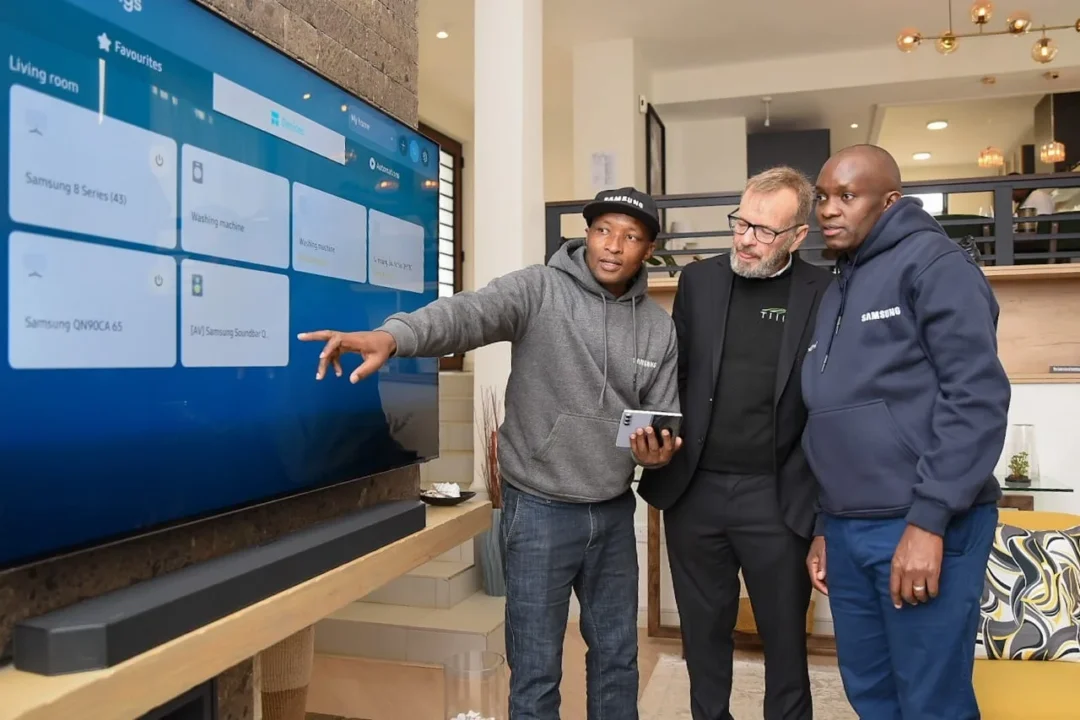
This stance aligns with broader industry efforts around standards like Matter, which aims to create a unified smart home protocol. Samsung’s SmartThings platform, which the company says now serves over 500 million users, already supports Matter alongside other connectivity standards.
Real-World Applications
The panel highlighted practical examples of how open ecosystems could deliver tangible benefits. Michael Wolf, founder of The Spoon, pointed to the kitchen as a particularly promising area for connected technology, noting that integration between refrigerators, water systems, and heating networks could enable more holistic home management.
Perhaps more intriguingly, Samsung showcased its partnership with HSB, a subsidiary of Munich Re that provides equipment breakdown insurance. According to Jed Usich, Senior Vice President at HSB, the collaboration demonstrates how smart home data—when used transparently and with user consent—can translate into direct consumer benefits like insurance discounts.
“We’ve created a bridge to the insurance industry that takes simple datapoints and turns them into tangible savings for consumers,” Usich explained.
This type of partnership represents a growing trend where smart home data moves beyond convenience features into financial services, though it also raises questions about data privacy and how much information consumers are comfortable sharing with insurers.
The AI Companion Challenge
Throughout the discussion, panelists stressed that home AI must feel natural rather than intrusive. The technology needs to blend into daily routines—cooking, relaxing, entertaining—without demanding constant attention or creating new friction points.
This human-centric approach to AI design has become increasingly important as companies like Samsung, Google, Amazon, and Apple compete to position their ecosystems as the foundation of the connected home. The challenge lies in creating AI that feels like a helpful companion rather than surveillance technology.
Industry Implications
Samsung’s emphasis on openness at CES comes as the smart home industry grapples with fragmentation. While standards like Matter offer a path forward, execution remains uneven across manufacturers. The company’s large user base—if the 500 million figure is accurate—gives it significant influence in pushing interoperability standards.
However, true openness also requires companies to relinquish some control over their ecosystems, a trade-off that has historically been difficult for tech giants to embrace. Whether Samsung’s advocacy for open systems translates into genuine cross-platform collaboration remains to be seen.
The panel’s consensus that “the future of home AI depends on interoperability, responsible data use and collaboration across industries” sounds promising, but the proof will be in implementation rather than CES keynotes.