
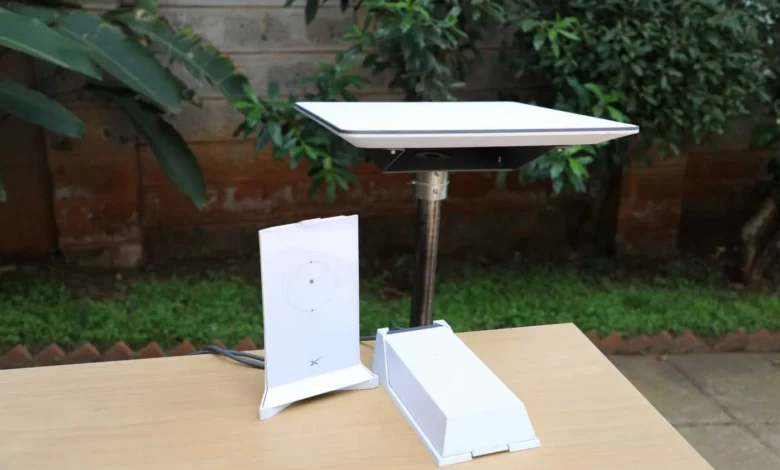

Starlink has introduced a significant pricing intervention in Kenya, rolling out monthly installment payments for its mini internet kit starting January 2026; a move reflecting the company’s struggle to penetrate an increasingly competitive market dominated by terrestrial providers.
Under the new plan, customers pay just KES 6,750 upfront for the mini kit hardware (75% discount from the KES 27,000 retail price), plus a KES 16,250 activation fee and KES 3,010 shipping charge, totaling KES 26,010 first payment. They then pay KES 4,500 monthly for hardware installments and KES 6,500 for residential internet service over six months – a combined KES 11,000/month commitment. Total cost over the initial six-month term: KES 92,010 (~USD 712).
This restructuring converts a capital purchase into operational expenses, targeting Kenya’s price-sensitive market where M-Pesa mobile payments dominate. However, it masks deeper competitive challenges. Starlink holds only 0.8% of Kenya’s total fixed internet market with 19,470 subscribers as of September 2025, despite controlling 98% of the satellite segment. Safaricom dominates at 35.6% market share with 815,037 subscriptions, while Airtel and others offer 5G routers for KES 3,000/month—one-tenth Starlink’s upfront hardware cost.
The announcement arrives amid mounting pressure. Starlink imposed a signup freeze from November 2024 to June 2025 to manage network congestion, during which competitors aggressively expanded. Growth has stalled: from 17,066 subs in March 2025 to 19,470 by September 2025—marginal gains despite the freeze lift. On the same day Starlink announced installments, American satellite startup Spacecoin secured a transmission license from Kenya’s Communications Authority, signaling regulatory openness to satellite alternatives and threatening Starlink’s market dominance.
Network performance remains unresolved. While Starlink’s January 2025 Nairobi Point of Presence reduced latency by 81%—from 120–150 milliseconds to 53 milliseconds—weather-related outages during heavy rains persisted, and median speeds of 47 Mbps lag terrestrial competitors in urban areas.
Starlink entered Kenya in June 2023 at KES 89,000 for the standard kit. Subsequent price cuts (to KES 45,500, then KES 27,000 for the mini kit) and rental options (KES 1,950/month) have failed to catalyze mass adoption. Third-party resellers had pioneered BNPL schemes like Lipa Pole Pole (KES 1,350/week over 24 weeks), which Starlink’s direct installment offering now consolidates—though at KES 15,335/month all-in cost, Starlink remains 3–6× more expensive than Safaricom fiber (KES 2,500–5,000) or 5G routers.
A December 2025 Airtel-SpaceX partnership to deploy Starlink Direct-to-Cell connectivity across 14 African markets by 2026 could reshape dynamics by enabling Starlink services through Airtel infrastructure, potentially bypassing dedicated kit requirements.
The bottom line: Installments may arrest subscriber decline but likely won’t catalyze mass-market adoption. With terrestrial providers entrenched and Spacecoin entering the satellite space, Starlink’s path to meaningful market penetration remains uncertain.