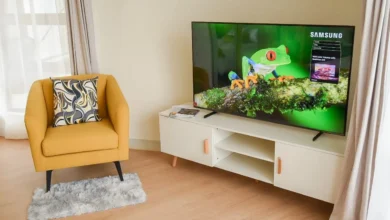

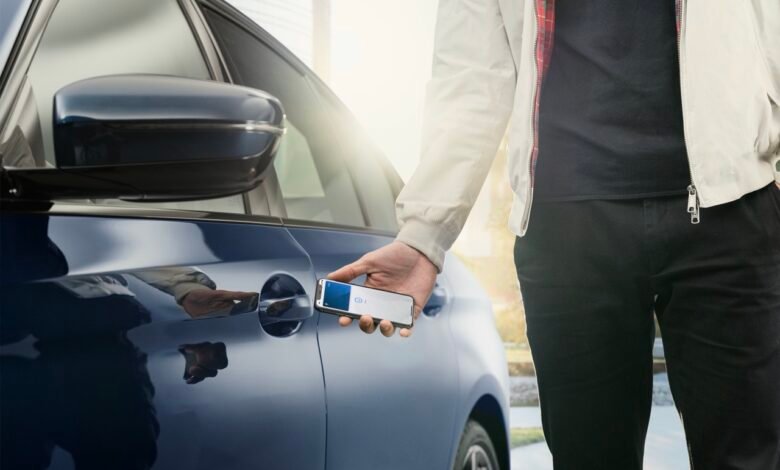

Imagine walking up to your car, and it unlocks before you even touch the handle. You walk into your living room, and the lights gently fade up, while your music seamlessly moves from your earbuds to the home speakers. You didn’t press a button. You didn’t open an app. No face scanning, no fingerprint. You didn’t speak a command. Only your phone spoke to the car and to the system, authenticated you, and the rest happened. Like a sixth sense!
For decades, technology has relied on Explicit Input: we had to tell our machines and appliances what to do (for example: flip a switch, tap a screen). We are now entering the era of Implicit Input. This is where the machine knows what you want simply based on where you are. And you can even share keys to friends and family.
But for a machine to know where you are, it needs eyes. Cameras can’t do this effectively – whether for privacy reasons or just due to their placement (a camera can’t see through your pocket). A solution to having a machine like a car door know where you are and authenticate you requires a means that is private and 100% verifiable. And that’s where Bluetooth and Ultra-Wideband (UWB) technology, stuff that is already baked into your phone, come in handy.
To understand how these invisible radios are giving your phone a “sixth sense,” we first need to look at the technology that started it all.
Part 1: The Foundation (Bluetooth & The Battery Problem)
Before we talk about the future, let’s talk about the radio in your pocket.
Bluetooth (Classic):
Think of original Bluetooth as a Heavy Load Truck on a Highway. It was designed to carry “heavy cargo”. Specifically, continuous audio streams for headphones or data for file transfers.
- How it works: It establishes a firm, steady connection.
- The Problem: Like a Heavy Load Truck, it requires a lot of energy to keep it moving on the Highway. If you left “Classic Bluetooth” running 24/7 to scan for smart locks, or pair to watches etc. batteries would be dead by lunch.
Enter Bluetooth Low Energy (LE):
In 2010, the industry released Bluetooth 4.0, which introduced “Low Energy” (LE).
- The Analogy: If Classic Bluetooth is a Heavy Load Truck on a Highway, Bluetooth LE is like a Boda Boda on a Single Lane.
- How it works: It is designed to be lightweight and agile. Instead of a constant stream, it sleeps 99% of the time. It wakes up for a millisecond, delivers a tiny envelope of data (like from a Watch it’ll send “Heart Rate: 80bpm” or “I am here”), and instantly goes back to sleep.
- The Main Flaw: Bluetooth LE has made “always-on” connectivity possible (launching the Smartwatch era), but it has had one massive weakness: It is bad at measuring distance.
Bluetooth LE tries to guess distance by measuring “Loudness” (Signal Strength). But a signal can be quiet because you are far away, or simply because your phone is inside a thick bag. So it becomes a guessing game. - Other Flaws: Bluetooth LE also suffers from interference (especially Wi-Fi) causing connectivity drops, poor audio, or devices not appearing
Part 2: The Evolution (Bluetooth 6.0)
For 14 years, we lived with that “guessing” limitation. Then, in September 2024, the Bluetooth Special Interest Group (SIG) announced Bluetooth 6.0. This update exists for one main reason: to stop guessing distance and start measuring it.
The New Feature: “Channel Sounding”
Bluetooth 6.0 introduces a feature called Channel Sounding. It stops relying on “loudness.”
- How it works: It shoots a radio signal to your phone, which bounces it back. By using a complex method called Phase-Based Ranging (PBR) and Round-Trip Time (RTT) measurements. This measures the position of the radio wave when it returns and it can calculate distance with much higher precision.
- The Result: It is the “Surveyor.” It can tell if you are 1 metre away or 3 metres away with decent accuracy (within 10-30cm).
- Why this matters for Kenya: Bluetooth chips are cheap. While the fancy tech (UWB) we are about to discuss is expensive and we’ve only seen it on expensive flagship, Bluetooth 6.0 will likely come to budget phones (TECNO, Infinix, Samsung A-Series) in the coming years.
- Challenge: Channel Sounding is Optional in Bluetooth 6.0: Not all BLE 6.0 devices are guaranteed to support Channel Sounding; manufacturers can implement selectively
Part 3: The Radical Alternative (Ultra-Wideband / UWB)
While Bluetooth was evolving, a completely different technology entered the chat. This is Ultra-Wideband (UWB).
What is it UWB?
Despite often being grouped with Bluetooth, Ultra-Wideband (UWB) has nothing to do with it. It is a completely different radio technology.
- The Analogy: Bluetooth uses narrow radio waves (like a single lane of traffic). Ultra-Wideband (UWB) uses a massive spread of frequencies (a 10-lane superhighway) to shoot billions of tiny pulses.
The Superpower: Time of Flight
Because Ultra-Wideband (UWB) uses pulses, it acts like Radar.
- How it works: It sends a pulse, waits for it to hit your phone and come back, and measures the exact time it took. Since the speed of light is constant, this gives centimetre-level precision.
- The Role: It is the “Sniper.” It doesn’t just know you are “near the car.” It knows you are standing 15cm from the driver’s door handle from either outside or from the inside.
The “Android Tax”
Apple has put Ultra-Wideband (UWB) chips in every iPhone since the iPhone 11. But in the Android world, it is fragmented. Usually, only the expensive “Ultra” or “Pro” models get UWB. If you have a standard Android, you likely lack this hardware.
Part 4: The Solution (How they work together)
So, we have a problem: We want a smart home that reacts to us without killing our battery. Knowing our exact position and getting everything to run smoothly without interference.
- UWB is precise
- Bluetooth Classic is too heavy.
- Bluetooth LE is power-efficient but blind to distance.
The Solution? The “Handover”
A true “Input-Free Ecosystem” uses all three in a perfect choreography. Let’s look at the “Arrival Sequence” of you coming home.
Step 1: The Scout (Bluetooth LE)
- Range: 50 metres+
- What happens: Your phone enters the driveway. The house’s LE sensor detects your phone’s unique ID faintly.
- System Thought: “The Master is somewhere nearby. Wake up the high-power sensors.”
- Battery Impact: Negligible.
Step 2: The Surveyor (Bluetooth 6.0)
- Range: 10 metres to 3 metres
- What happens: The system initiates “Channel Sounding.” It tracks your movement speed. You are walking towards the front door, not the garage.
- System Thought: “Target is approaching the main entrance at walking speed. Turn on the porch light.”
Step 3: The Sniper (UWB)
- Range: Less than 50 centimetres
- What happens: You reach for the door handle. UWB wakes up for a split second to verify you are outside the door, facing it, and within arm’s reach.
- System Thought: “Target is in position. Verification complete. Unlock deadbolt now.”
Result: You push the door open without breaking stride.
The same works for cars – we’ve seen implementation with cars from many different car companies. This year at CES 2026, we saw lots of smart home gadgets taking advantage of these tech and showcasing smart home appliances and door locks.
Part 5: Why We Need This (Security)
You might ask: “Is this just laziness? Can’t I just use a key?” Actually, this is about Security.
For years, thieves have been stealing Keyless Cars using Relay Attacks.
- The Hack: Thieves use a radio amplifier to boost the weak signal from your key (inside the house) to your car (outside). The car thinks the key is close because the signal is “Loud.”
- The Fix: UWB and Bluetooth 6.0 don’t care about loudness. They measure Time. Even if a thief amplifies the signal, the signal still has to travel the extra distance from your house to the car.
- The Car’s New Brain: “The signal is loud, BUT it took 50 nanoseconds too long to get here. This is a fake. Keep the car locked.”
Conclusion
We are moving away from a world where we stare and tap at screens to control our environment, to a world where the environment quietly adapts to our presence.
Bluetooth LE makes it possible (by saving battery). Bluetooth 6.0 makes it affordable (by bringing ranging to cheap phones). And UWB makes it perfect (by adding sniper-level precision).
The light switch isn’t dead yet, but it’s definitely looking for a retirement home.