
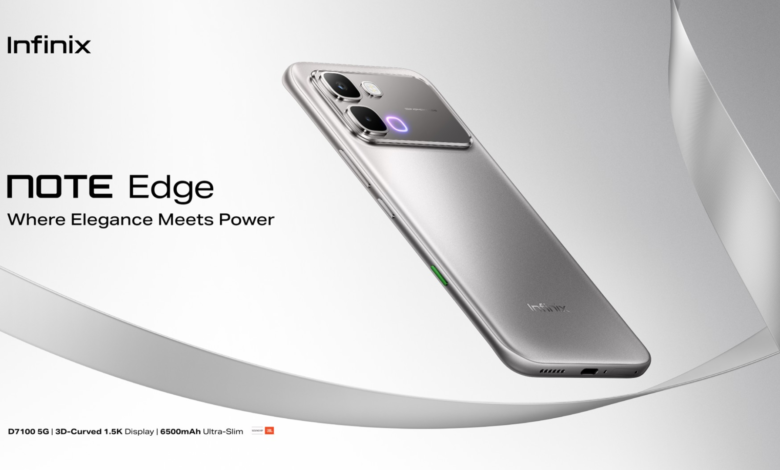

Infinix has officially launched the Note Edge in Kenya, a device that attempts to pivot the mid-range conversation from pure speed to longevity. Priced at KES 32,999, the phone acts as the global debut for MediaTek’s new Dimensity 7100 platform and ships with a headline-grabbing 6,150mAh battery that Infinix claims can “heal” itself.
For a market like Kenya, where power reliability can be inconsistent, the focus on battery health and endurance is a logical, if marketing-heavy, strategy. Here is a detailed look at what the Note Edge brings to the table.
The “Self-Healing” Battery: Real Tech or Buzzword?
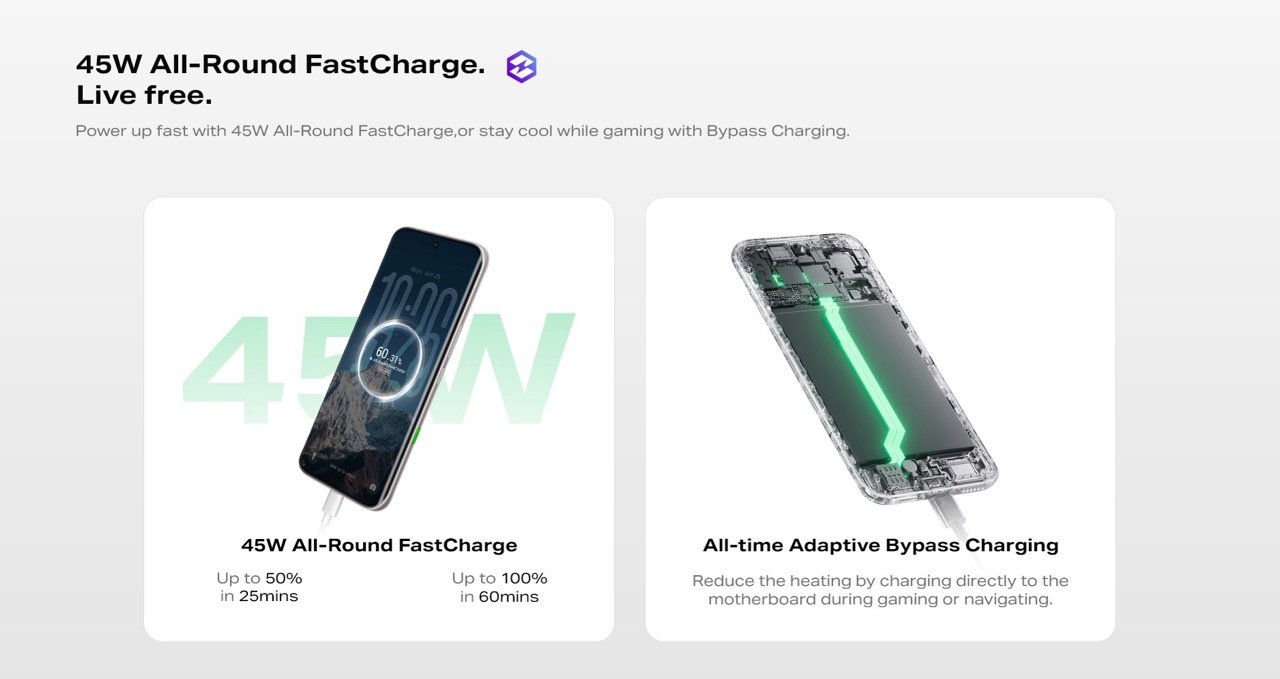
The most intriguing spec on the sheet is the 6,150mAh battery, which is significantly larger than the standard 5,000mAh cells found in most competitors. Despite this capacity, Infinix has managed to keep the chassis surprisingly thin at 7.2mm.
Infinix describes the battery technology as “self-healing,” stating that it actively repairs micro-damage during charging cycles. While the company hasn’t released a white paper detailing the chemistry, this likely refers to electrolyte additives that help repair the Solid Electrolyte Interphase (SEI) on the anode, preventing the degradation that typically kills lithium-ion batteries over time.
- The Claim: Infinix asserts the battery retains 80% capacity after 2,000 charge cycles.
- The Context: A standard phone battery is usually rated for 800 to 1,000 cycles. If accurate, the Note Edge could offer roughly six years of daily use before the battery significantly degrades.
- Real-World Stats: The company claims this translates to 25.42 hours of continuous Google Maps navigation or 20.9 hours of YouTube playback.
The Engine: What is the Dimensity 7100?
The Note Edge is the first device globally to run on the MediaTek Dimensity 7100 5G chipset.
Based on the positioning, the “7100” nomenclature suggests a refresh of MediaTek’s efficient mid-range 7000-series (likely a successor to the 7050 or 7200). Infinix marketing frames this chip as being built for “sustained efficiency rather than short bursts of peak performance”.
Analysis: In 2026, a chip in this segment is likely using proven, older core architectures (like Cortex-A78s) to keep costs down while ensuring 5G connectivity and decent multitasking. It won’t break benchmark records, but for the KES 32,999 price point, it is designed to handle the 120Hz display and general daily tasks without overheating or draining the battery – a concept Infinix calls “Dream Booster”.
The phone pairs this chip with 8GB of RAM (expandable to 16GB via virtual ‘MemFusion’ tech).
Display and Software
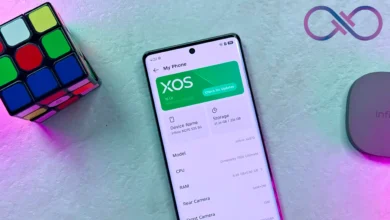
The device features a “premium curved-screen design”, a feature often reserved for more expensive ‘Pro’ models. It runs Android 16 out of the box, skinned with Infinix’s XOS 16.
Software support has historically been a weak point for budget manufacturers, but Infinix is committing to three major Android upgrades and five years of security updates for the Note Edge. If honoured, this would keep the phone relevant until Android 19, a substantial promise for a sub-KES 35,000 device.
Key Software Features:
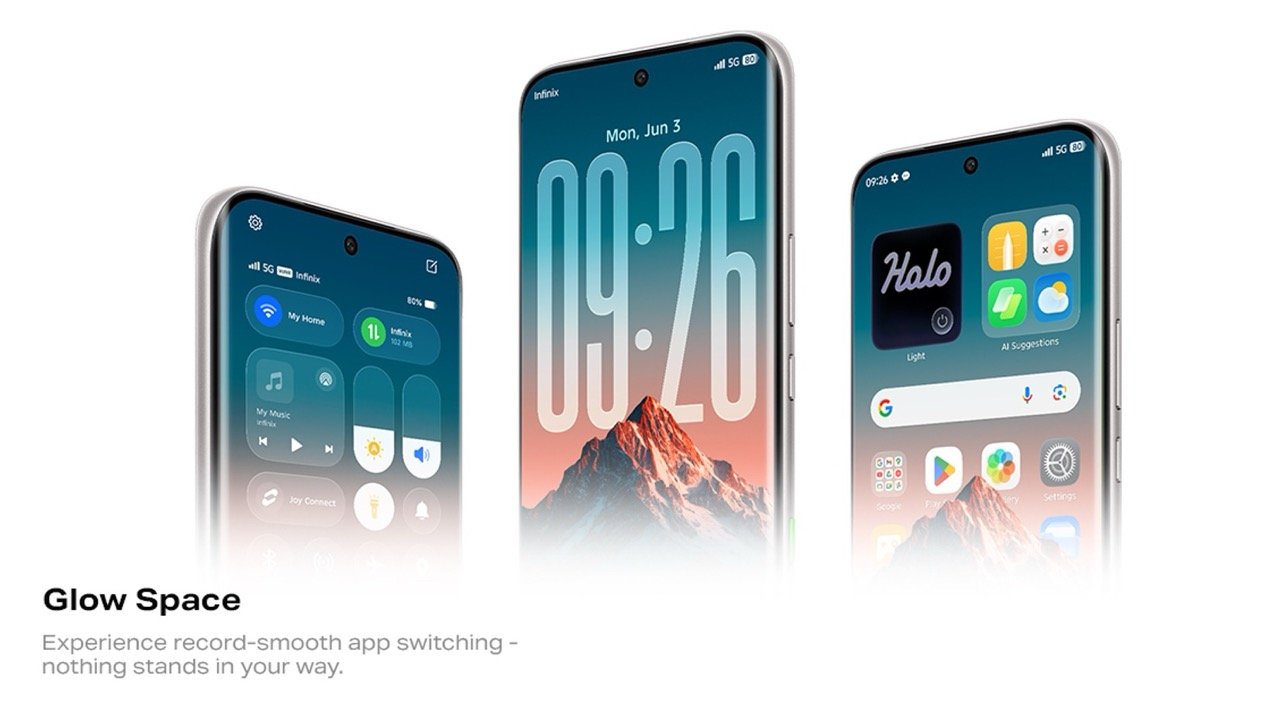
- Glow Space: A new UI element in XOS 16 that uses natural light effects for visuals.
- Perception Scheduling 3.0: An AI optimisation tool intended to smooth out lag during heavy loads.
- AI Integration: Standard 2026 fare, including AI-assisted productivity and imaging tools.
The Marketing Angle: Winter Olympics
In a move to localise its global branding, Infinix has partnered with Sabrina Simader, Kenya’s first female Winter Olympian. Simader will use the device during the Winter Olympics 2026 in Milano Cortina. While celebrity endorsements are standard, this aligns with the “endurance” marketing theme – Simader is positioned as a symbol of “resilience” much like the battery tech.
Price and Availability
The Infinix Note Edge is available now in authorised retail outlets across Kenya starting at KES 32,999.
Our Preliminary Verdict:
On paper, the Infinix Note Edge is an aggressive play for the practical user. Instead of chasing megapixels or raw gaming frame rates, it is doubling down on the two things that frustrate users most: battery life and software longevity. A 6,150mAh cell in a 7.2mm body is an impressive engineering feat. The real test will be whether the Dimensity 7100 can deliver the performance needed to make those three years of Android updates feel smooth.