

The global AI economy has just endured its most fragile 48 hours to date. What began as a report of a “stalled” deal between Nvidia and OpenAI has unravelled into a public display of the systemic risks underpinning the trillion-dollar industry.
While the headlines focused on something akin to “rift” between two CEOs, the real story is the financial plumbing connecting Nvidia, OpenAI, and Oracle. It is a system of circular dependency that critics are now comparing to the vendor financing collapse of the dot-com bubble.
Here is the definitive account of the event, the “nonsense” rebuttal, and the structural weakness it exposed.
1. The “Stalled” Deal Narrative
Late last week, the Wall Street Journal reported that Nvidia’s plan to invest $100 billion in OpenAI had “stalled”.
- The Claim: Nvidia executives allegedly expressed private concerns about OpenAI’s “lack of financial discipline” and the threat from rivals like Anthropic and Google.
- The Implication: This threatened the core narrative of the AI boom: that Nvidia and OpenAI are an unbreakable alliance.
2. What Jensen Huang Actually Said
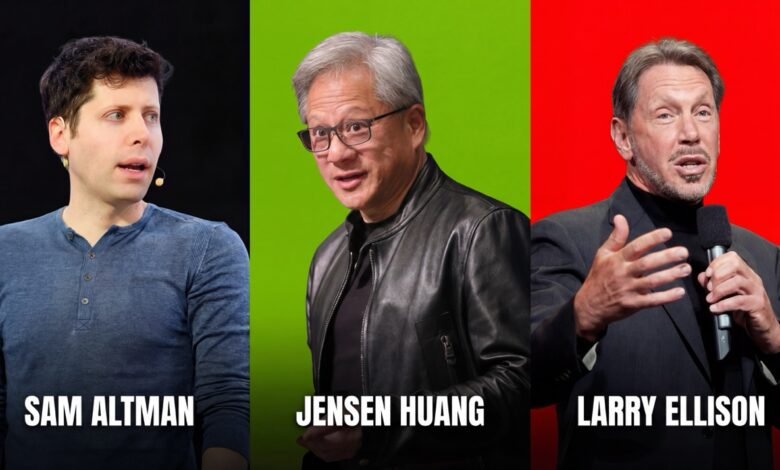
Then Nvidia CEO Jensen Huang, speaking from Taipei, issued a forceful but carefully worded denial.
- The Quote: He labelled reports that he was unhappy with OpenAI or Sam Altman as “nonsense“.
- The Correction: Crucially, Huang clarified that the widely reported $100 billion figure was “never a commitment”. He described it as an “invitation” from OpenAI.
- The New Reality: Instead of a blank cheque, Huang stated Nvidia would “invest one step at a time”. While confirmed to participate in OpenAI’s current funding round (valuation: $830 billion), the investment will be a fraction of the rumoured $12.9 trillion figure.
3. The Panic: Oracle’s $50 Billion Exposure
The fragility of the ecosystem was best illustrated not by Nvidia, but by Oracle. As the “landlord” of the AI boom, Oracle builds the data centres where OpenAI’s models live.
- The Coincidence: Simultaneous to the “stalled deal” news, Oracle announced plans to raise $50 billion in 2026 to fund infrastructure construction.
- The Market Fear: Investors connected the dots: Oracle is borrowing billions to build servers for OpenAI. If Nvidia cuts OpenAI’s funding, can OpenAI still pay Oracle?
- The Damage Control: Oracle’s stock dropped pre-market. Then the company issued a defensive statement: “The Nvidia-OpenAI deal has zero impact on our financial relationship with OpenAI.”
The “Confidence Crisis”:
This statement may have done more harm than good. The rule of thumb in crisis management is: If you have to deny you are in trouble, people immediately assume you most likely are in trouble. By addressing the fear so directly, Oracle inadvertently validated that the market’s anxiety was rational – echoing the “we are fine” statements that historically precede financial stumbles.
The “Circular Economy” of AI
The reason a single stalled negotiation caused panic across three mega-cap companies is that the AI industry is currently operating on a Circular Financing Model. This is the “bubble” argument in its purest form.
The Cycle of Cash:
- Nvidia (and others) invests billions of dollars into OpenAI as venture capital.
- OpenAI uses that cash to sign massive cloud contracts with Oracle.
- Oracle uses that revenue to buy thousands of H100/Blackwell chips from Nvidia.
The Result: Cash leaves Nvidia’s balance sheet as an “investment” and returns to its income statement as “revenue”, having passed through OpenAI and Oracle.
Why This Matters
This structure artificially inflates the growth metrics of all three companies.
- Nvidia records record chip sales.
- OpenAI shows massive “committed spend” on infrastructure.
- Oracle boasts of a $523 billion backlog of “remaining performance obligations”.
If any link in this chain breaks – for example, if Nvidia decides OpenAI is too risky to fund – the flow of capital stops. OpenAI cannot pay Oracle, and Oracle stops buying Nvidia chips. The “stalled” deal report was a glimpse of this chain snapping.
A Correction:
The events of the last 48 hours were not a crash, but a necessary correction of expectations. Jensen Huang has effectively ended the era of “blank cheque” AI funding. The relationship has shifted from an ideological alliance to a transactional one: Nvidia will fund OpenAI, but only if the returns are clear.