

by: Desmond Karani
We are living in the era of “usership” rather than ownership. You stream your music, you lease your software, and now, increasingly, you rent your health.
The fitness technology sector has aggressively pivoted towards subscription models, selling consumers the hardware and a monthly bill to use it.
While this model comes with promises of updates and better “AI-powered” features, as Whoop calls them, it has introduced a fragile, expensive, and environmentally damaging dynamic to our relationship with personal health.
Locked Hardware
The most glaring issue with modern fitness tech is the “bricking” of functional hardware once the payments stop. The Whoop strap is perhaps the most aggressive example of this phenomenon.
Unlike a traditional wearable that tells time regardless of an app’s functionality, a Whoop strap is strictly a data-gathering hardware on your wrist because it has no screen.
This means that if you cancel your membership, the device does not revert to a notification device, step counter, or even a basic heart rate monitor; it essentially becomes a piece of fabric on your wrist. It collects data it will not show you, effectively rendering the hardware useless.
This creates a scenario where the consumer never actually owns the device they wear 24/7. Instead, they are leasing the privilege of seeing their own biometrics, even though severing the cloud connection and processing basic data on a smartphone would cost manufacturers almost nothing.
Imagine you’re training for an endurance event, perhaps one of upcoming marathons, only to find your recovery data locked away because your credit card expired overnight.
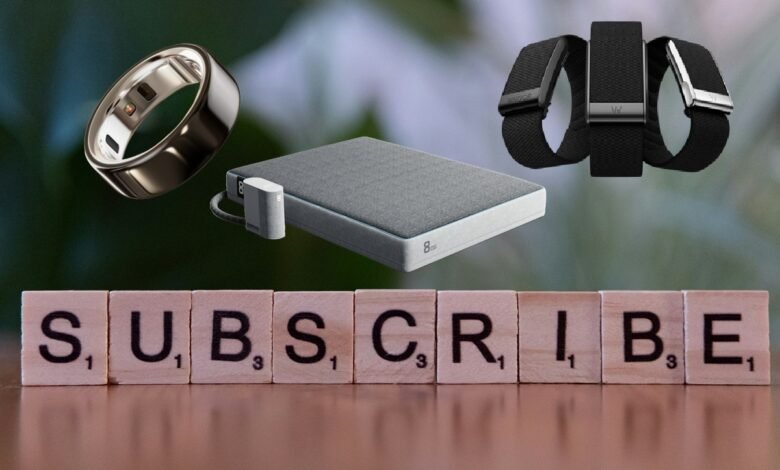
Other competitors like Oura Ring and Fitbit have similar, albeit slightly less draconian, plans. Oura, for instance, severely limits access to in-depth sleep data without a monthly fee, reducing it to just a basic sleep score generator.
In all these cases (and more), the hardware continues to work behind the scenes, but the “smart” aspect is held purely in the cloud, accessible only for a fee.
…But Companies Pay for the Cloud
The main argument with most of these subscriptions is that companies are able to invest in significantly more robust hardware to process your health data. However, tethering the users to a subscription often means a continuous connection to the cloud, introducing the internet as a new point of failure.
In this case, users are always at the mercy of massive web infrastructure providers like AWS or Cloudflare. This vulnerability was exposed last year when Eight Sleep, a company that makes high-end smart mattress covers, suffered system malfunctions due to AWS outage.
Users who paid thousands of dollars for smart beds reported being unable to adjust temperature settings. Some said the beds would automatically revert to previous preferences or become stuck on the “warm” setting or in an upright position, with no physical manual override.
When a server goes down halfway across the world, your physical comfort in your own bedroom shouldn’t become collateral damage. But this is the reality of cloud-dependency for objects that should be locally controlled.
In fact, after that failure, 8 Sleep pushed an update allowing smart mattresses to operate locally during such outages, suggesting that the hardware may not be as limiting a factor as claimed.
This is also evident in wearables, where non-subscription smartwatches like the Apple Watch consistently outperform subscription-based models like the Whoop Strap, according to tests by The Quantified Scientist on YouTube and other science-focused reviewers.
When Subscriptions Become Life-Threatening
Perhaps the most ethically concerning issue surrounding subscription-based technology is the restriction of “life-saving” or critical health features behind paywalls. Many devices now offer detection of atrial fibrillation (AFib), dangerously high heart rates, or sudden falls.
However, as companies look for more revenue streams, there is a risk of these safety nets slipping behind a paywall, even for companies that are yet to implement them.
For example, the “Safety Signal” feature on newer Google Pixel/Fitbit watches requires a Fitbit Premium subscription (and LTE connection) to alert emergency contacts if you are in trouble and away from your phone.
If a user’s credit card expires overnight, or their subscription lapses without them noticing, they lose this safety layer instantly. While we haven’t yet seen a widely publicised tragedy where a subscription lapse directly prevented a life-saving alert, the mechanism is in place for it to happen.
These issues raise the question of whether access to data about our own heart irregularities should be a luxury service. If a device on your wrist detects a potential cardiac event but your subscription has expired, shouldn’t user safety take precedence over revenue protection?
After all, a simple Bluetooth connection to a phone app that can alert close contacts is unlikely to cost manufacturers anything.
The Environmental Cost
Finally, the subscription model is a disaster for electronic waste. When a device loses its utility because the user no longer wants to pay the monthly fee, that hardware is often discarded.
A Whoop strap that works perfectly but has no active subscription has little to no resale value for non-subscribers and provides limited usefulness to its owner. It can only be returned to Whoop or sold to someone willing to pay for the subscription.
The same applies to 8 Sleep mattresses, which rely on large, integrated hardware components for water circulation.
This accelerates the lifecycle of electronics, pushing perfectly functional sensors, batteries, and plastics into landfills simply because the software licence expired.
In a traditional ownership model, an old Garmin or Casio watch could be handed down to a child or sold to a second-hand user. In the subscription model, the hardware is inextricably linked to a credit card, turning durable goods into disposable service terminals.
My Suggestion
Fitness technology has undoubtedly saved lives and improved health for millions. However, the economic model underpinning it has drifted too far from consumer interests.
When we build devices that fail without the internet, turn into garbage without a monthly payment, and gate safety features behind a paywall, we are creating a precarious ecosystem where users pay in perpetuity for hardware they never truly own.
One possible solution would be the introduction of policies similar to the GDPR, requiring such devices to offer a bare minimum of functionality in the absence of a subscription. This would prolong their usefulness and reduce their environmental impact.
At the same time, we should actively consider alternatives that discourage this business model. Real-world testing has repeatedly demonstrated that cloud-based data processing does not inherently improve products and often introduces new vulnerabilities to user data.
Desmond Karani is the founder and writer at fitsavanna.co.ke with a passion for tech and fitness.