

Starting today, March 10, 2026, every KRA Customs and Border Control officer on duty at Jomo Kenyatta International Airport (JKIA), the Port of Mombasa, and Kenya’s One Stop Border Points (OSBPs) is equipped with a body-worn camera. The devices, 350 in total, do not just record. They transmit. In real time. Twelve hours of live video and photographs flowing directly to a Central Command Centre at Times Tower in Nairobi, where KRA’s senior leadership can watch, replay, and audit every officer-taxpayer interaction as it happens.
This is not a pilot. This is the full deployment, and it goes live today.
Why This Rollout Matters
Customs is, by definition, Kenya’s most transactional border. Every day, KRA officers interact with thousands of travellers, importers, clearing agents, and traders. Billions of shillings in tax revenue pass through these human handshakes, and so does the temptation for corruption.
The scale of the problem has been glaring. Between July and December 2024 alone, 44 KRA officers were dismissed for graft-related offences. Lifestyle audits of customs staff have so far recovered KES 549 million in assets that cannot be explained by their salaries. The phrase “it’s your word against mine” had become a cliché at Kenya’s entry points; an open secret that disputes between officers and importers rarely ended in the importer’s favour.
The cameras are designed to break that dynamic entirely. Every interaction is now a verifiable record. Disputes that once took weeks to investigate can now be resolved with hours of footage. Officers doing their jobs correctly now have documented proof. Those who don’t, have no cover.
The initiative is part of the broader Horn of Africa Gateway Development Project (HoAGDP), partly financed by the World Bank, and operationalised through a KES 2.38 billion, three-year contract with Chinese security inspection firm Nuctec Hong Kong Company Limited, signed in October 2024. The camera deployment sits within a wider digital arsenal that also includes 350 handheld verification gadgets, 20 external surveillance cameras, 60 data collection devices, and 2 petabytes of storage infrastructure at Times Tower.
How the Cameras Work
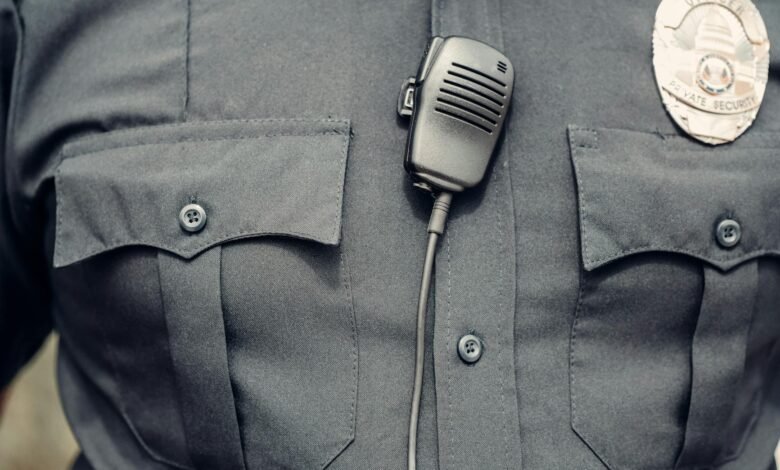
Each bodycam unit is a dual-component device. A front-facing camera handles high-definition video recording and photography of interactions — documenting exactly what officers see and do during inspections. A rear-facing camera supports video calls and image transmission back to headquarters.
The cameras are equipped with:
- Real-time GPS positioning — Times Tower knows exactly where each officer is at all times
- LTE connectivity — footage streams live over cellular networks, not stored locally and retrieved later
- Built-in microphones — audio is recorded alongside video, meaning conversations, not just visual interactions, are captured
- Secure recording capabilities to maintain chain-of-custody standards for evidence
Back at Times Tower, a Central Command Centre underpinned by four data storage servers, integrated docking stations, and backup systems manages the incoming feed.
The 12-Hour Question: Battery Life
The cameras are rated for 12 hours of continuous recording — in theory matching a standard officer shift. This is consistent with industry benchmarks; comparable bodycam models from Hikvision and i-PRO rely on batteries in the 3,200–3,300 mAh range to hit the 12-hour mark, though that rating typically applies at 720p resolution with GPS and network functions turned off.
Here is the practical problem: KRA’s cameras are streaming live over LTE and tracking GPS simultaneously. Both are significant power drains. Real-world battery life in active streaming mode is likely to fall short of the full 12 hours — possibly closer to 8 hours depending on network conditions and ambient temperature at busy border points like Malaba or Namanga.
KRA has not publicly clarified whether the cameras have hot-swappable batteries — a feature available on more advanced bodycam models that allows uninterrupted recording during a battery change. If they do not, there is a window of vulnerability every time a camera is re-charged mid-shift where an interaction goes completely off the record.
Who Controls the Off Switch?
This is the most critical question the rollout leaves unanswered — and it cuts to the heart of whether the system will work.
On paper, a live-streaming camera that beams footage directly to Times Tower should be essentially self-policing: if an officer turns it off, headquarters sees the feed go dark and can flag the incident immediately. That real-time visibility is arguably the most powerful accountability feature of the system — more powerful even than the recordings themselves.
But the questions remain:
- Can an officer turn the camera off without authorisation? If yes, there must be a strict policy framework, and consequences, for unauthorised deactivation.
- What happens when the camera “malfunctions”? History of bodycam deployments globally shows that technical failures tend to cluster suspiciously around high-stakes interactions.
- Who at Times Tower monitors the feeds? A bank of 350 simultaneous live feeds requires a dedicated, well-staffed monitoring team operating 24/7. If the control centre is under-staffed, real-time oversight becomes theoretical rather than actual.
KRA’s communication has been notably silent on the governance architecture around the cameras — specifically, who has the authority to pause, stop, or delete recordings, and under what circumstances.
What About KRA Staff Privacy?
This is the conversation Kenya has not yet had, and it needs to happen.
A body-worn camera on a customs officer records everything within its field of view and microphone range — not just formal taxpayer interactions. Officers eat lunch, use restrooms, have personal conversations with colleagues, and handle personal calls during their shifts. The law must be clear on what gets recorded, what gets stored, and who can access it.
Kenya’s Data Protection Act (2019) is relevant here. It requires that data collection be proportionate, purposeful, and subject to subject-access rights. KRA employees are data subjects too. If the cameras record personal conversations between officers in break rooms or capture biometric data beyond the scope of their official duties, that raises legitimate legal exposure for KRA — and legitimate grievance grounds for the officers’ union.
Globally, police bodycam programmes have grappled with this exact tension. The standard resolution is a formal “camera-on policy” that defines precisely when recording begins (officer approaches a taxpayer/traveller) and when it is permissible to pause (personal breaks, medical situations). KRA has not published such a policy framework yet, at least not publicly.
The audio dimension makes this especially delicate. Video of a desk interaction is one thing. Audio capture of a conversation — including potential legal discussions between importers and their clearing agents — is another. Kenya’s Evidence Act and communications interception laws could be engaged if audio recordings are used in prosecutions without proper legal scaffolding.
Why Body Cams? Why Not Just More Fixed CCTV?
This is a fair and important question. KRA already has CCTV cameras at its facilities, and the new contract extends those to previously unequipped border points while extending footage retention from three months to six months. So why spend money on body cams on top of that?
The answer is mobility. Fixed CCTV cameras cover zones — a scanner bay, a customs hall, an inspection lane. They do not follow officers. A corrupt interaction can happen:
- In the gap between scanning equipment and the exit gate
- In a warehouse aisle where no fixed camera has a line of sight
- During a vehicle inspection in a yard
- At a One Stop Border Point kiosk that lacks fixed camera infrastructure entirely
- In the five-metre walk between two rooms that nobody thought to cover
Body-worn cameras close these gaps because they go wherever the officer goes. They are not watching the room — they are watching the interaction. That is a fundamentally different accountability model. The bodycam follows the point of risk: the moment a customs officer and a trader are alone together, with money or clearance documents on the table.
This is why the UK Border Force, customs agencies across Europe, and increasingly agencies across Asia have standardised bodycams — not as a replacement for fixed infrastructure, but as its mobile complement.
The Bigger Picture
The KRA bodycam rollout is not happening in isolation. It is part of a broad data-driven enforcement shift under which KRA is integrating third-party financial data from banks and M-Pesa, deploying internet-connected cameras at excise goods manufacturing plants, and rolling out electronic tax registers — all under mounting pressure from President Ruto and the National Treasury to close a persistent revenue gap.
For traders and importers, the message is: the era of informal negotiations at the border is closing. For KRA officers doing their jobs honestly, these cameras may be the best protection they have ever had — a documented, irrefutable record that they acted with integrity in every interaction. For those who have not, the feed is already running, and it goes all the way to Times Tower.
The cameras are on. The questions about how they are governed need answers just as urgently as the cameras needed deployment.