

For technology enterprises, data centres, and specialised manufacturing plants, power reliability is not a luxury; it is the fundamental baseline of their entire business model. A five-minute power fluctuation can result in millions of KES in damaged hardware or corrupted data.
Yesterday, the Konza Technopolis Development Authority (KoTDA) crossed a critical threshold in solving this infrastructure puzzle. Konza is officially no longer just a passive consumer on the national grid. With the launch of the Konza Smart Energy platform, the city has taken control of its own internal power distribution across Phase One, creating a specialised, fail-proof mini-grid designed to align with global Tier III data centre standards.
But what does a “smart grid” actually mean for the companies setting up shop in Africa’s Silicon Savannah? We looked under the hood of Konza’s new electrical architecture to understand how they plan to guarantee a staggering 99.99% power uptime.
Escaping the Radial Trap: The 47km Underground Ring
Most traditional power distribution relies on a radial network. Think of it like a single highway: if an accident blocks the road, every town further down the line is cut off. This is why a single fault can plunge entire neighbourhoods into darkness.
Konza has bypassed this by deploying over 47 kilometres of underground 11kV cabling configured in a ring network.
In a ring network, the power flows in a continuous loop. If a cable is severed or a fault occurs at one of the 54 cabin substations scattered across Phase One, the system’s smart automation instantly detects the break and reroutes power from the opposite direction. The result? The fault is isolated, and the end-user experiences zero interruption.
The 2N+1 Redundancy: Bulletproofing the Core
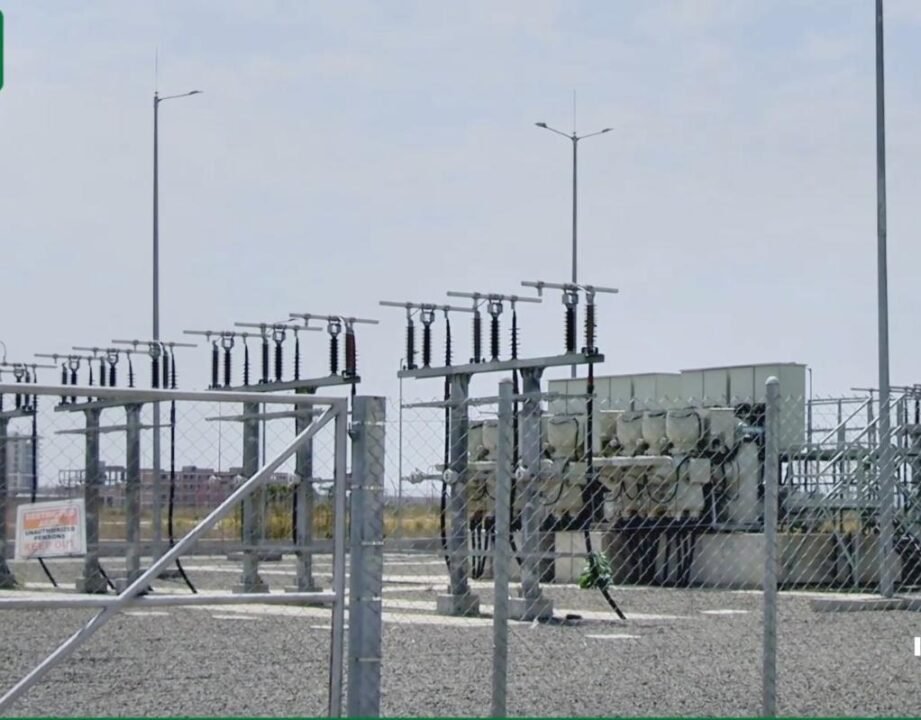
At the heart of this new system is Distribution Substation 2 (DS#02). Its primary job is heavy lifting: taking high-voltage 66kV electricity straight from the national grid and stepping it down to a more manageable 11kV for city-wide distribution.
However, transformers fail, and routine maintenance is unavoidable. To ensure this never impacts the city, DS#02 is built on a 2N+1 transformer configuration.
In engineering terms, “N” represents the exact baseline capacity needed to run the city. A “2N” system means they have built two completely independent, fully capable systems (a primary and a mirror backup). The “+1” adds a third, independent backup module on top of that. Even if a catastrophic failure takes out the primary system while the secondary system is undergoing scheduled maintenance, the “+1” module handles the load seamlessly.
Gas-Insulated Switchgear (GIS): Compact and Weatherproof
To further protect the grid, Konza has integrated Gas-Insulated Switchgear (GIS) technology. Older, traditional substations are air-insulated—they take up acres of land and expose vital electrical conductors to dust, wildlife, and extreme weather, all of which are common causes of short circuits.
GIS encloses all the critical conductors and contacts within a sealed, grounded metal housing filled with sulphur hexafluoride gas. This not only dramatically shrinks the physical footprint of the substation but also creates a pristine, isolated environment that drastically reduces maintenance needs and the risk of environmentally triggered outages.
The Real ‘Digital Superhighway’
Power reliability is measured globally using indices like SAIDI (System Average Interruption Duration Index) and SAIFI (System Average Interruption Frequency Index). By targeting benchmarks that keep outage durations virtually non-existent, Konza is speaking the language of global capital.
“Following the official launch of Phase 1 infrastructure in October 2025, this achievement demonstrates the steady progress we are making in building a resilient, future-ready city,” stated KoTDA CEO John Paul Okwiri.
Okwiri’s underlying message is clear: Kenya’s Digital Superhighway agenda cannot run on diesel generators.
As Konza Technopolis looks to populate its Special Economic Zone (SEZ) with export-oriented industries, research institutions, and digital enterprises, the Konza Smart Energy rollout is perhaps its most vital pitch yet. They aren’t just selling land in Kiambu or Machakos; they are selling absolute, uninterrupted certainty. And in the tech world, certainty is the ultimate currency.