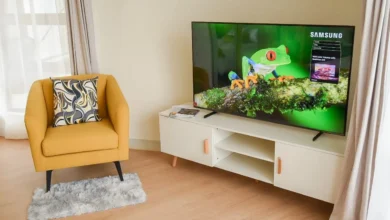



It is official: Samsung has held the top spot in the global television market for two solid decades. According to recent data from market research firm Omdia, the South Korean tech giant closed 2025 with a commanding 29.1% share of global TV market revenues, marking its 20th consecutive year as the industry leader.
Since taking the crown in 2006, Samsung has consistently steered the direction of home entertainment. Today, their strategy relies heavily on dominating the premium tier. Omdia’s figures show Samsung controls a massive 54.3% of the market for TVs priced over $2,500 (approximately KES 325,000), driven by their flagship Neo QLED, OLED, and lifestyle models. They also maintain a tight grip on the mid-to-high tier, securing a 52.2% share in the over $1,500 (approx. KES 195,000) segment.
“When consumers choose a TV, they’re choosing a brand they can trust for years to come,” noted SW Yong, President and Head of the Visual Display Business at Samsung Electronics, attributing this 20-year run to “decades of engineering excellence and premium innovation.”
Revenue vs. Volume
While a 20-year reign is objectively impressive, it is vital to apply some critical thinking to how these numbers are calculated.
Samsung’s 29.1% market share is based on revenue, not strictly the number of units shipped. This is a crucial distinction. In recent years, aggressive competitors like Hisense and TCL have been rapidly closing the gap in terms of pure volume—shipping millions of affordable panels worldwide.
Samsung’s continued dominance rests on a calculated pivot: conceding the budget tier to competitors while fiercely protecting the high-margin, premium categories. By convincing consumers to upgrade to ultra-large screens, 8K resolutions, and expensive lifestyle TVs like The Frame, Samsung ensures that even if they sell fewer total units than they did a decade ago, they capture the lion’s share of the money spent globally on televisions. It is a classic “value over volume” strategy that continues to pay dividends.
Visualising 20 Years of Display Evolution
To understand how Samsung stayed on top, we have to look at how they forced the industry to evolve. They did not just iterate; they frequently redefined what a television was supposed to be.
- 2006 (The Turning Point): Samsung takes the #1 spot with the Bordeaux TV. Instead of a bulky, utilitarian grey box, the Bordeaux featured a sleek, wine-glass-inspired design. It proved TVs could be aesthetic furniture, not just appliances.
- 2009 (The Thinning): The aggressive push into LED technology made screens drastically slimmer and more energy-efficient, killing off the heavy plasma displays.
- 2011 (The Connected Era): The normalisation of Smart TVs. The screen became a hub for internet connectivity and applications, paving the way for the streaming revolution.
- 2015 – 2017 (The Lifestyle Pivot): Realising hardware was plateauing, Samsung launched The Serif and The Frame. The Frame essentially created the “Art TV” category, turning a blank black rectangle into a customisable digital canvas that blends into modern home décor.
- 2017 – 2020 (The Pixel Wars): The introduction of QLED (using quantum dots for vibrant colour), the push into 8K (33 million pixels), and the debut of MICRO LED technology, which offers the deep blacks of OLED without the burn-in risks, cementing their lead in ultra-premium panels.
What is Next? The AI and Mini LED Push
Moving forward into 2026, the battlefield is shifting towards software and miniaturised hardware. Samsung is heavily expanding its Mini LED offerings to bring better contrast and brightness control to more accessible price points.
Simultaneously, the industry is entering the AI era. Modern Samsung displays are essentially high-powered computers, utilizing AI processors to upscale lower-resolution broadcasts in real-time, optimise sound based on the acoustics of your living room, and personalise the smart interface.
The challenge for Samsung over the next five years will be maintaining this premium allure as competitors master Mini LED and OLED manufacturing techniques, inevitably driving prices down across the board.