


Everyone is talking about how Artificial Intelligence is getting smarter. But behind the scenes, the tech industry has been quietly panicking about a totally different problem: AI is getting too hungry, and it’s causing a massive digital traffic jam.
Last week at NVIDIA’s GTC 2026 conference, basically the Super Bowl for computer brains, Samsung announced a major breakthrough that solves this exact bottleneck. And while it involves complex microchips, the result is simple: the AI tools you use are about to get radically faster, and your next smartphone’s battery won’t die the moment you ask it to do something smart.
Here is why Samsung’s quiet announcement could actually be the biggest tech news of the month.
The AI Traffic Jam (And How to Fix It)
To understand the problem, you need to understand how computers think. Imagine an AI processor (like the famous ones made by NVIDIA) as a genius chef in a kitchen. The chef can cook a thousand meals a minute. But there is a problem: the waiters bringing the chef the ingredients are moving at a walking pace.
In the computer world, those waiters are the Memory. It doesn’t matter how fast the processor is if the memory can’t deliver data fast enough. This is the “memory bottleneck.”
Samsung just gave those waiters jetpacks.
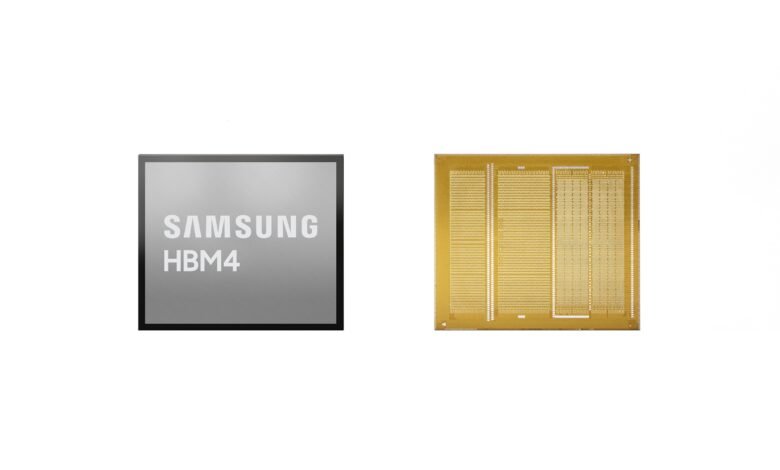
They announced mass production of a new type of memory called HBM4, and teased an even faster version called HBM4E. To put it in perspective, HBM4E can move 4.0 terabytes of data per second. That is the equivalent of downloading roughly 1,000 high-definition movies in a single tick of the clock.
Keeping Things Cool
Making memory this fast isn’t just about speed; it’s a physical space problem. To fit enough memory next to an AI processor, companies have to stack the memory chips on top of each other, like a stack of pancakes.
Historically, they used a filler material between the layers to stick them together. But just like syrup between hot pancakes, this filler trapped a massive amount of heat. When you stack 16 chips on top of each other, the middle ones get dangerously hot.
Samsung introduced a brilliantly simple manufacturing fix called Hybrid Copper Bonding. Instead of using the sticky filler, they are essentially fusing the copper connections of the chips directly to each other. By removing the insulation in the middle, they dropped the heat resistance by over 20 percent.
For the massive, power-hungry servers running tools like ChatGPT or Midjourney, running 20 percent cooler saves millions in electricity and stops the servers from literally melting down.
Why This Matters for Your Next Phone
While data centres get the massive, stacked chips, Samsung didn’t forget about the device in your pocket.
At the same event, they previewed a new type of mobile memory called LPDDR6. Right now, if you want to run a powerful AI feature on your phone, like live-translating a phone call or generating an image, it drains your battery incredibly fast.
LPDDR6 is designed specifically to run these heavy AI tasks locally on your device, pushing data up to 40% faster than older models while actually saving power. It introduces smart features that only draw power exactly when the processor needs it.
The takeaway? Your next premium smartphone or smartwatch will be able to handle complex AI tasks instantly, without needing a constant connection to the cloud, and without sacrificing your battery life to do it.
Samsung might not be building the flashy AI software you interact with, but with these new memory breakthroughs, they are building the roads that allow the entire AI industry to drive faster.