

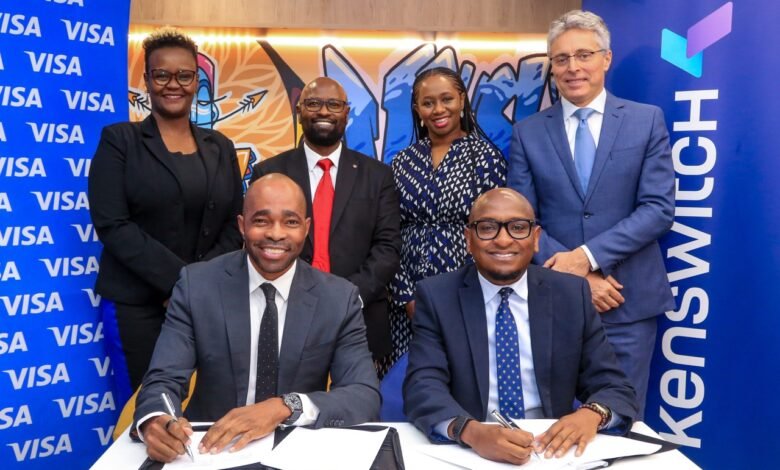

Kenswitch Limited and Visa announced on Wednesday that they have signed a framework agreement to collaborate on payment innovation, merchant acceptance, and the strengthening of Kenya’s domestic payment processing and settlement systems.
If you haven’t heard of Kenswitch, that’s partly the point. It’s the silent infrastructure; the invisible hand that ensures that when you walk up to an ATM belonging to a different bank from your own, your card still works and your money still moves. Founded in 2002 under the Central Bank of Kenya’s National Payments System modernisation process, Kenswitch was built as a shared utility: a consortium of banks pooling resources to avoid each bank having to build and run its own ATM and point-of-sale network. Today it connects over 30 financial institutions including banks, SACCOs, microfinance institutions, and fintechs, across a network of more than 2,500 ATMs, 35,000 merchant POS terminals, and 50,000 agent banking outlets.
Put simply: Kenswitch is the plumbing. Visa, on the other hand, is one of the world’s most recognised payments brands, operating in over 200 countries and territories, and increasingly focused on selling value-added services to the financial institutions it works with, beyond just card processing.
This deal brings the two together.
What the Agreement Actually Covers
The announcement describes a “framework agreement”, and it’s important to understand what that means and what it doesn’t. This is not a product launch. No new card, app, or payment tool has been announced today. A framework agreement is a structured commitment to work together on defined areas, with the actual products, services, and timelines to be developed through that collaboration. Think of it as the official handshake before the actual building begins.
Three focus areas are outlined in the agreement.
First, Visa’s Value-Added Services. Visa has spent years building a portfolio of services it sells to financial institutions — tools for fraud detection, risk management, digital acceptance, data analytics, and more. The largest of Visa’s clients now use an average of 22 of these products. Under this deal, Kenswitch and Visa will explore co-developing and extending these services to the financial institutions, merchants, and consumers within the Kenswitch network. In practical terms, this could mean that smaller banks and SACCOs connected to Kenswitch — many of whom could never afford Visa’s services on their own — could eventually access fraud prevention tools or data analytics capabilities they wouldn’t otherwise have.
Second, joint merchant payment innovation. This is the area with the most obvious visible upside for everyday Kenyans. The two organisations will jointly explore and pilot new payment technologies at the merchant level, drawing on Visa’s global innovation ecosystem and Kenswitch’s existing local infrastructure of 35,000 POS terminals. Kenya’s merchant acceptance landscape has improved dramatically over the last decade, but acceptance gaps, particularly among smaller traders and in informal markets, remain real.
Third, domestic processing and settlement. This is perhaps the most technically significant piece. Kenya’s banks settle transactions with each other through a combination of infrastructure layers, and Kenswitch is one of the key domestic nodes in that system. The agreement includes collaborative efforts to “modernise and strengthen the security, efficiency, and resilience of payment clearing and settlement processes.” In short, this is about improving the hidden machinery that moves money between banks, making it faster, more secure, and better aligned with the CBK’s regulatory expectations.
Why This Matters, and Why Now
Kenya’s payments story is genuinely impressive. The country’s financial inclusion rate now sits at 84.8% of adults, according to the 2024 FinAccess Household Survey — a figure that would have seemed impossible 20 years ago, when mobile money didn’t yet exist and the majority of Kenyans had no formal financial account at all. Digital transaction volumes continue to grow.
But access is not the same as infrastructure quality. Kenya’s payment processing and settlement layers — the backend systems that most consumers never see — are what determine whether that 84.8% can actually transact quickly, cheaply, and reliably. A weak or fragmented domestic infrastructure creates inefficiencies that cost banks money, and eventually, those costs pass to consumers and merchants.
The Kenswitch-Visa partnership positions itself squarely in that infrastructure layer. The CBK’s National Payments Strategy, which ran from 2022 to 2025 and has now given way to the National Financial Inclusion Strategy 2025–2028, has consistently pushed for a more efficient, secure, and collaborative domestic payments ecosystem. This agreement explicitly aligns with that direction.
There is also a competitive dimension worth noting. Mastercard has been active across East Africa’s payments infrastructure, and international card networks are competing to deepen their footprint beyond consumer-facing products and into the plumbing itself. Visa entering into a structured relationship with Kenya’s shared switch is a meaningful move in that competition.
What to Watch For
A framework agreement is a starting point. The measure of this deal will be in the specifics that follow: which products get built, on what timeline, and whether smaller financial institutions; the SACCOs, MFIs, and fintechs that Kenswitch serves alongside the major banks, actually benefit alongside the large players.
John Mukono, Kenswitch’s Chief Executive Officer, pointed to the network’s role in serving every participant in Kenya’s financial ecosystem. “By aligning with Visa’s global capabilities, we can now co-create value-added solutions and next-generation processing and settlement infrastructure that will benefit every participant in Kenya’s financial ecosystem. From major banks, saccos and fintechs to merchants and everyday Kenyans,” he said.
Chad Pollock, Visa’s Vice President and General Manager for East Africa, described the intent as combining Visa’s innovation capabilities with Kenswitch’s domestic infrastructure to “support safer, more efficient payment experiences and strengthen acceptance, processing, and settlement across Kenya.”
Neither quote mentioned timelines, specific product launches, or financial details, which is typical for a framework agreement at this stage.