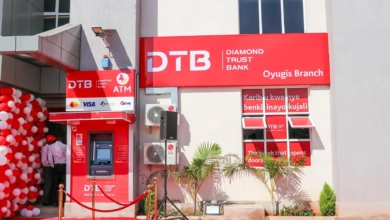



There is a problem hiding in plain sight at almost every bank in Africa. Walk into any branch and ask the business manager how the bank tracks its merchant clients — the shops, kiosks, restaurants, and traders that use its POS machines and business accounts. What you will likely hear is a patchwork answer: a CRM system here, a separate payments dashboard there, merchant onboarding done over email, and reconciliation that still involves a spreadsheet somewhere in the mix.
That gap, between how banks say they serve small businesses and how they actually do it operationally, is exactly where a Johannesburg-based fintech called littlefish has built its entire business.
On 24 March, littlefish announced it had closed a $9.5 million Series A funding round led by Partech, the global venture capital firm with a strong track record on the continent, with participation from TLCOM Capital, Flourish Ventures, and Proparco. The raise comes roughly a year after the company secured its seed round — in which TLCOM and Flourish also participated — underscoring that its investors are not just confident in the idea; they are doubling down on the execution.
Kenya, alongside Tanzania, Uganda, Botswana, Zimbabwe, and Zambia, is named as a target for expansion.
What littlefish Actually Does, and Why It Is Harder Than It Sounds
To understand littlefish’s pitch, it helps to understand the problem it is solving from the bank’s perspective.
When a bank like Equity or KCB or Absa onboards a merchant — say, a supermarket chain or a small hardware shop — it typically gives that merchant a POS terminal, a business account, and maybe some basic reporting. But the experience is fragmented. The POS system is often supplied by a third-party acquirer. The CRM that manages the merchant relationship lives in a different system. The merchant’s back-office — invoicing, inventory signals, reconciliation — is handled elsewhere entirely, often by a separate fintech app the merchant downloaded independently.
The result is that banks, despite being the primary financial relationship for millions of African merchants, are effectively losing the operational relationship to a scattered ecosystem of other apps and platforms. The merchant’s loyalty to their bank weakens because the bank’s tech cannot keep up.
littlefish’s solution is what it calls a merchant operating system: a single, unified commerce layer that consolidates POS applications, back-office CRM tools, merchant portals, payments processing, and APIs into one orchestration platform. Critically, this platform is designed to embed directly into a bank’s existing core banking system and into POS devices — meaning the bank does not have to rip out its infrastructure to use it. It plugs in.
The platform is sold to banks as a white-label SaaS product, meaning merchants experience it as their bank’s own service, not as a third-party tool. The bank retains ownership of the merchant relationship. littlefish stays invisible, running the engine underneath.
“Whether you’re using online store tools, e-commerce tools, in-store tools, a book and a pen, an Excel spreadsheet, a bank account, a wallet, or an accounting package, these are all the things you’re expected to use nowadays,” CEO and co-founder Brandon Roberts said in an earlier interview. “We help bring that together.”
The Banks Are Already Buying It
The credibility test for any B2B infrastructure startup is whether serious institutions are willing to stake real business on its platform. littlefish has passed that test convincingly.
Its clients already include Standard Bank, First National Bank (FNB), and Absa — three of South Africa’s four largest banks by assets. That is not a proof-of-concept pilot. That is production infrastructure trusted by tier-one institutions.
Beyond the banks, Visa has embedded littlefish’s platform into its small business onboarding strategy — meaning that when Visa signs up a new small business merchant in markets where the partnership is active, littlefish’s infrastructure is part of the welcome kit. That is a remarkable commercial validation for a company that was founded in Johannesburg in 2021 by Brandon Roberts and co-founders Neha Kumar and Miod Davith Kahwa.
The commercial traction is reflected in the numbers. The company’s monthly recurring revenue has grown 30 times since its seed round. The press release does not disclose what the seed round amount was, and the figure has not been made public, which makes it difficult to assess the absolute revenue base — but the growth trajectory is significant regardless of starting point.
Why “Work With Banks, Not Around Them” Is the Right Bet in Africa
The fintech industry’s first decade was largely defined by disruption narratives — fintechs as the plucky challengers that would outmanoeuvre slow, bureaucratic banks. That framing made for compelling fundraising decks, but the African market has exposed its limits.
Regulatory complexity, the cost of acquiring customers from scratch, thin margins in low-income markets, and the persistent trust advantage that incumbent banks hold with merchants have all conspired to make the “bypass the bank” strategy expensive and slow.
littlefish takes a different approach: rather than competing directly with financial institutions, the startup positions itself as the technology layer that helps banks operate with fintech-level speed and flexibility.
“Our fundamental role is to play more of a connector and an enabler,” co-founder Neha Kumar has said. “The approach we take is not to say what slice of the pie we are trying to keep for ourselves, but rather what allows us to provide this connected, interoperable system for merchants.”
This “infrastructure under the bank” model is gaining significant traction across Africa. Rather than fighting for the merchant customer, littlefish makes itself indispensable to the institution that already has the merchant customer. It is a B2B2B play: littlefish serves banks, banks serve merchants, and merchants get fintech-grade tools through a relationship they already trust.
Proparco, the French development finance institution that participated in the round, described littlefish as illustrating “the key role that B2B fintechs can play in helping African banks improve financial inclusion for SMEs.” Proparco’s investment is also backed by the EU’s Choose Africa VC programme — adding a layer of development finance logic to what is otherwise a pure venture bet.
What Kenya Can Expect
For the Kenyan market specifically, littlefish’s arrival will be worth watching closely — though it will not be immediately visible to the average consumer.
Kenya already has a well-developed merchant payments ecosystem. M-Pesa’s Lipa na M-Pesa, Pesalink, and a growing cohort of local fintech platforms have given Kenyan merchants more digital payment options than most markets on the continent. But the problem littlefish is solving — the fragmentation of merchant management tools at the bank level — is just as real here as anywhere else.
Commercial banks in Kenya still largely manage their merchant relationships through siloed systems. A Equity Bank business client with a POS terminal, an overdraft facility, and a loan is often tracked across three or four different internal systems that do not talk to one another cleanly. That friction costs the bank in operational efficiency and costs the merchant in service quality.
If littlefish can embed its platform into Kenyan banks the way it has done with Standard Bank and Absa in South Africa, the change would be felt not in the consumer-facing M-Pesa interface, but in the back-end infrastructure that business owners interact with — merchant portals, reconciliation dashboards, CRM data, and the commercial loans and credit lines that banks can better extend when they have richer, more unified merchant data.
The Investor Thesis
The investors backing this round are not making a speculative bet. Partech, which led the round, has backed some of Africa’s most significant fintech infrastructure companies. TLCOM Capital, which led littlefish’s seed round and returned for the Series A, is known for long-term conviction bets on African tech infrastructure. Flourish Ventures, also a repeat investor, focuses on fintech for underserved populations globally.
“littlefish has done something rare: it has built indispensable infrastructure and convinced Africa’s most powerful financial institutions to stake their merchant businesses on it,” said Matthieu Marchand, Principal at Partech.
The framing — “indispensable infrastructure” — is deliberate. In enterprise B2B software, the gold standard is becoming a system your client cannot easily remove without operational disruption. That stickiness is what commands premium valuations and makes revenue predictable.
With $9.5 million now in the bank, littlefish will scale its team, accelerate product development, and fund the market entry costs associated with entering more than 10 new African markets. Regulatory environments, banking partnerships, and localisation requirements differ significantly country-by-country, so the expansion will be resource-intensive. Whether the capital is sufficient to execute simultaneously across that many markets — or whether the company will stage its entry sequentially — is not addressed in the announcement.
What the Press Release Does Not Tell You
A few things worth noting that the announcement leaves out:
- The seed round amount is undisclosed. littlefish has never publicly revealed how much it raised at the seed stage, which makes the “30x MRR growth” claim hard to contextualise. Thirty times a small number is still a small number; thirty times a meaningful base is genuinely impressive. The company should consider being more transparent as it enters new markets where investor and partner scrutiny will be higher.
- The co-founders. The press release names only Brandon Roberts as co-founder and CEO. littlefish was co-founded with Neha Kumar and Miod Davith Kahwa, both of whom have been named in prior company communications and interviews.
- Kenya market entry timeline. Kenya is named as a target market, but no timeline, banking partner, or regulatory status is specified. Given Kenya’s relatively mature digital payments infrastructure and the Central Bank of Kenya’s established licensing requirements for payment service providers and acquiring banks, the path in will require careful navigation.