

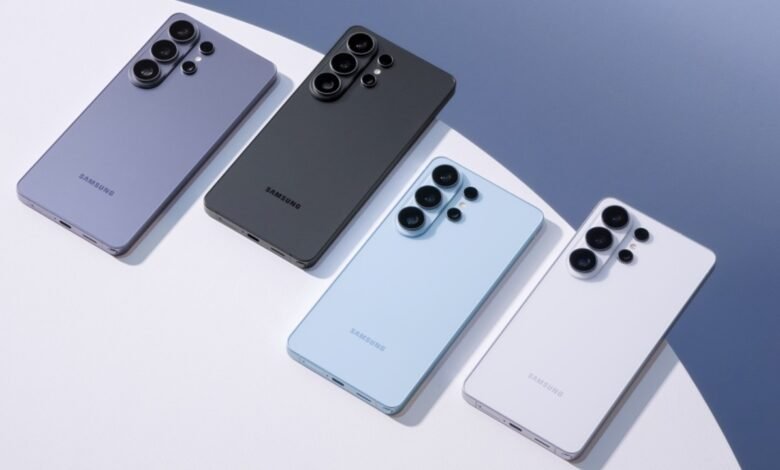

Samsung is reportedly planning to shake up its flagship smartphone strategy in a significant way. According to a report from South Korean outlet ETNews, citing multiple industry sources, Samsung’s Mobile eXperience (MX) division has decided to introduce a “Pro” model to the Galaxy S27 series. If accurate, the move would expand the lineup from three models to four: Galaxy S27, S27+, S27 Pro, and S27 Ultra.
This would mark the first time since 2020 that Samsung has restructured the core Galaxy S lineup. Since the Galaxy S20 series, the company has stuck to a three-tier approach of standard, Plus, and Ultra. The S27 generation, expected in early 2027, would break that pattern.
What exactly is the Galaxy S27 Pro?
Think of it as an Ultra without the S Pen. According to the ETNews report, the S27 Pro would share most of the Ultra’s core technologies, including Samsung’s Privacy Display feature that debuted on the Galaxy S26 Ultra. One source told the publication that “the general direction is clear: a high-end model without the S Pen, while sharing most of the Ultra’s technologies.”
For context, Samsung’s Privacy Display is a hardware-level screen feature that makes the display difficult to read from an angle. It was one of the standout additions to the S26 Ultra when it launched in February, and expanding it to a second device would make premium screen technology more accessible within the Galaxy S family.
Specific details like display size, camera configuration, and pricing have not been finalised. But the positioning is clear: Samsung wants two premium devices at the top of the lineup instead of one.
Why now?
Two factors appear to be driving this decision.
First, Samsung’s last attempt to add a new model to the lineup did not go well. The Galaxy S25 Edge, launched in May 2025 with a focus on ultra-thin design, reportedly sold poorly. Samsung originally planned for the Edge to replace the Plus model starting with the S26 series, but reversed course after weak market reception. The S26 launched in February with the traditional three-model structure, and no Edge successor was announced. Samsung executives have since described the Edge as an ongoing experiment, but the lack of a follow-up speaks volumes.
The S27 Pro takes a different approach. Rather than replacing an existing model, it expands the lineup. It is additive, not substitutive, which means Samsung is not betting against any of its existing tiers.
Second, there is the Apple factor. Apple currently sells four iPhone models at the flagship level: iPhone, iPhone Air, iPhone Pro, and iPhone Pro Max. That gives Apple two standard-tier and two premium-tier devices. Samsung, by contrast, has relied on a single Ultra model as its only no-compromise flagship. Industry analysts cited in the ETNews report interpret the S27 Pro as a direct response to this competitive gap.
What this means for buyers
If the S27 Pro materialises as described, it would address a real gap in Samsung’s lineup. Currently, the jump from the Galaxy S26+ to the S26 Ultra is steep, both in price and in features. The Ultra commands a significant premium, partly because of exclusive technologies like the 200MP camera system and Privacy Display, and partly because of the S Pen, which not every buyer wants or needs.
A Pro model sitting between the Plus and Ultra would give consumers access to flagship-grade camera hardware and display technology without paying the full Ultra premium or committing to S Pen functionality. This mirrors what Apple has done successfully: the iPhone 17 Pro and Pro Max are nearly identical in capability, differing mainly in screen size and battery.
The key question is how Samsung differentiates the Pro from both the Plus below it and the Ultra above it. If the Pro gets the same camera system and Privacy Display as the Ultra, and the only difference is the S Pen, then the Ultra’s value proposition becomes narrower. Samsung will need to be deliberate about where it draws the lines.
A note of caution
It is worth remembering that rumours of a Galaxy S26 Pro circulated last year as well. Samsung dismissed those reports and launched only three S26 models. The fact that similar sources are now pointing to an S27 Pro does not guarantee it will ship. Display sizes, camera specifications, and even the model’s existence could change between now and early 2027.
ETNews is a credible South Korean tech publication with a strong track record on Samsung leaks, and the report cites multiple industry insiders. But at this stage, nothing is confirmed by Samsung.
The bigger picture
Samsung’s flagship strategy has been under pressure for several years. The company dominates global smartphone shipments by volume, but Apple continues to capture a disproportionate share of premium segment profits. Expanding the high-end lineup is one way to compete for those buyers without cannibalising the mid-range Galaxy A series that drives volume sales in markets like Kenya and across East Africa.
Whether the S27 Pro delivers on this promise will depend on execution, particularly pricing and how much of the Ultra’s technology actually trickles down. For now, the signal from Samsung’s MX division is clear: one premium flagship is no longer enough.