

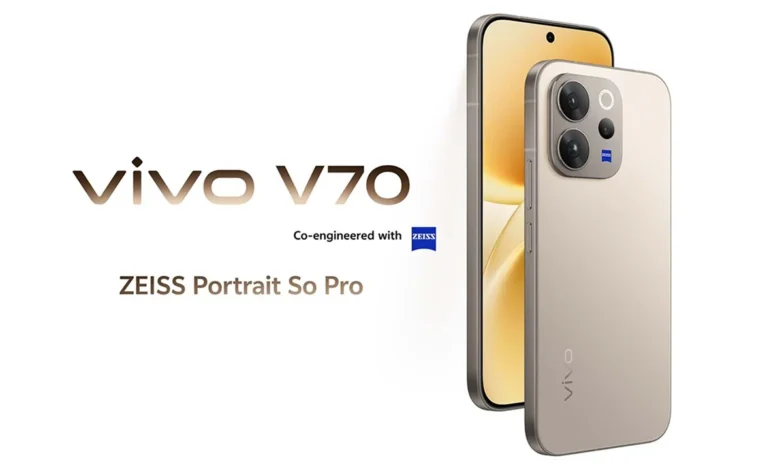

The vivo V70 is now officially available in Kenya, with first sales going live nationwide today, 7 April 2026. Priced at KES 84,999 at vivo’s official retail channels, the phone brings a 50MP ZEISS Super Telephoto camera, an aluminium alloy frame, and IP69 water resistance to a segment where most competitors are still working with plastic builds and digital zoom.
We previewed the V70 last week when vivo first teased it for the Kenyan market. The pitch was clear then: telephoto photography and premium materials at mid-range money. Now that the phone is actually shipping, it’s worth digging into what the spec sheet delivers, and what the marketing materials conveniently skip over.
The camera story
The headline feature is the 50MP ZEISS Super Telephoto camera. This is a proper periscope telephoto lens with 3x optical zoom, not the crop-and-upscale approach that cheaper phones pass off as “telephoto.” It’s paired with a 50MP main sensor and an 8MP ultra-wide, plus a 50MP selfie camera up front.
For the V-Series, this is new territory. Previous models in this line leaned heavily on selfie cameras and portrait modes. The V70 is the first to bring a dedicated telephoto back to the rear camera array, narrowing the gap between vivo’s mid-range V-Series and its flagship X-Series phones.
vivo is particularly proud of AI Stage Mode, a feature designed for shooting in concerts and live performance settings. It promises usable zoom from 1x to 20x in tricky lighting. If you’ve ever tried to photograph a performer at Koroga Festival from 15 rows back and ended up with a blurry mess, this is the problem vivo is targeting. Whether it delivers consistently is something that will need real-world testing to confirm.
The V70 also records 4K video at 60 frames per second, a first for the V-Series. Previous models topped out at 30fps. For content creators working in Kenya’s growing digital media space, the jump to 60fps is meaningful for anything involving motion, whether that’s event coverage, short-form social content, or sports clips.
What else you should know
Beyond the headline features, there are a few details worth filling in. The V70 runs on the Qualcomm Snapdragon 7 Gen 4, the same chipset found in last year’s vivo V60. That’s not unusual for the V-Series, which has historically prioritised camera and design upgrades over annual processor swaps. The Snapdragon 7 Gen 4 remains a capable mid-range chip, though buyers upgrading from a V60 shouldn’t expect a performance leap. Reviews from GSMArena confirm that benchmark differences between the two models are modest.
The 8MP ultra-wide camera also returns largely unchanged from previous generations, using the familiar OmniVision OV08D10 sensor. It’s functional for landscape and group shots, but it’s clear that vivo’s investment this generation went into the telephoto and main sensors rather than the ultra-wide. That’s a deliberate trade-off, and for most users, probably the right one.
The phone runs OriginOS 6 on Android 16, ships with up to 12GB of RAM and 512GB of UFS 4.1 storage depending on the variant, and is promised four major Android updates. These are competitive numbers for the price bracket.
Build and durability
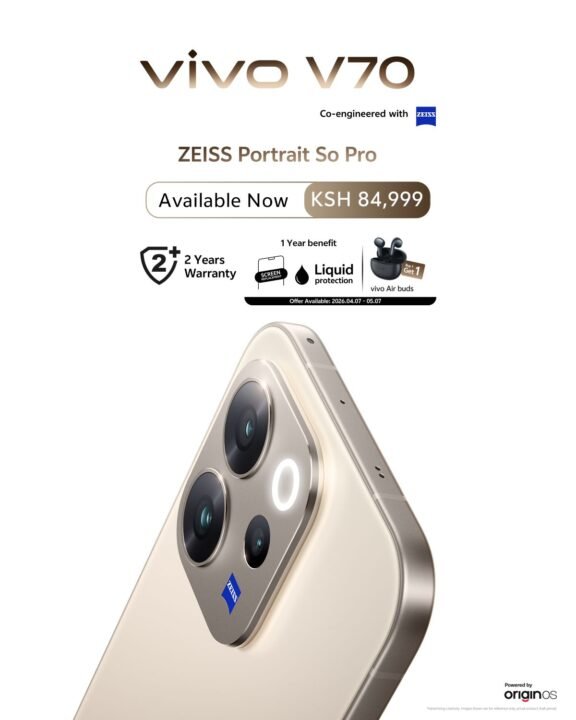
This is where the V70 genuinely impresses for its price bracket. The frame is built from what vivo calls “aerospace-grade 6-series aluminium alloy,” which is marketing-speak for 6000-series aluminium, the same family of alloys used in aircraft structures and bicycle frames. In practical terms, it means a stiffer, more corrosion-resistant frame than the plastic-edged phones common at this price point.
The phone carries both IP68 and IP69 ratings. IP68 means it can survive submersion in 1.5 metres of water for 30 minutes. IP69 adds resistance to high-pressure, high-temperature water jets. For Kenyan users who work outdoors, commute in rain, or simply want a phone that can handle the unexpected, this is a tangible selling point.
The display is a 6.59-inch flat AMOLED panel at 1.5K resolution (2750 x 1260 pixels) with a 120Hz refresh rate and peak brightness of 5,000 nits. It’s a step down in size from the V60’s 6.77-inch curved display, but the flat panel should be more practical for everyday use, with fewer accidental edge touches.
Battery and charging
The 6,500mAh silicon-carbon battery is carried over from the V60, and that’s not a complaint. Independent reviews have consistently praised this battery for delivering a day and a half of use under normal conditions. Pair it with 90W FlashCharge, and you get a phone that recovers quickly when you need it to.
Pricing context
At KES 84,999, the V70 sits at the upper edge of mid-range pricing in Kenya. It’s worth noting that third-party retailers are already listing the phone at between KES 65,000 and KES 78,500 depending on the variant and seller. The KES 84,999 figure appears to be the recommended retail price for the top-spec 12GB/512GB configuration through vivo’s official channels.
That puts it in direct competition with devices like the Xiaomi 15T and Samsung Galaxy A56, both of which trade blows in different areas. The V70’s strongest cards are its ZEISS telephoto system and its build quality. Where it concedes ground is in raw processing power, given the year-old chipset.
The bottom line
The vivo V70 is a focused phone. It knows what it wants to be: a mid-range device with genuinely good telephoto photography, premium materials, and a battery that doesn’t quit. It delivers on those promises. Where it falls short is in the areas vivo chose not to upgrade, particularly the processor and the ultra-wide camera.
For buyers in Kenya who prioritise camera versatility and build quality over raw performance, the V70 makes a compelling case. For those upgrading from a V60, the gains are mostly cosmetic and camera-related, not computational.
The vivo V70 is available now at vivo retail stores and authorised online channels across Kenya.