
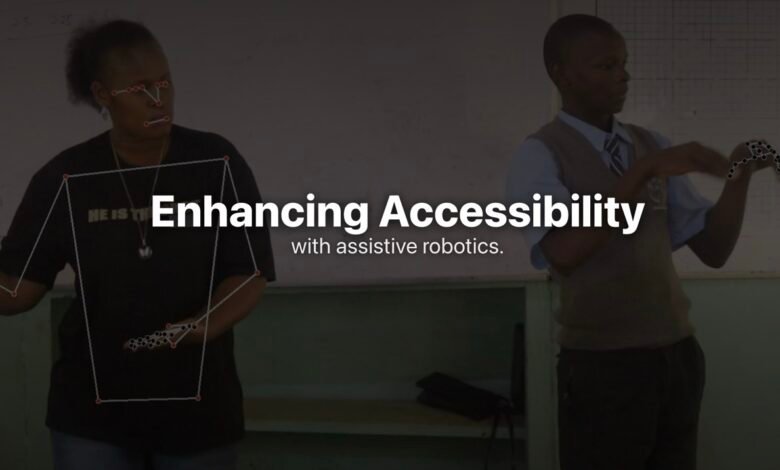

Zerobionic, a Nairobi-based startup that builds AI-powered humanoid robots capable of translating speech into sign language in real time, has been selected for the 2026 cohort of Qualcomm’s Make in Africa Mentorship Programme.
The startup is one of 10 chosen from a record pool of over 1,200 applications across more than 45 African countries. It is the only Kenyan representative in this year’s cohort.
Now in its fourth year, the Qualcomm Make in Africa programme is an equity-free initiative under the broader Qualcomm Africa Innovation Platform. It targets early-stage startups working with deep technology, specifically hardware, AI, IoT, and advanced connectivity. Unlike many accelerator programmes that focus on pitch decks and go-to-market strategy, Qualcomm’s offering is heavily engineering-led. Selected startups get hands-on technical mentorship from Qualcomm engineers, product design guidance built around Arduino AI platforms (Arduino is now a Qualcomm company), business coaching, and something relatively rare for African startups: structured intellectual property training and support.
That IP component is worth emphasising. Through L2Pro Africa, an e-learning platform designed for African innovators, and a partnership with Adams & Adams, a leading African IP law firm, participants receive patent filing consultations. Startups that file patents during the programme can claim up to $5,000 (roughly KES 645,000) in filing fee reimbursements. All participants who complete the programme are also eligible for a $5,000 stipend. At the programme finale, one startup will receive a Social Impact Fund grant from Qualcomm for Good.
What Zerobionic actually does
Founded by Maxwell Opondo, a 21-year-old Strathmore University-linked innovator, Zerobionic builds 3D-printed robotic prosthetic arms made from recycled plastic waste. These robots use machine vision and machine learning to perform real-time translation between spoken language and sign language, working in both directions: speech-to-sign and sign-to-speech.
The core use case is education. In Kenya and across much of Africa, students with hearing impairments often have limited access to STEM subjects because the curriculum and teaching infrastructure are not designed for them. Zerobionic’s robots sit in the classroom and act as live interpreters, converting a teacher’s spoken words into sign language. The system reportedly achieves 92% accuracy in translation.
The startup has already run pilot programmes in schools across Garissa, Machakos, and Kirinyaga counties. According to the company, early results showed a measurable increase in deaf students’ interest in STEM subjects where none had existed before. Opondo won the Young Tech Innovator Award at the 2025 Africa Tech Summit and took a Gold award at the Reimagine Education Awards in 2024 for this work.
Zerobionic describes itself as a “disability-led” startup, which adds an important dimension. The team is not just building for people with disabilities but building alongside them.
The rest of the 2026 cohort
The other nine startups span eight countries and reflect a strong tilt towards agriculture, infrastructure, and accessibility. Amperra Charging Company from Namibia is building AI-driven, grid-adaptive EV charging infrastructure. Nigeria has two representatives: Anatsor Ltd, working on digital poultry farm management, and D-Olivette Labs, a bio-intelligence platform for sustainable agriculture. Mindora Corporation from Zimbabwe is developing a Braille keyboard for visually impaired users. MVUTU from the Republic of the Congo builds solar-powered IoT cold storage for smallholder farmers. Zambia’s QualiKeeper Investments is tackling livestock monitoring in low-connectivity rural areas. SafeSip from Tanzania focuses on smart water monitoring. Ghana’s Sesi Technologies is applying AI to cocoa quality assessment. And TWave Ltd from Uganda is automating solar-powered fish feeding systems.
A pattern is visible across all four years of the programme: these are not software-only plays. Qualcomm, as a semiconductor and connectivity company, is specifically hunting for startups that build physical products and deploy them in challenging environments. Last year’s winner, Kenya’s Farmer Lifeline, built solar-powered edge AI devices that detect crop pests directly in the field.
Why it matters
The programme is implemented in partnership with the African Telecommunications Union (ATU), which has been involved for all four years. Wassim Chourbaji, Qualcomm’s Senior Vice President and President for Middle East and Africa, pointed to the growing sophistication of applications as evidence of the continent’s maturing tech ecosystem.
For Kenya specifically, Zerobionic’s selection continues a pattern. Kenyan startups have featured in every Make in Africa cohort, and Farmer Lifeline’s win in 2025 established a strong track record. The focus on assistive technology also opens a relatively underserved category in Africa’s startup landscape, where fintech and agritech tend to dominate conversations and funding.
The mentorship programme runs through the remainder of 2026, culminating in a finale event where the Social Impact Fund grant winner will be announced.