
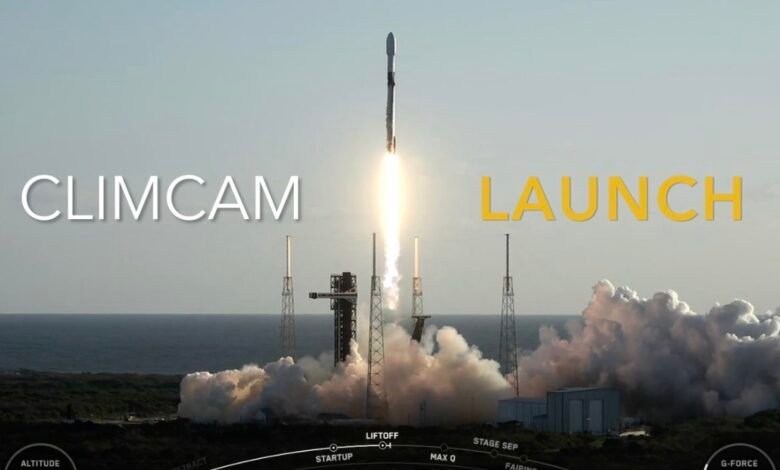

The Kenya Space Agency (KSA) has confirmed the successful launch of the Climate Camera (ClimCam), an AI-equipped payload now heading to the International Space Station (ISS). The payload lifted off on Saturday, 11 April 2026, at 1:41 pm East African Time, from Cape Canaveral Space Force Station in Florida, aboard a SpaceX Falcon 9 rocket.
ClimCam is travelling as part of Northrop Grumman’s Cygnus XL NG-24 commercial resupply mission, which is carrying over 11,000 pounds of supplies, experiments, and equipment to the ISS. The Cygnus XL spacecraft, named S.S. Steven R. Nagel, successfully separated from the Falcon 9 booster about seven minutes after liftoff. It is expected to be captured by the ISS’s Canadarm2 robotic arm today, Monday 13 April, at around 12:50 pm EDT (7:50 pm EAT), with NASA astronauts Jack Hathaway and Chris Williams operating the arm.
What is ClimCam, and what does it do?
ClimCam is a compact, 3.5-kilogram payload designed to capture high-resolution images of the Earth’s surface and use machine learning algorithms to process climate data in near real-time. Once installed on the Airbus Bartolomeo platform, which is attached to the European Columbus Module on the ISS, it will spend approximately one year in orbit.
According to Space in Africa, the mission’s operational objectives include daily colour imaging of at least 20 square kilometres over East Africa, at a ground sampling distance of 10 metres, from an altitude of roughly 400 kilometres. The payload is expected to begin commissioning around August 2026, with data transmission following later in the year.
The data it collects will support flood detection, agricultural monitoring, weather forecasting, disaster management, and natural resource tracking across Eastern Africa. For a region increasingly vulnerable to extreme weather events, droughts, and food insecurity, having an African-built and African-operated instrument feeding localised climate intelligence is significant.
How did this come about?
ClimCam is a joint effort between three African institutions: the Kenya Space Agency (KSA), the Egyptian Space Agency (EgSA), and the Uganda National Space Programme. The consortium won a competitive Announcement of Opportunity issued by the United Nations Office for Outer Space Affairs (UNOOSA), in partnership with Airbus Defence and Space, under the “Access to Space for All” initiative. This programme is designed to give developing nations the chance to build payloads for flight on ISS platforms.
The Egyptian Space Agency served as the technical lead on the project, with assembly, integration, and testing (AIT) taking place at EgSA facilities in Cairo. The payload then underwent further end-to-end validation and fit-checks at Airbus facilities in Houston, Texas, before being cleared for spaceflight.
Why this matters for Kenya and the continent
This is not Kenya’s first interaction with space hardware. In 2018, Kenyan engineers were involved in building the 1KUNS-PF nanosatellite, a 1U CubeSat developed in collaboration with Sapienza University of Rome and launched from the ISS. In 2023, Kenya followed up with Taifa-1, its first operational Earth observation satellite, a 3U CubeSat developed by nine Kenyan engineers with the help of Bulgarian aerospace company EnduroSat. It cost roughly KES 50 million and was launched aboard a SpaceX Falcon 9 from Vandenberg Space Force Base.
ClimCam represents a step in a different direction. Where Taifa-1 was a sovereign Kenyan effort focused on building internal capacity, ClimCam is a regional collaboration focused on producing actionable climate intelligence. It also marks the first time three African space agencies have partnered on a single payload destined for the ISS.
As Space in Africa noted, the mission signals a shift for the continent from being purely a consumer of space data to becoming a co-producer and co-owner of space data systems. The project could pave the way for more ambitious initiatives, such as the proposed African Development Satellite (AfDevSat).
The bigger picture
ClimCam’s launch comes at an interesting moment. Kenya is set to host the combined Global Data Festival and Kenya Space Expo and Conference 2026 in Nairobi from 2 to 5 June, bringing together experts, policymakers, and industry leaders around data, space, and emerging technologies. Having a functioning payload on the ISS will give KSA and its partners a strong showcase for what African-led space projects can deliver.
It also aligns with continental momentum. The African Union inaugurated the African Space Agency in April 2025. Countries like Nigeria, Ethiopia, Egypt, South Africa, and Angola have either launched satellites or signed agreements to build new ones. The space sector across Africa is no longer a novelty. It is becoming a serious policy tool.
KSA has said it will provide further updates after the successful docking and installation of the ClimCam payload aboard the ISS.