


If you live in Nairobi or any of Kenya’s major towns, fibre internet is something you probably argue about on Twitter. Is Safaricom’s Home Fibre worth it? Why is Zuku so inconsistent? Should you switch to Faiba? These are the kinds of complaints that come with actually having options.
But in Northern Kenya, particularly across Isiolo, Garissa, Wajir, and Mandera counties, the conversation is completely different. There, the question is not which ISP to choose. It is whether internet exists at all.
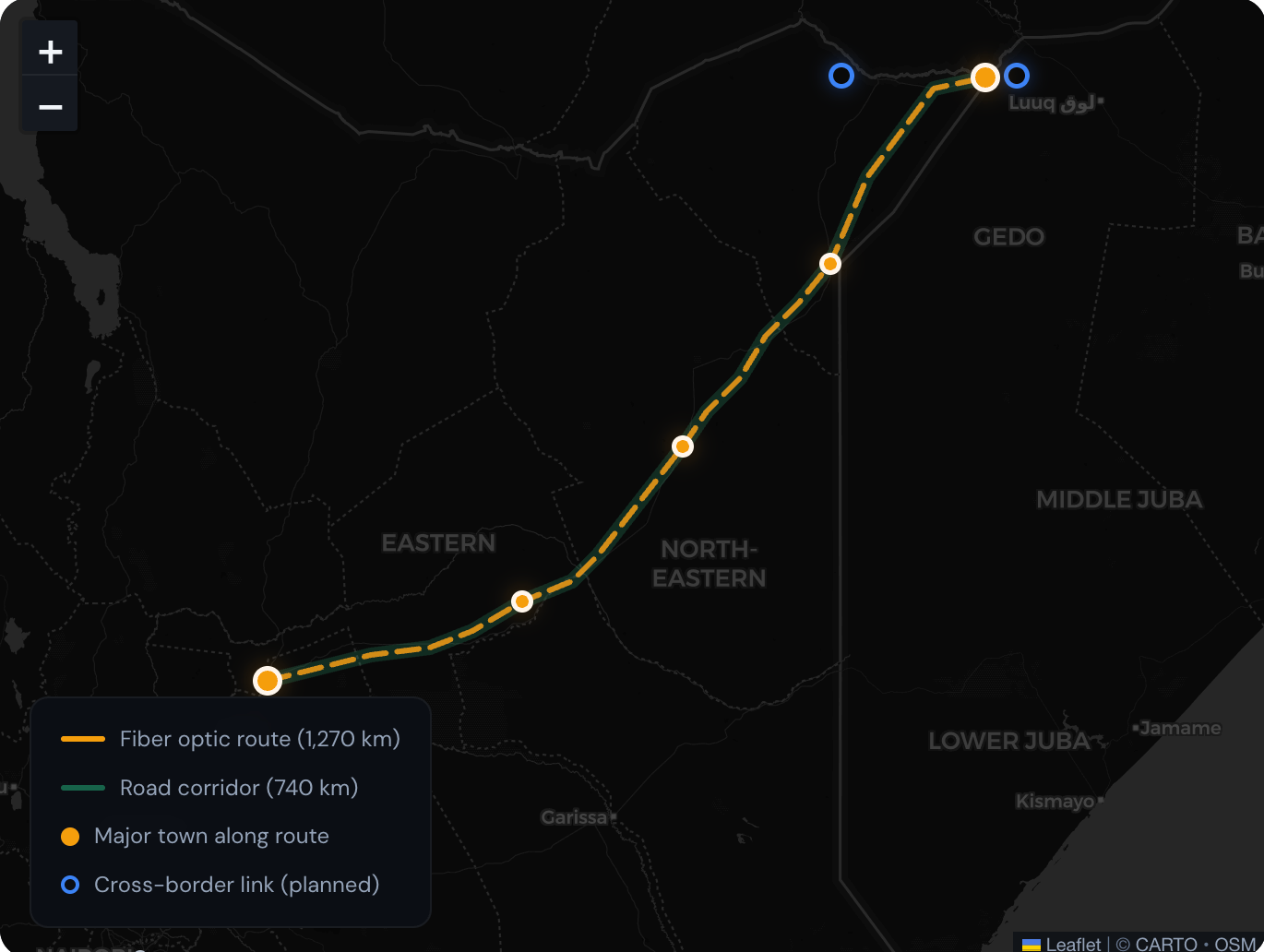
That is starting to change. In late March 2026, the World Bank Board of Directors approved KES 58.3 billion (about $550 million) in fresh funding for a project that will lay approximately 1,270 kilometres of high-capacity fibre optic cable from Isiolo to Mandera. The cable will run alongside a major road upgrade covering 508 km of the 740 km Isiolo-Mandera corridor.
What the project actually involves
This is not a standalone fibre project. It is bundled into a wider infrastructure effort called the Horn of Africa Gateway Development Project (HoAGDP), which combines road construction with digital connectivity. Think of it as a two-for-one deal: while KeNHA (Kenya National Highways Authority) digs trenches and lays tarmac, fibre optic cables are going into the ground at the same time.
The total estimated cost for the entire project is KES 115.9 billion. Of that, the World Bank is contributing KES 97.05 billion ($750 million) through an International Development Association (IDA) credit. The latest approved tranche of KES 58.3 billion is split into two parts: KES 37.7 billion in additional financing for the original HoAGDP, and KES 33.8 billion for a second phase of the project.
Cash disbursement started back in 2021, and the project is expected to run until June 2028.
Two government bodies are handling the work. KeNHA leads the civil works: trenching, ducting, laying PVC pipes, and building manholes along the road. The ICT Authority (ICTA) is responsible for the digital side, including feasibility studies, supervising cable installation, and connecting public institutions to the network. ICTA’s share of the fibre work is budgeted at KES 3.1 billion ($24.1 million).
Check your internet connection or ensure Leaflet resources are accessible.
- Trenching and ducting along the corridor
- Laying PVC pipes for fiber conduits
- Constructing manholes and access points
- Road upgrade: 508 km to bitumen standard
- Feasibility studies and engineering design
- Supply and installation of fiber cable
- Fiber spurs to 341 public institutions
- Cross-border fiber links to Ethiopia & Somalia
- Budget: KES 3.1 billion ($24.1M)
Why this matters for Northern Kenya
Currently, terrestrial fibre links between Kenya and Ethiopia are very limited. Between Kenya and Somalia, they do not exist at all. Most people in Northern Kenya rely on mobile internet, while a small number use expensive satellite or microwave systems to get online. Kenya’s digital divide is well documented, but the northern corridor represents its sharpest edge.
The project aims to connect at least 341 public institutions to the fibre network. These include schools, hospitals, pastoralist roadside markets, rest stops, and community service centres. ICTA is also tasked with building fibre spurs and rings branching off the main backbone to reach these institutions.
For the 3.2 million people living in the region, this is not about streaming Netflix. It is about access to e-government services, telemedicine, digital education, and basic economic participation in a country that is rapidly digitising everything from tax payments to land registrations.
The integrated approach of laying fibre alongside road construction is projected to cut the cost of service delivery by around 40%. That saving, in theory, should translate into lower costs for end users. Whether ISPs actually pass those savings on is another question entirely.
The bigger picture: roads, trade, and regional integration
Beyond connectivity, the road upgrade itself is transformative. Once complete, travel time between Nairobi and Mandera is expected to drop from roughly three days to one. That is a massive shift for trade, logistics, and everyday life in a region that has historically been cut off from the rest of the country.
The project also has a cross-border dimension. The Isiolo-Mandera corridor is part of a broader road network linking Kenya to Ethiopia and Somalia. As the World Bank noted in its announcement, interventions that enhance connectivity and support livelihoods are essential for fostering peace, security, and economic growth in the Horn of Africa.
Qimiao Fan, the World Bank’s Division Director for Kenya, Rwanda, Somalia, and Uganda, described the project as a “multisectoral” effort. The idea is that better roads and better internet together unlock economic potential that neither could achieve alone.
What could go wrong
Kenya’s track record with large-scale infrastructure projects is mixed. Delays, cost overruns, and political interference are common. The fact that this project is operating in a fragile, security-sensitive region adds another layer of complexity. The June 2028 deadline looks ambitious given that construction only began in mid-2025 and some road sections have already stalled due to inadequate funding.
There is also the question of what happens after the fibre is laid. Infrastructure without services is just expensive cable in the ground. For the fibre to actually benefit residents, ISPs need to offer affordable packages in the region, and the electricity supply needs to be reliable enough to keep equipment running. Neither of those is a given in Northern Kenya.
The government’s broader goal of deploying 100,000 km of fibre nationally under the Digital Superhighway Project is impressive on paper. But the gap between ambition and execution has frustrated many in Kenya’s tech industry. As ICTA CEO Stanley Kamanguya once put it when the agency partnered with the Communications Authority on last-mile fibre across 19 underserved counties, it is “an interesting time to begin the 100,000 kilometre journey.” That journey is still far from complete.
The bottom line
This is, without question, one of the most significant digital infrastructure projects Kenya has undertaken outside its major urban centres. If delivered on time and complemented by affordable services, it could meaningfully close the connectivity gap for millions of people in the country’s most underserved region.
But fibre in the ground is only half the story. The other half is ensuring that the schools, hospitals, and markets connected by this network actually have the power, the devices, and the digital literacy to use it. That part does not come with a World Bank cheque.