
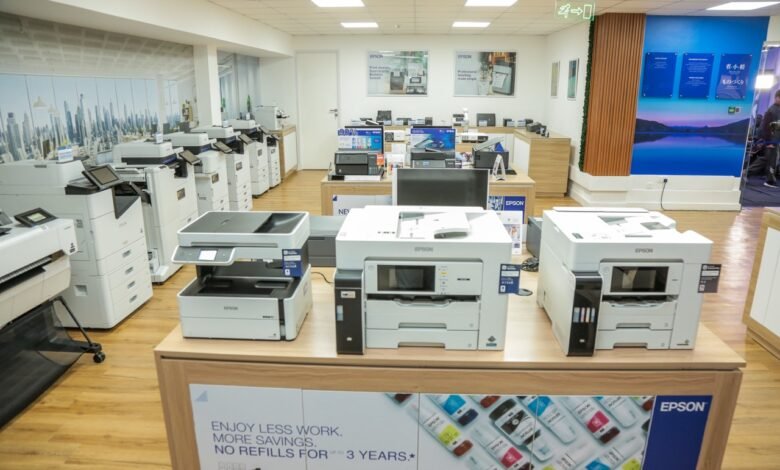
Epson has opened an expanded regional office in Nairobi after spending KES 19,417,500 on premises 50% larger than its previous Kenyan office. The company announced the opening on 1st September 2026 and says the facility will be the hub for its East African operations.
Epson is a Japanese electronics company best known for printers and projectors. Kenya sits inside the company’s Middle East, Turkey, Africa and Central & West Asia region, which Epson shortens to META-CWA, and the company calls East Africa one of the priority growth markets within it. Epson says demand for business printing and visual products is rising across emerging markets, and that companies in these markets increasingly want local support rather than service routed through offices abroad.
The expanded office has a dedicated showroom and demonstration area where partners and customers can try Epson’s printing and projection products before buying. It also adds space for training, partner enablement and in-market servicing.
“Our new office here in Nairobi is a good example of what our commitment to customers looks like in practice,” said Mukesh Bector, Epson’s regional head for East and West Africa, in the announcement. “It creates a hub where partners and customers can experience our technology first-hand, access training and work directly with our local team.”

Renewable energy certificates for 10 offices
Epson paired the announcement with an update on its energy purchases. The company has extended its use of renewable energy certificates to 10 sites across the region, including the Kenyan office, its offices in Johannesburg, Cape Town, Dubai, Saudi Arabia, Morocco, Türkiye, Israel and Ukraine, and its Experience Centre in the UAE. A renewable energy certificate is a purchase that matches a site’s electricity use with an equivalent amount of renewable generation elsewhere on the grid; the site itself keeps drawing whatever power its local utility supplies.
Between March 2025 and April 2026, Epson bought 416 MWh of these certificates to cover the combined electricity use of the 10 sites. The purchases sit under Environmental Vision 2050, the company’s plan to become carbon negative and to stop using exhaustible underground resources such as oil and metal by 2050. We reported in September 2025 that Epson says all of its group sites worldwide have run on renewable electricity since 2023.
“Sustainability is central to our growth strategy,” said Neil Colquhoun, president of Epson META-CWA, in the announcement.
New EcoTank printers and LifeStudio projectors
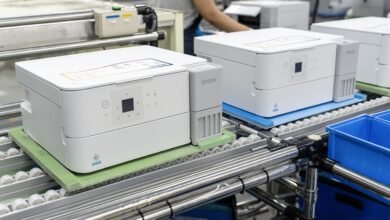
Epson also named the products it is bringing to Kenya and the wider region for its 2026 financial year. The headline range is a new generation of EcoTank printers, the refillable ink tank machines that Epson says are the world’s best-selling ink tank printer brand. Epson’s figures for the new range: up to 90% savings on ink costs compared with cartridge printers, up to three years of printing before a refill, and colour printing up to 20% faster than the outgoing models. The printers use Epson’s Micro Piezo Heat-Free print technology, which the company says uses up to 96% less energy than traditional thermal inkjet printing because it fires ink without heating it.
The second range is LifeStudio, a projector line Epson launched in the United States in 2025 with built-in Google TV and speakers developed with Bose. Two models are coming to the region: the LifeStudio Pop, a compact projector aimed at young adults and gaming, and the LifeStudio Flex, a portable model for home entertainment with Sound by Bose audio. In the US, the Pop sells for USD 679.99. Epson did not give Kenyan prices or launch dates for either range, and we will update this piece when it does.
For Kenyan businesses and buyers, the practical change is proximity. Product demonstrations, training and after-sales support for Epson equipment now run from a larger Nairobi office instead of being limited by the capacity of the old one, and buyers can see the FY26 printers and projectors in person before the products reach retail pricing announcements.





Join the discussion