
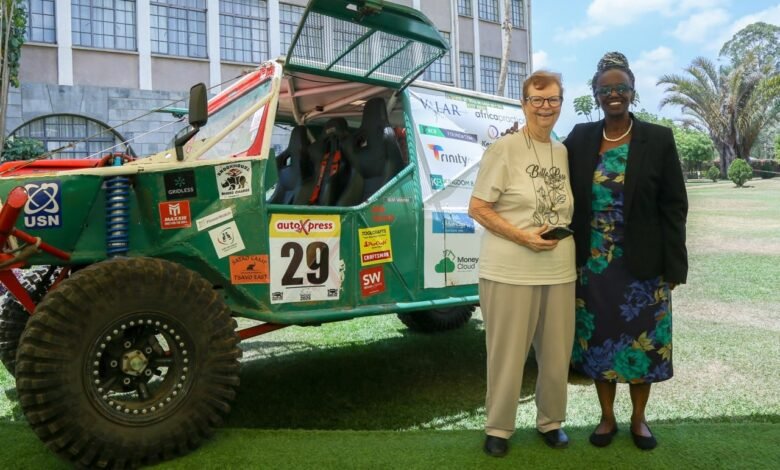
KCB Foundation and EV Explorers have named Caroline Mutheu and Esther Leja winners of the first EV Explorers Rhino Charge Innovation Challenge, a competition for engineering students at Kenyan technical and vocational education and training colleges, which train technicians and craftspeople rather than degree engineers. Each wins a scholarship covering up to 75 per cent of her remaining tuition, a three-month paid internship at Silent Savannah, and a seat with the crew at the 2027 Rhino Charge as a technical observer.
KCB Foundation is the corporate social investment arm of KCB Bank Group, set up in 2007. EV Explorers is the team that put the first electric car into the Rhino Charge, and its sponsors include KCB itself, so the bank is funding a scholarship attached to a team it already backs.
What the Rhino Charge is
The Rhino Charge has run since 1989. It is a one-day off-road fundraising event held in some of the roughest terrain in Kenya, at a location kept secret until shortly before the start. Cars navigate by GPS between thirteen guard posts scattered across bush, rock and dry riverbeds, and the car that reaches all of them in the fewest kilometres wins. Entry is conditional on fundraising. The money goes to Rhino Ark, which builds electric fences around Kenya’s forested mountain ranges to keep wildlife out of neighbouring farms.
The 2026 edition, the 37th, ran in late May at Ngilai Community Conservancy in Samburu County with 65 cars and raised a record KES 365 million. The event has now raised more than KES 2.6 billion, which Rhino Ark has spent on roughly 650 kilometres of electric fencing that protects more than 80,000 households.

Why finishing on batteries was hard
EV Explorers first entered in 2025 and did not finish. The car cleared six guard posts before its transfer box broke and it lost four-wheel drive. The cause was the same property that makes electric motors good off-road. A petrol or diesel engine has to be revved to reach its peak twisting force, but an electric motor produces all of it from a standstill. That is an advantage crawling up a rock face and a problem for a gearbox built around an engine that ramps up gradually. The team had underestimated how much torque the drivetrain would put through the transmission.
The 2026 rebuild left the electrics alone and went at the mechanical side: a heavy-duty transfer box, strengthened prop shafts and drivetrain, and a recalibrated throttle so the motor delivers its torque less abruptly. The car was built from scratch on a tube frame, with Land Rover Salisbury axles front and rear and a 240 kW motor taken from a Lexus. It finished the 2026 course.
The two sources disagree on the battery. The KCB Foundation release puts it at 62 kWh. Silent Savannah, which built the car, says on its own build page that it carries 120 kWh. We have asked both and will update this piece.
Charging was the other half of the problem, because a diesel car carries its fuel into the bush and an electric one cannot. In 2025 the team ran a 20-foot shipping container with solar panels on the roof. For 2026 Silent Savannah replaced it with a towable solar trailer with its own battery storage, which a pickup drags to camp and which sets up in under five minutes. The car was charged to full from sunlight before the start and ran the whole competition day on that charge, with no generator and no grid.
What the students will do
Silent Savannah builds electric safari vehicles and off-grid solar charging for lodges and conservancies. EV Explorers Innovation Challenge lead Andrew Waititu said the two will work on the 2027 entry using data recorded during the 2026 event. “During their placement at Silent Savannah, our scholars will utilise the performance telemetry datasets to assist our crew with chassis, wiring, and energy optimizations for the 2027 entry,” Waititu said in the release. That puts them on the parts of the car the 2026 rebuild had to fix, and on a deadline: the 38th Rhino Charge is set for 29 May 2027.
What the energy strategy actually targets
The release says Kenya’s National Energy Efficiency and Conservation Strategy “targets increased uptake of electric vehicles”. The target set in 2020 was narrower: electric and hybrid vehicles together at 5 per cent of annual vehicle imports by 2025. It counted imports rather than cars on the road, and lumped hybrids in with battery cars. That deadline has passed and no official confirmation has been published that the threshold was met. Kenya had 6,442 registered electric vehicles as of June 2025, on Electric Mobility Association of Kenya figures.
The rest of the framework has moved faster than the workforce behind it. The National Electric Mobility Policy launched in February 2026, and we wrote about the KEA plates it put on electric cars. Chargers are going in, as we covered when BasiGo and Rubis put fast chargers at petrol stations. Tax is less settled, and we reported on the Finance Bill 2026 attempt to reverse the EV tax break. Training is the gap this scholarship aims at, and we have covered Huawei’s training of 65 TVET trainers before.
“Scholarships like these are an important tool for connecting education to applied learning, industry exposure, and pathways into employment,” KCB Foundation managing director Mendi Njonjo said in the release.
What the press release leaves out
It does not name the colleges Caroline Mutheu and Esther Leja attend, say how many students entered, describe what they had to submit, name the judges, or put a shilling figure on the scholarship or the internship pay. It does not say whether the challenge runs again for 2027. We have asked KCB Foundation and will update this piece.
EV Explorers enters again on 29 May 2027. Whether Caroline Mutheu and Esther Leja are on that crew list, and credited on the car’s chassis and wiring, is what to check then.







Join the discussion