


The MacBook Neo is rapidly becoming the laptop other manufacturers are designing around.
Huawei has introduced the Qingyun L420z in China, a thin all-metal laptop with a 14.2-inch OLED touchscreen, 2.8K resolution and refresh rates of up to 120Hz. On paper, that immediately fixes one of the most obvious compromises Apple made when building the cheaper MacBook Neo: the screen.
But there is an important qualification. The Qingyun L420z is not a conventional consumer MateBook. Qingyun is Huawei’s business computing line. This particular model currently lists China’s Galaxy Kylin Desktop OS V10 and UnionTech UOS V20 as its operating systems. Huawei has also conspicuously left the processor out of the public specification sheet.
That makes this a fascinating piece of hardware rather than, for now, something a Kenyan MacBook buyer can realistically cross-shop.

The display is the obvious headline
Huawei has fitted the L420z with a 14.2-inch OLED touchscreen using a tall 3:2 aspect ratio and a resolution of 2880 × 1920 pixels.
It reaches a claimed 450 nits, covers 100 percent of both the sRGB and P3 colour spaces, and Huawei says individual panels are factory calibrated to an average Delta E below 1. The display also supports 1920Hz PWM dimming at lower brightness levels and has TÜV Eye Comfort certification.
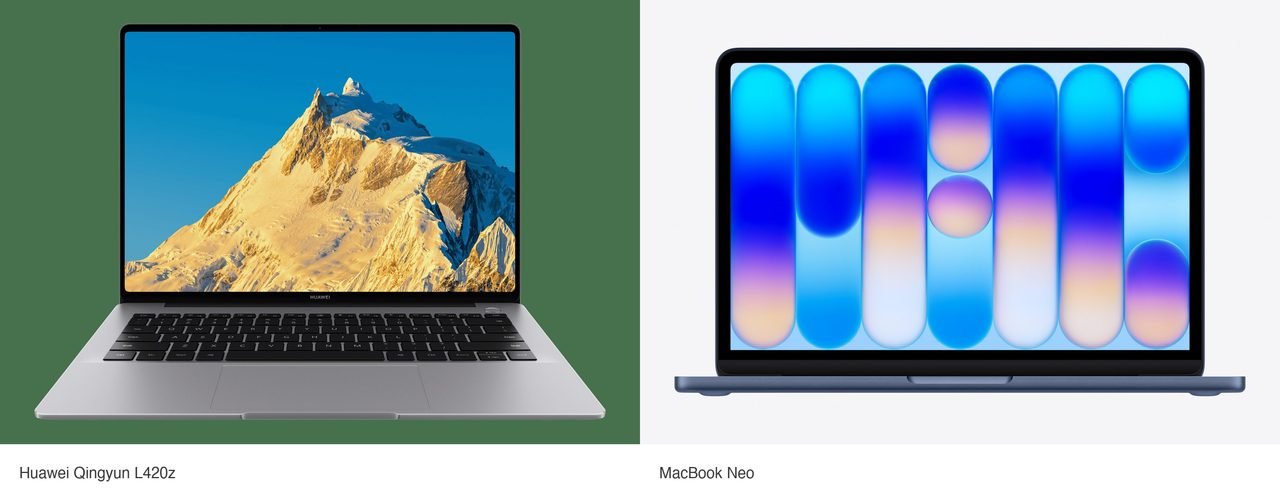
And then there is 120Hz.
Huawei says the laptop ships with its refresh rate set to 60Hz but can be switched to a maximum of 120Hz. That should make scrolling, animations and general movement visibly smoother.
The MacBook Neo has a smaller 13-inch 2408 × 1506 IPS display rated at 500 nits. It supports one billion colours but only the sRGB colour space, and Apple’s spec sheet lists it at 60Hz rather than the ProMotion refresh rates of the pricier MacBooks.
So the Neo is technically brighter, but Huawei has the more ambitious panel almost everywhere else:
- OLED,
- Touch,
- P3 colour,
- a larger canvas,
- higher resolution and 120Hz refresh rates.
Huawei also gives you actual ports
The L420z is 14.5mm thick and weighs about 1.32kg. Its body is all metal.
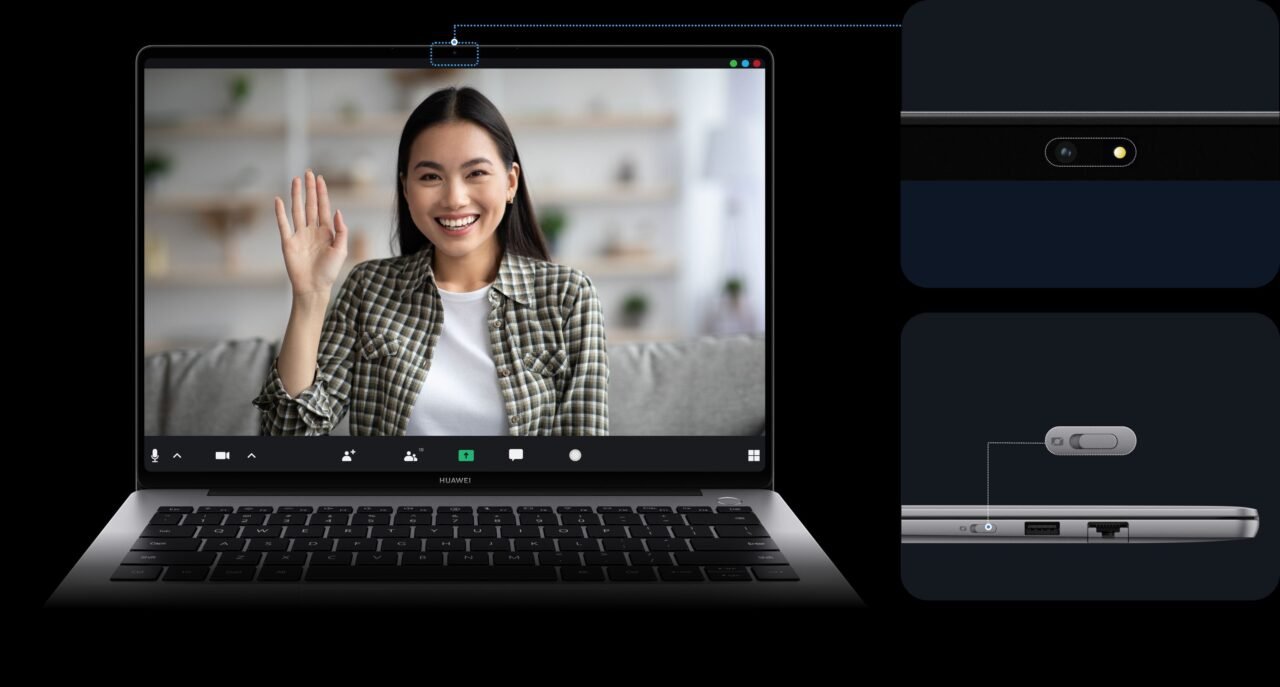
Around the sides Huawei has fitted one full-function USB-C 3.2 port, two USB-A 3.2 ports, HDMI 1.4, an RJ45 Ethernet port and a 3.5mm audio jack. There is also a physical privacy switch for the camera and microphones.
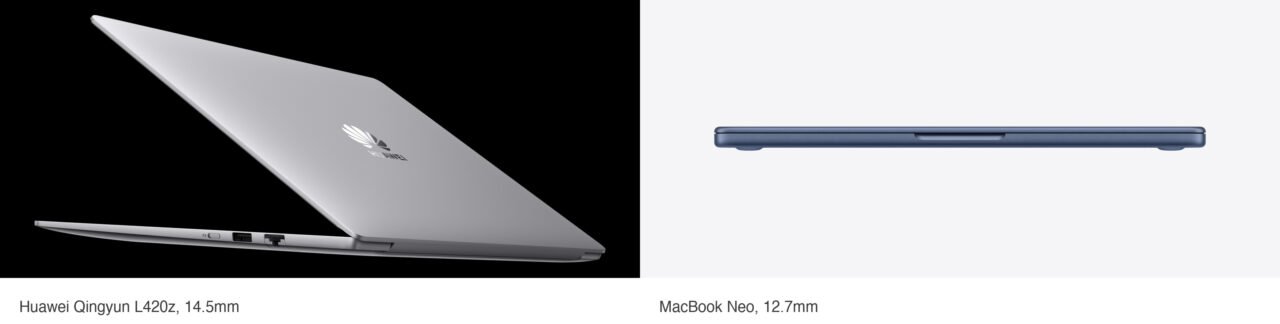
The MacBook Neo is thinner and lighter at 12.7mm and 1.23kg, but Apple’s port selection consists of two USB-C connections and a headphone jack. More unusually, only one of those USB-C ports supports USB 3 at up to 10Gbps and external displays. The second is USB 2 at up to 480Mbps.
Huawei’s decision to provide just one USB-C port feels dated in the opposite direction, but HDMI, USB-A and Ethernet mean many office users would not need a dongle at all.
The L420z also has a 1080p webcam, fingerprint reader integrated into the power button, a backlit keyboard, dual microphones and two speakers.
There is a huge 70Wh battery
Huawei has packed a 70Wh battery inside, almost twice the MacBook Neo’s 36.5Wh capacity.
The company claims more than 14 hours of local 1080p video playback and about 10 hours of web browsing. It also says 15 minutes on the supplied fast charger can take the battery to 25 percent while the laptop is switched off.
Those numbers should not be compared directly with Apple’s claimed 16 hours of video streaming and 11 hours of wireless web use because the two companies use different test methods.
Huawei’s own 14-hour result was recorded on a 16GB RAM, 512GB storage configuration at approximately 150 nits brightness, another useful detail because Huawei has not published a complete list of L420z memory and storage options.
And this is where the comparison falls apart
We know exactly what powers a MacBook Neo.
Apple uses its A18 Pro with a six-core CPU, five-core GPU, 16-core Neural Engine and 8GB of unified memory. The entry model now costs $699 in the US after Apple raised it from the original $599 launch price in June.
Huawei, meanwhile, does not specify the processor in either the L420z product page or specification sheet.
The company talks about an independently developed hardware architecture and LPDDR5x quad-channel memory, and claims improvements of 26 percent in startup speed, 15 percent when opening a large PowerPoint file and 32 percent when copying a large file compared with the preceding L420x. Those are Huawei laboratory measurements rather than enough information to judge actual CPU or GPU performance.
That missing processor specification is enormous. Without knowing the chip and architecture, we cannot meaningfully compare the L420z with the A18 Pro, judge software compatibility, or know how it performs outside Huawei’s chosen tests.
There is also no announced retail price.
| Huawei Qingyun L420z | MacBook Neo | |
|---|---|---|
| Display | 14.2-inch OLED touchscreen | 13-inch IPS |
| Resolution | 2880 × 1920 | 2408 × 1506 |
| Refresh rate | Up to 120Hz | 60Hz |
| Brightness | 450 nits | 500 nits |
| Colour | 100% sRGB, 100% P3 | sRGB |
| Processor | Not disclosed | Apple A18 Pro |
| Memory | LPDDR5x, capacities not fully listed | 8GB unified |
| Battery | 70Wh | 36.5Wh |
| Claimed web use | 10 hours | 11 hours |
| Weight | 1.32kg | 1.23kg |
| Thickness | 14.5mm | 12.7mm |
| USB-C | 1 | 2 |
| USB-A | 2 | None |
| HDMI | Yes | No |
| Ethernet | Yes | No |
| OS | Galaxy Kylin V10 / UOS V20 | macOS |
| US price | Not announced | $699 |
The MacBook Neo effect is becoming visible
Huawei is not alone.
Earlier this month Lenovo announced the IdeaPad Vibe, another thin laptop clearly playing in the Neo’s territory, with AMD and Snapdragon processors, optional OLED displays, upgradeable memory on AMD versions and a $699.99 starting price. We covered how it compares with the MacBook Neo.
The difference is that Lenovo is actually selling into the same broader consumer market as Apple.
Huawei’s Qingyun L420z is much harder to classify. Its hardware looks remarkably attractive, particularly that 2.8K 120Hz OLED panel, but the software platform, undisclosed processor and China-focused enterprise positioning make the “MacBook Neo competitor” label premature. Until Huawei launch a rebadged/renamed version for the global market.
For now, what the L420z really shows is how aggressive laptop hardware can become around the Neo’s size class. Apple’s entry Mac still has advantages in weight, efficiency, software compatibility and the fact that you can actually buy one. Huawei, though, has produced the sort of screen and port selection that makes the Neo’s compromises suddenly look much more obvious.





Join the discussion