

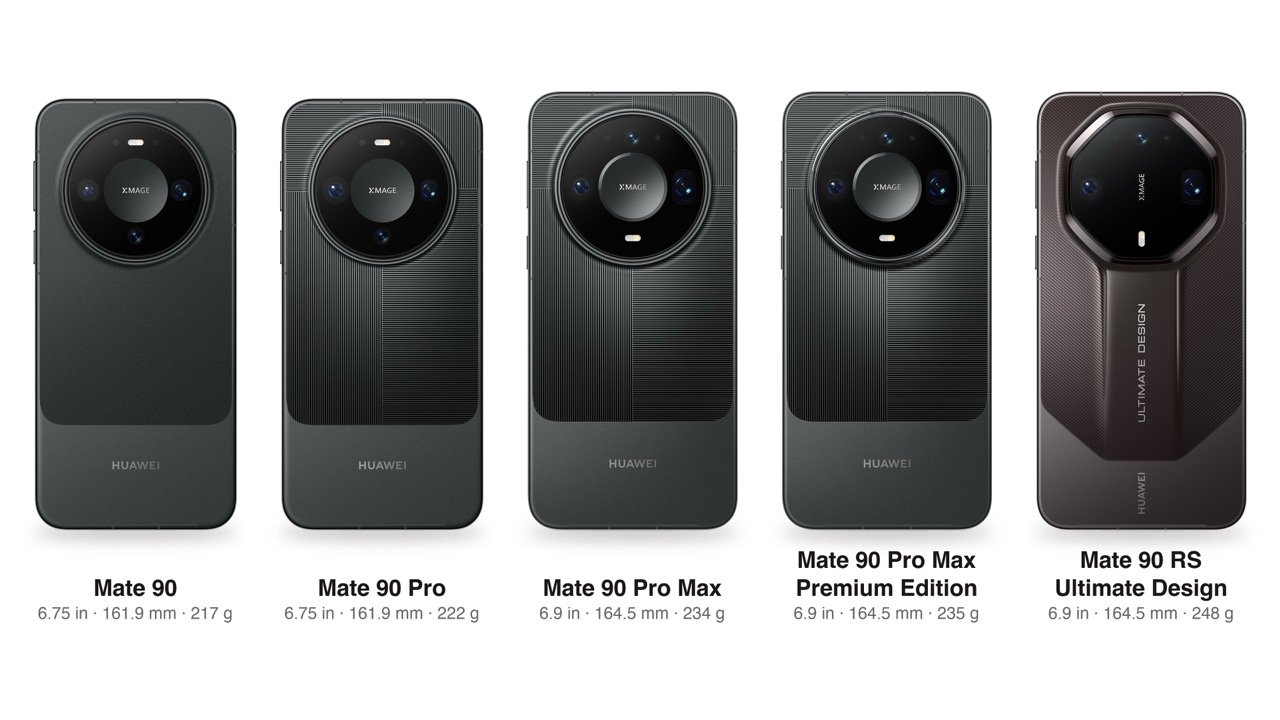
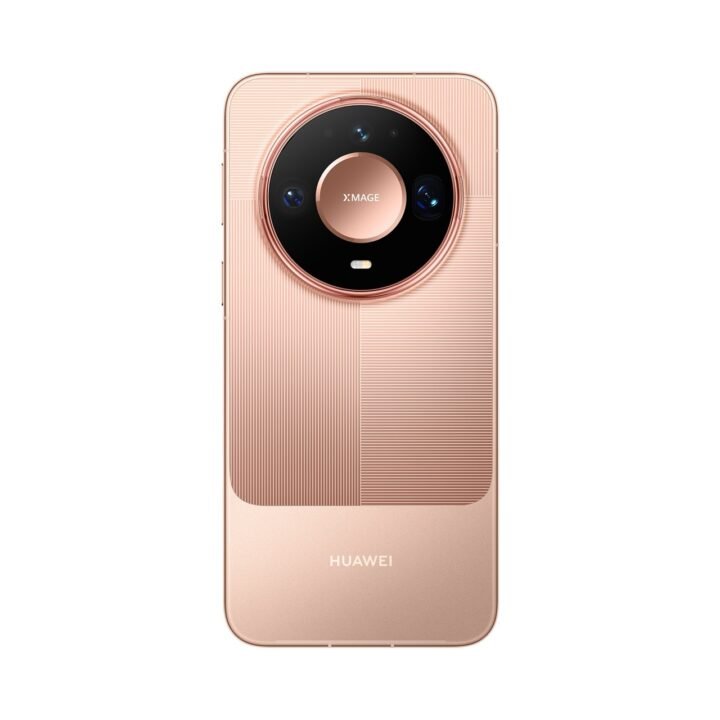
Huawei has officially launched the Mate 90 series. There are five phones in this year’s series:
- the Mate 90,
- Mate 90 Pro,
- Mate 90 Pro Max,
- Mate 90 Pro Max Premium Edition and
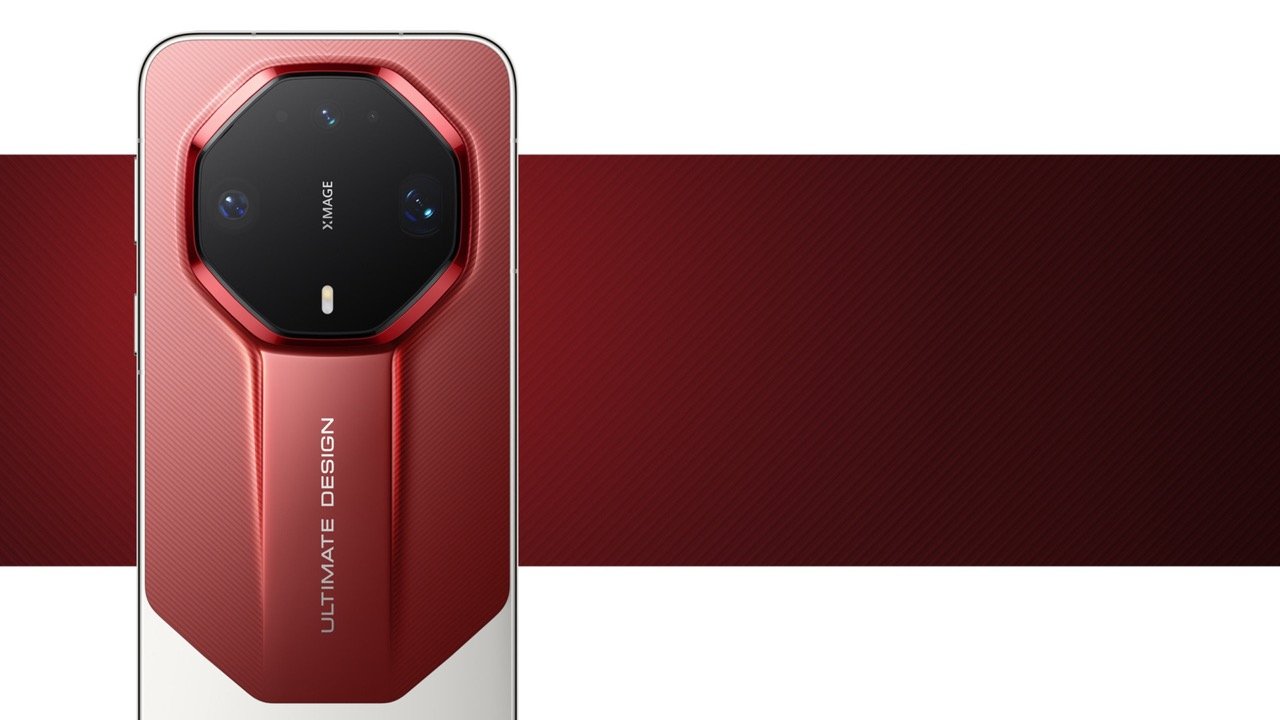
- Mate 90 RS Ultimate Design.
The Mate is Huawei’s top phone line, and it gets a new generation every year. The cheapest phone is the Mate 90 with 256GB of storage, at about USD 890 or KES 116,000. The most expensive phone is the RS with 2TB, at about USD 2,830 or KES 366,000.
Huawei hasn’t announced a launch outside China. All five run HarmonyOS 7, Huawei’s own operating system, which replaces Android on its China phones.
On 27th September we covered the leaks and a booking page that showed this date. We had flagged a Pro Max “collector’s edition” as possible, and that turned out to be the Premium Edition.

Prices
Huawei sells each phone in several memory and storage versions. Its price list has 14 of them.
| Phone | Memory and storage | Launch price (CNY) | USD | KES |
|---|---|---|---|---|
| Mate 90 | 12GB + 256GB | 5,999 | 890 | 116,000 |
| Mate 90 | 12GB + 512GB | 6,999 | 1,040 | 135,000 |
| Mate 90 | 12GB + 1TB | 8,499 | 1,260 | 164,000 |
| Mate 90 Pro | 12GB + 256GB | 6,999 | 1,040 | 135,000 |
| Mate 90 Pro | 12GB + 512GB | 7,999 | 1,190 | 154,000 |
| Mate 90 Pro | 16GB + 512GB | 8,499 | 1,260 | 164,000 |
| Mate 90 Pro | 16GB + 1TB | 9,999 | 1,490 | 193,000 |
| Mate 90 Pro Max | 12GB + 512GB | 9,499 | 1,410 | 183,000 |
| Mate 90 Pro Max | 16GB + 512GB | 9,999 | 1,490 | 193,000 |
| Mate 90 Pro Max Premium Edition | 16GB + 512GB | 10,999 | 1,640 | 212,000 |
| Mate 90 Pro Max Premium Edition | 16GB + 1TB | 12,999 | 1,930 | 251,000 |
| Mate 90 RS Ultimate Design | 16GB + 512GB | 12,999 | 1,930 | 251,000 |
| Mate 90 RS Ultimate Design | 16GB + 1TB | 14,999 | 2,230 | 289,000 |
| Mate 90 RS Ultimate Design | 16GB + 2TB | 18,999 | 2,830 | 366,000 |
For the same 12GB and 512GB, the Pro costs about USD 150 more than the Mate 90. It has a dual-layer OLED screen, which stacks two light-emitting layers so the panel can run brighter, and 100W wired charging in place of 66W. The Pro Max has a bigger 6.9-inch screen and a 200MP telephoto camera, the lens that zooms in on distant subjects.
The Premium Edition costs about USD 150 more than the 16GB Pro Max. For that it has a floating camera ring, tougher glass over the screen, and support for Huawei’s Z10 camera module. The RS adds a titanium frame and satellite calling.
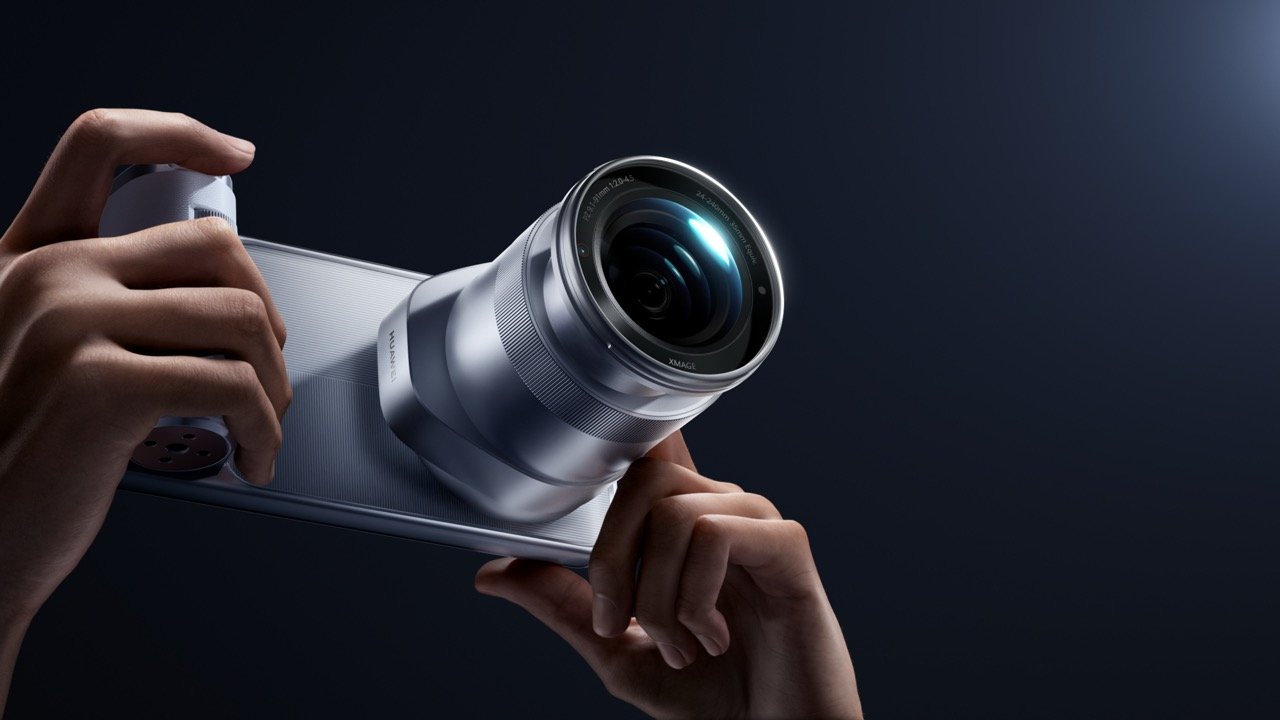
The Z10 is a clip-on camera with a 1-inch sensor, the part that captures the picture, and a 10x zoom lens that covers 24mm to 240mm in 35mm terms. Huawei’s page lists it for the Premium Edition and the RS. It starts at about USD 890 or KES 116,000 on its own, the same as the cheapest Mate 90, and it weighs about 346g, more than the 235g Premium Edition it clips onto. Huawei also sells the 1TB Premium Edition with the Z10 as one kit at about USD 2,900 or KES 376,000.
What changed since the Mate 80
The Mate 90 costs more than the Mate 80 did at launch in November 2025, version for version.
| Phone and version | Mate 80 at launch (CNY) | Mate 90 (CNY) | Difference (about USD / KES) |
|---|---|---|---|
| Mate 90, 12GB + 256GB | 4,699 | 5,999 | 190 / 25,100 |
| Mate 90 Pro, 12GB + 256GB | 5,999 | 6,999 | 150 / 19,300 |
| Mate 90 Pro Max, 16GB + 512GB | 7,999 | 9,999 | 300 / 38,600 |
| Mate 90 RS, 16GB + 512GB (Mate 80 RS had 20GB) | 11,999 | 12,999 | 150 / 19,300 |
What you get for that is a bigger battery in a body that hasn’t grown. The Mate 90 and Pro have 6,600mAh, up from 5,750mAh on the Mate 80 and Mate 80 Pro. The Pro Max, Premium Edition and RS have 6,800mAh, up from 6,000mAh. Those are typical capacities, the average for the model. The rated capacity, the guaranteed minimum, is 6,415mAh and 6,615mAh. On the typical figures, that is about 15% more battery in the Mate 90 and Pro, and about 13% more in the Pro Max, Premium Edition and RS. The Mate 90 is the same 7.95mm thick and 217g as the Mate 80. The Pro Max is slimmer and lighter than before, at 8.15mm and 234g against 8.25mm and 239g.
The cost is wireless charging speed. The Pro, Pro Max and RS charge wirelessly at 50W, down from 80W on their Mate 80 counterparts. Wired charging stays at 100W, and the Mate 90 stays at 66W wired and 50W wireless. Huawei gives no reason. Our reading is that wireless charging loses more of its power as heat than a cable does, and a bigger battery in a body this thin has little room to shed it. So if you charge on a stand or in the car, a Mate 90 Pro will be slower than a Mate 80 Pro, even on an 80W stand. On the cable it charges as fast as before, from a bigger battery.
The Pro Max also lost a lens. The Mate 80 Pro Max had two telephoto cameras: a 50MP lens at 4x and a 50MP periscope at 6.2x. A periscope lens sits sideways inside the phone and uses a mirror, which lets it zoom further in a thin body. The Mate 90 Pro Max has one 200MP telephoto at 4x. Huawei lists 8x as “optical-quality” zoom, a separate line from its 4x optical zoom. So if you photograph distant subjects, the Mate 80 Pro Max reaches further before it has to crop. The base Mate 90 changed too, to a 50MP telephoto at 4x from a 12MP periscope at 5.5x.
Huawei also says the new phones are faster: 27% for the Mate 90, 20% for the Pro and 31% for the Premium Edition and RS, each against its Mate 80 counterpart. These are Huawei’s own lab figures.
Specifications of Mate 90 Series
| Mate 90 | Mate 90 Pro | Mate 90 Pro Max | Pro Max Premium Edition | Mate 90 RS | |
|---|---|---|---|---|---|
| Screen | 6.75-inch OLED | 6.75-inch dual-layer OLED | 6.9-inch dual-layer OLED | 6.9-inch dual-layer OLED | 6.9-inch dual-layer OLED |
| Resolution | 2832 x 1280 | 2832 x 1280 | 2848 x 1320 | 2848 x 1320 | 2848 x 1320 |
| Refresh rate | 1 to 120Hz | 1 to 120Hz | 1 to 120Hz | 1 to 120Hz | 1 to 120Hz |
| Peak brightness claim | Not announced | 12,000 nits at 1% APL | 12,000 nits at 1% APL | 12,000 nits at 1% APL | 12,000 nits at 1% APL |
| Screen glass | 3rd-gen Kunlun | 3rd-gen Kunlun | 3rd-gen Kunlun | Xuanwu Kunlun | Xuanwu Kunlun |
| Chip | Kirin 9030 | Kirin 9035 | Kirin 9050 (12GB) or Kirin 9050 Pro (16GB) | Kirin 9050 Pro | Kirin 9050 Pro |
| RAM | 12GB | 12GB or 16GB | 12GB or 16GB | 16GB | 16GB |
| Storage | 256GB, 512GB or 1TB | 256GB, 512GB or 1TB | 512GB (1TB listed, no price) | 512GB or 1TB | 512GB, 1TB or 2TB |
| Main camera | 50MP, f/1.4 to f/4.0 | 50MP, f/1.4 to f/4.0 | 50MP, f/1.4 to f/4.0 | 50MP, f/1.4 to f/4.0 | 50MP, f/1.4 to f/4.0 |
| Ultra-wide camera | 40MP, f/2.2 | 40MP, f/2.2 | 40MP, f/2.2 | 40MP, f/2.2 | 40MP, f/2.2 |
| Telephoto camera | 50MP, f/2.2, 4x | 50MP macro, f/2.1, 4x | 200MP, f/2.6, 4x | 200MP, f/2.6, 4x | 200MP, f/2.6, 4x |
| Battery (typical / rated) | 6,600 / 6,415mAh | 6,600 / 6,415mAh | 6,800 / 6,615mAh | 6,800 / 6,615mAh | 6,800 / 6,615mAh |
| Wired / wireless charging | 66W / 50W | 100W / 50W | 100W / 50W | 100W / 50W | 100W / 50W |
| Size | 161.9 x 75.7 x 7.95mm | 161.9 x 75.7 x 7.95mm | 164.5 x 78.7 x 8.15mm | 164.5 x 78.7 x 8.15mm | 164.5 x 78.7 x 8.4mm |
| Weight | 217g | 222g | 234g | 235g | 248g |
| Satellite | BeiDou messaging | BeiDou messaging | BeiDou messaging | BeiDou messaging | Tiantong calling and BeiDou messaging |
| SIM cards | 2 nano-SIM + eSIM, 2 numbers active | 2 nano-SIM + eSIM, 2 numbers active | 2 nano-SIM + eSIM, 3 numbers active | 2 nano-SIM + eSIM, 3 numbers active | 2 nano-SIM + eSIM, 3 numbers active |
| Dust and water | IP68 and IP69 | IP68 and IP69 | IP68 and IP69 | IP68 and IP69 | IP68 and IP69 |
| Connections | Wi-Fi 7, Bluetooth 6.0, NFC, USB-C | Wi-Fi 7, Bluetooth 6.0, NFC, USB-C | Wi-Fi 7, Bluetooth 6.0, NFC, USB-C | Wi-Fi 7, Bluetooth 6.0, NFC, USB-C | Wi-Fi 7, Bluetooth 6.0, NFC, USB-C |
| Software | HarmonyOS 7.0 | HarmonyOS 7.0 | HarmonyOS 7.0 | HarmonyOS 7.0 | HarmonyOS 7.0 |
| In the box | Charger, cable, case | Charger, cable, case | Charger, cable, case | Charger, cable, case | Charger, cable, case |
| Software update promise | Not announced | Not announced | Not announced | Not announced | Not announced |
| Chip manufacturing process | Not announced | Not announced | Not announced | Not announced | Not announced |
| Main camera sensor size | 1/1.56-inch | 1/1.28-inch | 1/1.28-inch | 1/1.28-inch | Not announced |
| Other camera sensor sizes | Not announced | Not announced | Not announced | Not announced | Not announced |
| Price outside China | Not announced | Not announced | Not announced | Not announced | Not announced |
Against the iPhone 18 Pro Max
| Mate 90 Pro Max | iPhone 18 Pro Max | |
|---|---|---|
| Screen | 6.9-inch dual-layer OLED, 1 to 120Hz | 6.9-inch OLED, up to 120Hz |
| Brightness claim | 12,000 nits at 1% APL | 1,000 nits typical, 1,600 HDR peak, 3,000 outdoor peak |
| Chip | Kirin 9050 or 9050 Pro | A20 Pro |
| Main camera | 50MP, f/1.4 to f/4.0 | 48MP, f/1.48 to f/4.0 |
| Telephoto | 200MP, 4x, plus 8x “optical-quality” | 48MP, 4x, plus 8x “optical-quality” |
| Battery (rated) | 6,615mAh | 5,391mAh with a SIM tray, 5,567mAh eSIM-only |
| Video playback claim | Up to 45 hours | Up to 45 hours (eSIM-only model) |
| Wired / wireless charging | 100W / 50W | 50% in about 15 minutes with a 60W adapter / up to 25W |
| Thickness and weight | 8.15mm, 234g | 8.75mm, 249g |
| Starting price | CNY 9,499 for 512GB: about USD 1,410 or KES 183,000 | USD 1,299 for 256GB: about KES 168,000. USD 1,499 for 512GB: about KES 194,000 |
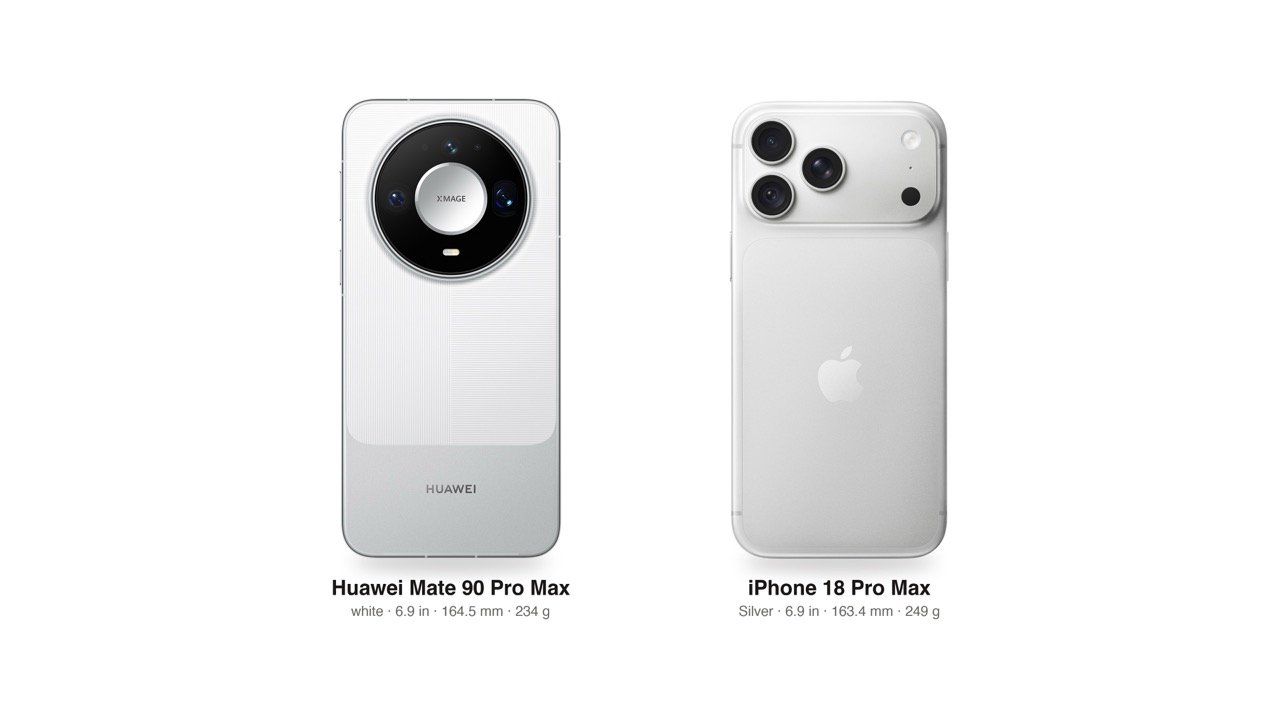
Huawei’s launch price includes tax, while Apple’s US price is before tax, so the prices aren’t on the same basis. The table also holds numbers that don’t compare. Huawei’s 12,000 nits is a peak with only 1% of the screen lit, while Apple’s 3,000 nits is its outdoor peak under a different test. Both phones claim up to 45 hours of video, but Huawei tested a 2 hour 34 minute downloaded video, and Apple tested a 2 hour 23 minute HDR film with Bluetooth headphones connected, so the matching 45 hours doesn’t mean matching battery life. The battery sizes do compare, since both are rated capacities, and we covered Apple’s in two pieces last month.
On cameras there’s nothing independent to compare yet. DXOMARK, the camera-testing lab, hasn’t published a score for any Mate 90. The top of its camera ranking belongs to Huawei’s Pura 80 Ultra, which scored 175 to the iPhone 18 Pro’s 172, as we reported two weeks ago.
Availability and rivals
Huawei’s Kenya site lists only the Pura 90s Pro and Pro Max, with no buy button on either, and a Mate 90 page there returns a 404 error. Some Kenyan shops stock Huawei’s flagships. Avechi for example lists the Mate 80 Pro, the Mate X7 and the Mate XT 2 Ultimate, and no Mate 90 yet.
If you’re expecting the Mate 90 series, looking at the Mate 80 shows how this can go. It launched in China in November 2025, and only the Mate 80 Pro followed outside China, in February 2026, three months later. That global phone runs EMUI 15, Huawei’s Android-based software, instead of HarmonyOS, and comes in one version, 16GB and 512GB. Huawei hasn’t said whether the Mate 90 will follow.
The Mate 90 Pro Max has to compete with the Honor, vivo and Xiaomi flagships that launched in the last two weeks. At 12GB and 512GB, Honor’s Magic 9 Pro Max costs about USD 1,040 or KES 135,000, and vivo’s X500 Pro Max and Xiaomi’s 18 Pro Max cost about USD 1,190 or KES 154,000. The Huawei costs about USD 220 to 370, or KES 28,900 to 48,200, more than the three, and its battery is the smallest of the four: 8,000mAh to 8,800mAh on the others against 6,800mAh.






Join the discussion