

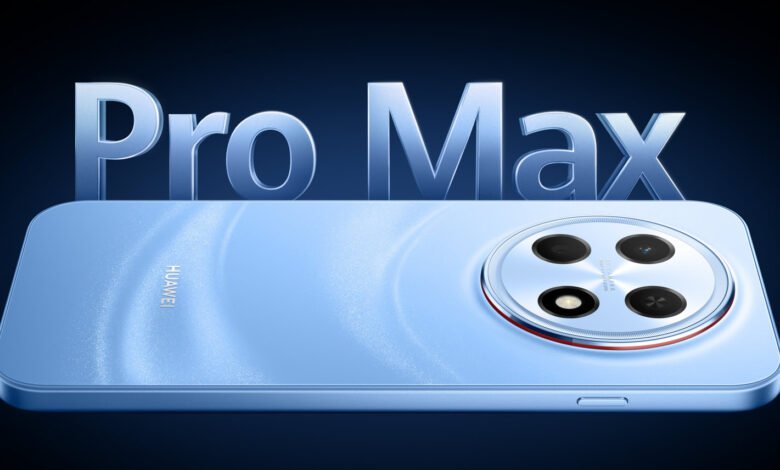
Choosing storage on Huawei’s Enjoy 100 Pro Max also means choosing a processor. The 512GB version uses Kirin 8020, while the 128GB and 256GB versions use Kirin 8020A.
The Chinese-market phone runs HarmonyOS 7, Huawei’s operating system, and has a battery with an 8,800mAh typical capacity.
All three configurations have 8GB of RAM, the working memory used by running apps. Storage is the space for installed apps and saved files. Huawei’s configuration footnote makes the distinction clear:
| Configuration | Processor |
|---|---|
| 8GB RAM / 128GB storage | Kirin 8020A |
| 8GB RAM / 256GB storage | Kirin 8020A |
| 8GB RAM / 512GB storage | Kirin 8020 |
These are factory configurations: moving from 128GB to 256GB keeps Kirin 8020A, while choosing 512GB changes both the storage capacity and the processor model.

Kirin 8020 vs Kirin 8020A: what Huawei’s figures establish
Huawei gives no technical breakdown of the differences between the chips or a direct performance comparison on its product and specification pages. We haven’t tested the configurations against each other, so we can’t tell you whether the 512GB model opens apps faster or how its battery life compares.
Huawei does advertise an improvement of up to 62% in overall phone performance. Its test conditions specify a 512GB Enjoy 100 Pro Max running its factory version of HarmonyOS 7 against a 512GB Enjoy 90 Pro Max running its factory version of HarmonyOS 6. The test applications were October 2026 versions.
The comparison changes both the phone generation and the operating system, so it cannot isolate the processor’s contribution. It doesn’t compare Kirin 8020 with Kirin 8020A, so it gives no measurement of the performance gap between the current storage options.
Battery capacity and screen brightness
Huawei lists 8,800mAh typical battery capacity and 8,560mAh rated capacity. These are two capacity figures for the same battery. The typical figure is up by 300mAh, or about 3.5%, from the Enjoy 90 Pro Max’s 8,500mAh.
The new phone supports wired charging at up to 40W with compatible Huawei charging equipment. The OLED display, whose pixels produce their own light, measures 6.84 inches diagonally as a full rectangle and has a resolution of 2756 × 1272 pixels. Its refresh rate goes up to 120Hz, meaning it can refresh the image up to 120 times a second, though the actual rate varies with the app or game.
Huawei also advertises 8,000 nits peak brightness at 1% APL, measured in its laboratory. Nits measure screen brightness. APL means average picture level, a measure of how light or dark the test image is overall; at 1% APL, the image is very dark overall. The claim doesn’t establish how bright a fully illuminated screen can remain during outdoor use.
The predecessor’s advertised 4,000-nit peak uses a different condition, 20% APL. Calling the new screen twice as bright would ignore that difference. Neither figure, on its own, is a measurement of everyday full-screen brightness.
Earlier this month, we explained the China scope of Huawei’s HarmonyOS phone features. The Enjoy 100 Pro Max specifications here are for China. Anyone considering an import should check app compatibility and local warranty terms before ordering.



Join the discussion