
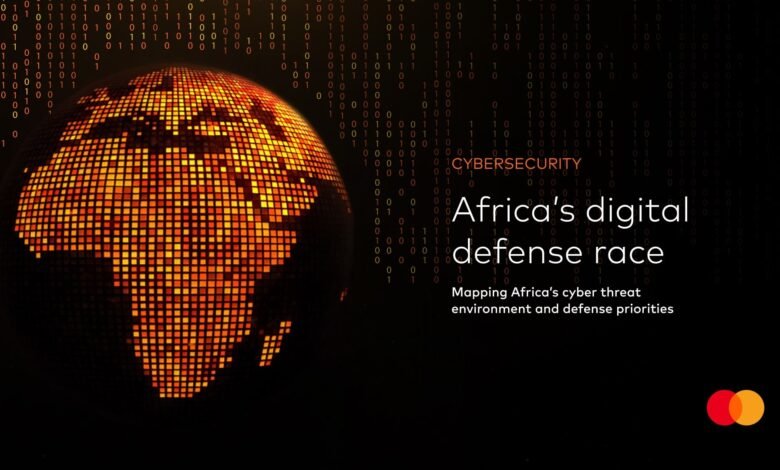
Cyberattacks in Africa grew by 421% between 2016 and 2025, against 307% globally. The figures come from Africa’s Digital Defense Race, a whitepaper Mastercard commissioned and released on 12th October 2026. It looks at the whole continent and four countries in detail: Kenya, Nigeria, South Africa and Morocco.
A 421% rise means Africa saw about five times as many attacks in 2025 as it did in 2016. Globally, it was about four times. Mastercard’s point is that the attacks grew about as fast as the digital services they target. Over the same ten years, mobile money users in Africa grew 5.9 times, digital banking users 4.7 times and the e-commerce market 5.3 times. So the more people pay, bank and shop on their phones, the more there is for criminals to take.
The 2025 count comes from Cyber Insights, Mastercard’s own threat-intelligence platform. Last year it recorded 69,236 cyber events aimed at African organisations, roughly one every eight minutes.
If 69,236 sounds small, it’s because Kenyans are used to much bigger numbers. KE-CIRT, the national cyber incident response team run by the Communications Authority of Kenya (CA), detected 2,355,938,192 cyber threats between April and June 2026 alone. The two figures count different things, so you can’t set one against the other. About 96% of KE-CIRT’s count for that quarter falls under what the CA calls system vulnerabilities, so it mostly measures how much is exposed and probed on Kenyan networks. Mastercard’s figure counts events its platform saw aimed at organisations, and what it adds is the ten-year trend.

Where the attacks landed
Nigeria, South Africa, Morocco and Kenya together drew 54.7% of the cyber events Mastercard observed across Africa in 2025. South Africa’s financial sector on its own was the target of 12.6% of all of them. Technology companies, government bodies and financial services firms accounted for 44% of the activity. As for what attackers were after, personal information, financial information and customer-facing services made up 27% of targeted assets. Where Mastercard could tell who was behind an event, more than 60% were linked to blackhat (criminal) hackers and organised cybercriminal groups.
Kenya gets one sentence in Mastercard’s release: the report “highlights the importance of strengthening resilience around the systems that support financial inclusion and digital growth”. In Kenya that most likely means mobile money. Shabir Ahmed, Mastercard’s senior vice president and Customer Solutions Center lead for Africa, put it more directly when he spoke about the report. “Mobile money has become national infrastructure in Kenya,” he said.
Neither the release nor Mastercard’s summary page gives Kenya’s own share of the 69,236 events, or says which Kenyan sectors were hit. The full report is behind a sign-up form on Mastercard’s site.
Attacks on mobile money are already costing Kenyans. In August we covered INTERPOL’s estimate that Kenyans lost KES 491.6 million to SIM swap fraud in 2025. In a SIM swap, a fraudster gets your number moved to a new SIM card, then uses the codes sent to it to empty your M-Pesa and bank accounts.
Skills and police work
The report’s main answer is people: Africa has about 200,000 unfilled cybersecurity jobs, on security company Check Point’s count, and Mastercard calls talent “the clearest opportunity for investment”.
It also points to police working across borders. Between June and August 2025, INTERPOL’s Operation Serengeti 2.0 brought together investigators from 18 African countries and the UK. They arrested 1,209 people and recovered USD 97.4 million, or about KES 12.6 billion at KES 129.78 to the dollar on 12th October 2026. Kenya took part, though INTERPOL’s release names no Kenyan case. A later operation did: in February we reported that Operation Red Card 2.0 led to 27 arrests in Kenya over fake “global investment” schemes.
Mastercard’s own stake
Mastercard is in the cybersecurity business itself. In September 2024 it agreed to buy threat-intelligence company Recorded Future for USD 2.65 billion, or about KES 344 billion, and completed the deal that December. Its own projection, from a Genesis Analytics report it commissioned in 2025, puts Africa’s digital payments economy at USD 1.5 trillion by 2030, about KES 195 trillion. Mastercard earns from that market, and this report says it needs defending.
The whitepaper is one of the first things to come out of the Africa Cybersecurity Center of Excellence, which Mastercard launched in June. It brings governments and companies together to share threat intelligence and run practice drills for attacks. When we covered the launch, Kenya wasn’t part of its first phase, which started with South Africa and Nigeria. This release doesn’t say Kenya has been added.
So for anyone running a bank, a Sacco or a payments app in Kenya, the useful part of this report is the trend. Attacks on African organisations grew about as fast as digital payments did, and most of the ones Mastercard could trace came from criminal hackers and organised gangs. What Kenyan readers don’t get yet is a Kenyan number, even though Kenya is one of the four countries Mastercard chose to study.







Join the discussion