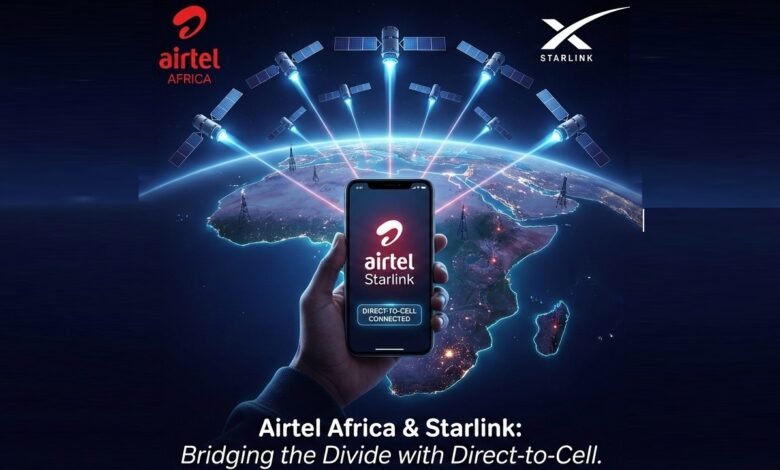

Airtel Africa has officially cemented its partnership with SpaceX’s Starlink to bring Direct-to-Cell satellite connectivity to its 174 million customers. The move, announced yesterday, positions Airtel as the first mobile network operator in Africa to leverage Starlink’s low-Earth orbit (LEO) constellation to plug coverage gaps where terrestrial towers simply can’t reach.
This latest development follows an earlier announcement back in May 2025, and signals a major escalation in the battle for connectivity supremacy on the continent, particularly here in Kenya where Safaricom remains the dominant player.
“Through this partnership, Airtel Africa customers with compatible smartphones in regions without terrestrial coverage can have network connectivity through Starlink, which is the world’s largest 4G connectivity provider (by geographic reach).” Airtel Africa said.
Direct-to-Cell: How it works and rollout timeline
The service is slated to begin in 2026. Initially, it won’t be the full broadband experience; the rollout will start by supporting data for “select applications” and text messaging. This mirrors the global rollout strategy for Direct-to-Cell, ensuring that users in remote areas can at least maintain essential communications.
Following the initial phase, the partnership aims to scale up to high-speed broadband. Starlink’s statement promises support for their next-generation satellites, which are capable of delivering data speeds “20x improved” over current standards for direct smartphone connectivity.
"In partnership with Airtel Africa, Starlink Direct to Cell will connect more than 170 million people in Africa across 14 countries, powering life-saving connectivity when it’s needed most. This marks the sixth continent for the satellite-to-mobile service and expands our mission to end mobile dead zones. The service will begin by delivering data that enables voice, video and messaging, and will advance to providing high-speed broadband service to smartphones with 20x improved data speeds."
Crucially, this technology targets standard, compatible smartphones. You won’t need a special satellite phone or bulky external hardware. If you are in an Airtel market without a cell tower signal but have a clear view of the sky, your phone should theoretically connect to one of Starlink’s 650+ satellites dedicated to this service.
Airtel Africa MD Sunil Taldar noted that the tech “complements the terrestrial infrastructure” and reaches areas where deploying traditional towers is challenging.
“Airtel Africa remains committed to delivering great experience to our customers by improving access to reliable and contiguous mobile connectivity solutions. Starlink’s Direct-to-Cell technology complements the terrestrial infrastructure and even reaches areas where deploying terrestrial network solutions are challenging. We are very excited about the collaboration with Starlink, which will establish a new standard for service availability across all our 14 markets.”
Starlink VP of Sales Stephanie Bednarek described the deal as a major step toward eliminating mobile dead zones across Africa, marking the sixth continent for Starlink’s satellite-to-mobile service.
“For the first time, people across Africa will stay connected in remote areas where terrestrial coverage cannot reach, and we’re so thrilled that Starlink Direct to Cell can power this life-changing service. Through this agreement with Airtel Africa, we’ll also deliver our next-generation technology to offer high-speed broadband connectivity, which will offer faster access to many essential services.”
Airtel is taking the fight to Safaricom
While this is a pan-African announcement covering 14 markets, the implications for Kenya are significant. Safaricom has long held the crown for the best network coverage, a key selling point that justifies its premium pricing. By partnering with Starlink, Airtel is effectively outsourcing its “remote coverage” strategy, potentially nullifying Safaricom’s geographic advantage without spending billions on remote towers.
This comes at a time when the fixed internet market is also heating up. As we reported last week, Safaricom still commands a massive 35.6% of the fixed data market, while Starlink, though growing, sits at around 0.8% (approx. 19k subscriptions). Last month, Vodacom Group, which holds a 35% stake in Safaricom, also announced its strategic partnership with Starlink to deliver high-speed satellite broadband across Africa, marking a significant step toward bridging the continent’s digital divide. Similar to Airtel Africa, this agreement integrates Starlink’s low-Earth orbit (LEO) satellite technology into Vodacom’s existing mobile network infrastructure to expand rural connectivity and enhance network performance in underserved areas.
However, Airtel isn’t sitting idle either. Beyond this satellite deal, Airtel has previously signaled plans to enter the fixed internet space in Kenya courtesy of its 5G smart routers. Meanwhile, Safaricom is trying to lock in users by “tokenizing” its home fibre, introducing flexible pay-as-you-go hourly and daily plans to cater to the kadogo economy.
Voice battles and mobile data costs
Airtel’s aggressive moves align with recent user behaviour trends. Recent stats show that while Safaricom dominates volume, Airtel users are actually the most “talkative,” with significantly longer average call durations (2.8 minutes vs Safaricom’s 1.6 minutes).
However, the elephant in the room remains the cost of data. A World Bank report highlighted just this week that Kenya’s mobile data prices remain among the most expensive in the region due to a lack of competition. If Airtel can leverage Starlink to offer consistent connectivity without passing on astronomical costs, it could finally offer a compelling alternative to The Big Green for heavy data users in peri-urban and rural Kenya.
Regulatory approval is the final hurdle. The rollout will proceed “in line with country-specific regulatory approvals,” which in Kenya involves the Communications Authority (CA). Given the government’s recent warming up to Starlink as a competitor to keep local telcos on their toes, approval seems likely.
For now, we wait for 2026.