


If you’ve ever tried to load a single email attachment while flying over the Indian Ocean, you know the struggle. You pay KES 2,500 ($20) for a “Wi-Fi pass,” connect, and then watch a spinning wheel for three hours until you start your descent.
That era is officially dead – at least if you’re flying Qatar Airways.
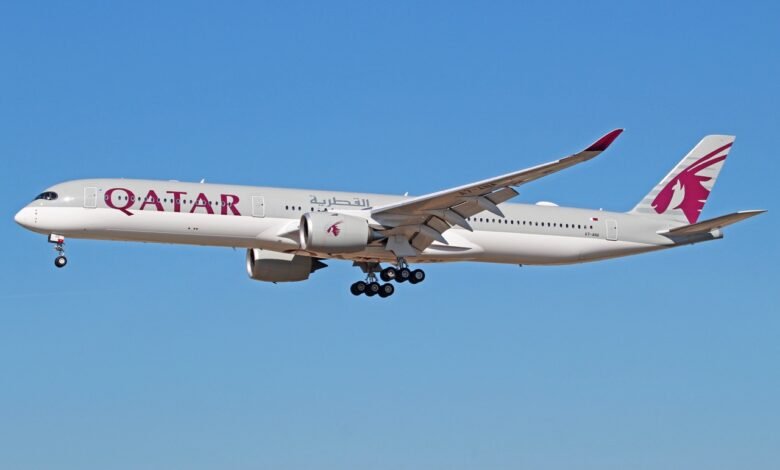
The airline has just successfully installed Starlink on a Boeing 787 Dreamliner, a milestone that sounds like marketing fluff but is actually a genuine technical marvel. This completes a massive trifecta: alongside their fully upgraded Boeing 777 and Airbus A350 fleets, nearly 120 of their widebody jets now carry internet that is statistically faster – and definitely lower latency – than the average home connection in many homes.
Here is why this matters for your next trip out of JKIA, the physics behind the upgrade, and the ruthless business strategy driving it.
The “Straw” Problem: Why Old AirPlane Wi-Fi Sucked
To understand the hype, you have to understand why old in-flight Wi-Fi was trash.
Traditional aircraft internet used Geostationary (GEO) satellites sitting 35,000 kilometres away. When you clicked a link, the signal had to travel 70,000 km round-trip. It’s like trying to drink a milkshake through a straw that is 35,000 km long – no matter how hard you suck (bandwidth), it takes forever for the shake to hit your mouth (latency).
Starlink changes the physics. It uses Low Earth Orbit (LEO) satellites floating just 550 km above the planet.
- Old Latency: ~600+ milliseconds (painful lag).
- Starlink Latency: ~25–40 milliseconds (instant, like home fibre).
The Engineering Flex: The “Plastic Plane” Problem
The most impressive part of this news isn’t the speed; it’s the specific aircraft involved. The Boeing 787 Dreamliner is unique because its fuselage is made of Carbon-Fibre Reinforced Polymer (CFRP), not traditional aluminium.
You can’t just drill holes and bolt antennas onto carbon fibre like you do with metal. Carbon fibre doesn’t conduct electricity well, which makes grounding the antenna against lightning strikes a nightmare.
Qatar Airways and Starlink had to engineer a specific installation kit – likely a custom shroud and grounding plate – to bond the antenna without compromising the hull’s structural integrity. By cracking this code, they have unlocked high-speed internet for their “smaller” long-haul jets, the ones often used for routes like Nairobi-Doha that don’t always get the massive A380.
Scale: The “Beta Tester” Volume
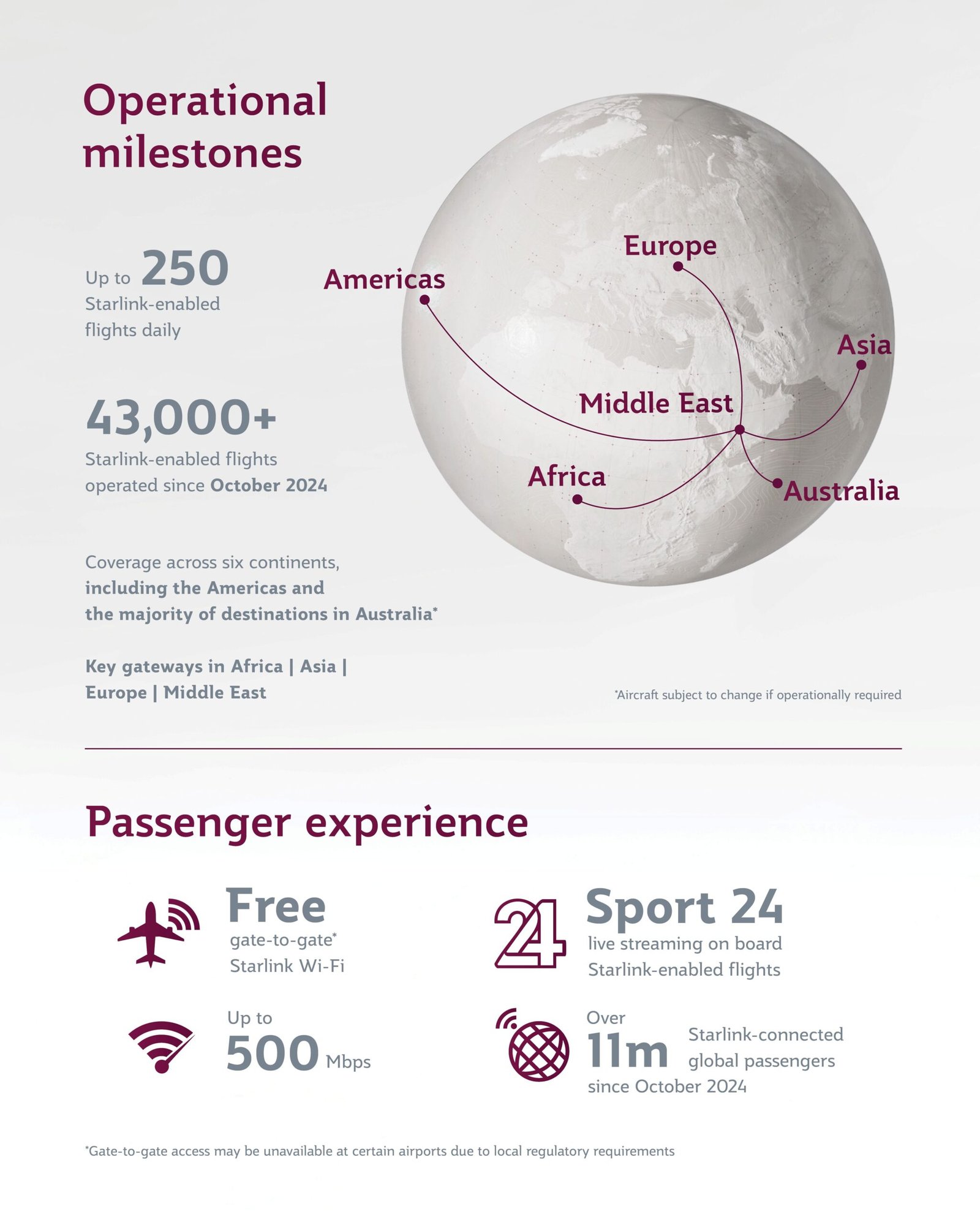
If you think this is just a small trial, look at the numbers. In 2025, Starlink connected 21 million passengers globally – and Qatar Airways accounted for 10 million of them.
That means nearly 50% of all people using Starlink in the sky last year were on a Qatar Airways jet. They aren’t just testing the tech; they are the primary driver of its adoption. They even retrofitted their entire Airbus A350 fleet in just eight months – a logistical sprint that usually takes airlines years of hangar time. (However, competitors including Emirates and United Airlines are rapidly deploying Starlink across their fleets in 2026).
The “Loss Leader” Strategy
Why is Qatar Airways doing this for free? It’s not out of the goodness of their hearts. They are turning connectivity into a weapon.
The airline heavily leverages its “World’s Best Airline” status (won nine times via Skytrax). Budget airlines need that KES 2,500 Wi-Fi revenue to survive. Qatar uses its premium ticket prices to subsidize the internet, effectively making connectivity a standard amenity like food or pillows.
They know that business travellers, entrepreneurs, and Gen Z tourists will choose a flight based on connectivity. The plane has effectively become a co-working space that moves at 900 km/h. Crucially, this isn’t just for London or New York routes; the rollout explicitly covers flights to Africa, Asia, and Australia, meaning flights into hubs like Nairobi are getting the same hardware treatment as the trans-Atlantic flagships.
How to Know If Your Flight Has Starlink
Before you board, here is how to spot if you’re getting the “good Wi-Fi”:
- Check the Aircraft: If it’s a Boeing 777 or Airbus A350, you are almost certainly set.
- Check the 787 Variant: If you are on a Boeing 787-8 (the smaller Dreamliner), you have a good chance. The larger 787-9s are likely next in line.
Bottom line: We are rapidly approaching a world where “disconnecting” on a plane is a choice, not a technical limitation. Enjoy the excuse while it lasts.