

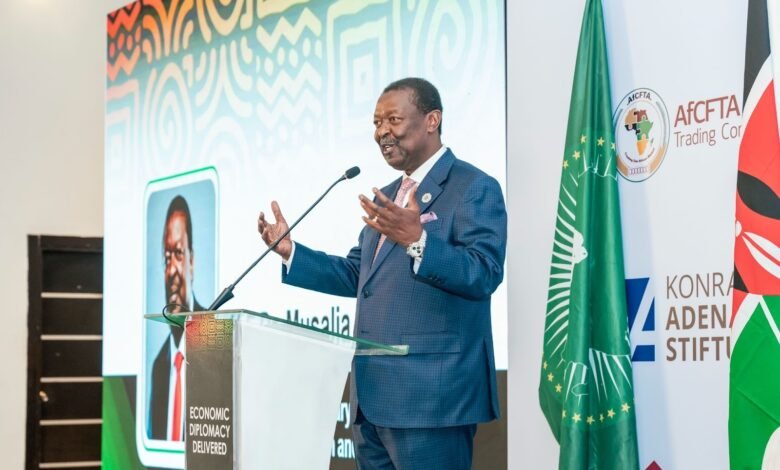

In a move to digitise the often opaque world of government-to-government commercial dealings, Kenya has unveiled a dual-platform tech stack designed to turn African embassies into active trade nodes.
Launched this week in Addis Ababa alongside the 39th AU Summit, the initiative introduces two platforms – BiasharaLink and Deal House – aimed at solving the continent’s most glaring economic inefficiency: the “execution gap” between diplomatic goodwill and signed contracts.
The News in Brief:
- The Tech: Two interconnected platforms. BiasharaLink acts as a CRM for diplomats to capture leads; Deal House acts as a digital investment bank to structure and close them.
- The Problem: African embassies generate roughly 3,500 trade enquiries monthly, but less than 1% convert into deals due to a lack of follow-through infrastructure.
- The Partners: The Government of Kenya (Ministry of Foreign Affairs), Real Sources Africa (Tech/Infrastructure), and Equity Group (Financing).
- The Goal: To operationalise the African Continental Free Trade Area (AfCFTA) by moving from policy frameworks to transactional execution.
Why This Matters:
To understand the significance of this launch, one must first understand the inefficiency it attempts to solve.
For decades, economic diplomacy in Africa has been analogue. An ambassador might meet a potential investor at a cocktail reception, exchange business cards, and send a manual report to the Ministry. These leads, numbering in the thousands, often die in bureaucratic silos.
Felix Chege, CEO of Real Sources Africa (RSA), the firm powering the tech, provided a staggering data point at the launch:
“We realised that our embassies collect 3,500 trade enquiries a month, but the closure rate of deals was less than 1 per cent. Our main goal is to build the infrastructure… that can drive trade.”
This gap is what the new stack targets. It is an attempt to industrialise serendipity, turning casual diplomatic encounters into trackable, bankable data points.
How the Ecosystem Works:
The system is split into two distinct layers, mimicking a sales funnel:
1. The Capture Layer: BiasharaLink
Think of this as a specialised Salesforce for diplomats. It is deployed to over 1,000 diplomatic missions. When a Trade Attaché receives an enquiry (e.g., a Ghanaian textile firm looking for Kenyan cotton), they input the raw data here. It standardises the “ask,” categorising it by sector, volume, and AfCFTA priority alignment.
2. The Execution Layer: Deal House
This is where the platform pivots from record-keeping to transaction-making. Once a lead is validated in BiasharaLink, it migrates to Deal House. Here, the system:
- Matches the enquiry with verified counterparties.
- Structures the deal (moving from a casual conversation to a Memorandum of Understanding or contract).
- Connects Financing: This is the critical “last mile.” By integrating with financial partners like Equity Group, the platform allows banks to see the pipeline and offer trade finance, letters of credit, or working capital to facilitate the transaction.
James Mwangi, CEO of Equity Group, described the platforms as “the day-to-day machinery that enables enquiries to turn into bankable and trackable deals,” effectively calling it a “trade superhighway.”
The Shift to “Digital Economic Diplomacy”:
This launch signals a pivot in Kenya’s foreign policy under Prime Cabinet Secretary Musalia Mudavadi. By moving from “representation” to “execution,” the Ministry is effectively asking diplomats to act as business development officers.
Why it could work:
- Standardisation: Currently, trade data is fragmented. A unified digital standard allows for better data mining and policy adjustment.
- SME Inclusion: Large corporations have their own networks. This platform specifically targets SMEs and women-led businesses who lack the budget for international business development but need access to cross-border markets.
- AfCFTA Integration: The platforms are designed to align with the Continental Free Trade Area protocols, potentially smoothing the friction of intra-African tariffs and regulations.
Potential bottlenecks:
- Adoption Inertia: Technology is only as good as its users. Will career diplomats, accustomed to traditional statecraft, embrace a high-frequency trading style workflow?
- Data Quality: A system entering 3,500 enquiries a month requires rigorous vetting. If “garbage data” (unserious enquiries) floods BiasharaLink, the Deal House execution rate will remain low.
- Interoperability: While Kenya is leading, trade requires two hands to clap. Success depends on how well these platforms integrate with systems in partner nations like Ethiopia, Ghana, or South Africa.
The Bigger Picture:
The timing is deliberate. With the global economy fracturing into protectionist blocs, AfCFTA Secretary General Wamkele Mene noted that Africa has “no alternative but to succeed” in building a strong domestic market.
By digitising the handshake, Kenya is betting that software can do for African trade what mobile money did for African banking: leapfrog legacy infrastructure to create a hyper-connected, efficient ecosystem.