

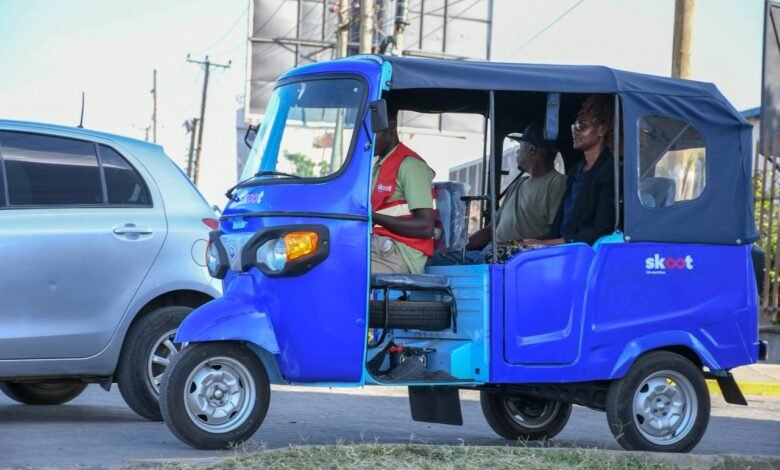

In a significant move to electrify Kenya’s bustling paratransit sector, Skoot Technology has officially launched the Skoot e3W, a smart electric three-wheeler designed to replace the ubiquitous, noisy, and polluting diesel tuk-tuks.
This isn’t just another EV launch; it is a tripartite ecosystem play. The initiative combines a vehicle supplied by the Nairobi heavy-hitter Car & General, battery-swapping tech from India’s Sun Mobility, and a digital lease-management platform from Skoot.
Here is a deep dive into the technology, the economics, and the potential impact of this launch.
The Technology: A “Smart” Hybrid of Hardware and Software
To understand the Skoot e3W, you have to look past the chassis. While the vehicle itself is a Piaggio-designed body, known for durability on Kenyan roads, the “engine” has been completely rethought.
1. The Battery Swap Advantage
Unlike personal EVs that sit in a garage charging overnight, a commercial tuk-tuk is a workhorse that cannot afford downtime.
- The Problem: Charging a standard EV battery can take hours – time a driver isn’t earning money.
- The Solution: The e3W uses Sun Mobility’s ‘ultrafast’ battery swapping platform. Instead of plugging in, drivers pull into a station and swap their depleted battery for a fully charged one in minutes.
- The Stats: Sun Mobility’s tech has been stress-tested over 465 million kilometres globally, powering over 60,000 vehicles.
2. The Digital Nervous System
The “smart” aspect comes from Skoot’s unified app. This is the central nervous system for the driver, handling:
- Lease Management: Drivers manage their daily or weekly rental payments directly on their phone.
- Logistics: The app displays swap station locations and even provides access to delivery contracts, allowing drivers to pivot between passenger transport and logistics.
- Earnings: It tracks income, aiming to stabilise what is traditionally a volatile cash-based profession.
The Economics: Does the Math Work for the Driver?
For a tuk-tuk driver in Nairobi, environmental benefits are a luxury; cost savings are a necessity. Skoot’s pitch is heavily financial.
The Daily Ledger: According to Skoot’s data, an average driver covers roughly 150 km per day.
| Cost Component | Traditional Diesel Tuk-Tuk | Skoot e3W (Electric) | Savings/Difference |
| Energy/Fuel Cost | ~KES 850 (Diesel) | ~KES 650 (Swap Fees) | ~30% Cheaper |
| Maintenance | Variable (often high) | Included in Lease | Stabilised Cost |
| Lease Cost | Variable | Starts at KES 1,200/day | Predictable |
Insight: The reported 30% saving on fuel is significant for a low-margin business. However, the real game-changer is likely the “Maintenance Included” model. Internal combustion engines (ICE) vibrate, causing wear and tear. Electric motors are smoother and have fewer moving parts, theoretically reducing downtime.
Who Does What?:
This launch is a case study in specialisation. No single company is trying to do everything.
- Car & General‘s Role: Distributor and Service Support.
- Context: They have been in East Africa since 1936 and pioneered the tuk-tuk taxi model in 2002. They provide the physical Piaggio vehicles and the servicing network, ensuring drivers aren’t left stranded with broken tech.
- Sun Mobility‘s Role: Battery Technology and Infrastructure.
- Context: Backed by giants like Bosch and Vitol, they bring the interoperable “Swap Point™” infrastructure. They have already deployed over 1,000 swap points in India, bringing mature tech to the Kenyan market.
- Skoot‘s Role: Platform and Customer Interface.
- Context: Skoot acts as the mobility layer, connecting the driver to the vehicle, the work (delivery contracts), and the payments. CEO Sacha Cook positions the company not just as a vehicle provider, but as a platform for “clean mobility, smart energy, and digital commerce”.
The Pilot Phase:
The companies didn’t just drop this tech into Nairobi traffic. Over the last 24 months, they conducted trials to adapt the solution to local conditions.
- Stress Testing: The pilots involved “maintenance stress testing” and “swap cycle durability monitoring” to ensure the batteries could handle Nairobi’s specific road conditions and traffic loads.
- Driver Feedback: Benson K., a pilot driver, noted that the system stabilised his earnings and reduced time wasted on maintenance and refuelling.
Next Steps:
Skoot has signaled this is just the beginning. CEO Sacha Cook teased that “smart gas and 2-wheelers are coming next,” hinting at a broader ecosystem that integrates home energy and personal transport.
What to Watch For:
- Infrastructure Rollout: Success depends entirely on the density of Sun Mobility’s swap stations. If a driver has to drive 5km to swap a battery, the efficiency gains are lost.
- Grid Reliability: While battery swapping mitigates the need for fast charging points, the stations themselves need reliable power from the grid to recharge the inventory.
For now, the Skoot e3W represents a mature, data-backed attempt to solve the “last mile” problem in African cities, not by reinventing the wheel, but by electrifying it.