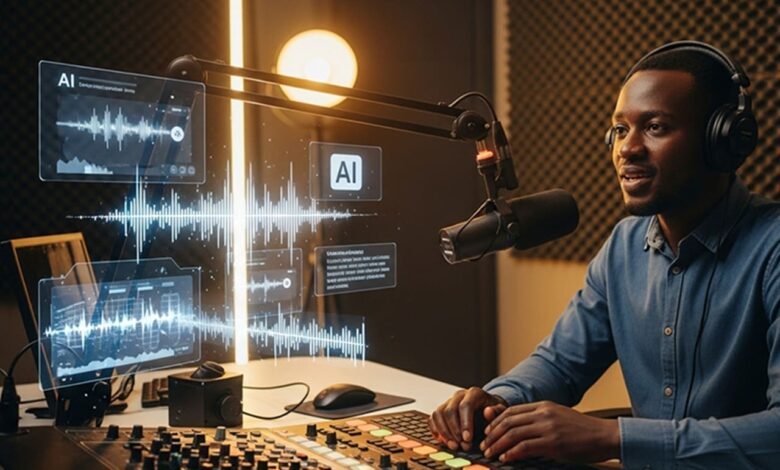

Every year on World Radio Day, brands suddenly remember radio exists. Even the Kenyan government joined in the fun with the first digital radio trials in Nairobi. On the other hand, Safaricom chose to spotlight something actually worth discussing: how AI is creeping into radio studios and quietly rewriting job descriptions.
The company’s feature, “The AI in your radio,” leans on voices from across Kenya’s broadcast industry, including presenters at Radio 47, Nation FM, Classic 105, and producers at Radio Africa Group. The consensus is predictable but telling: AI has not replaced radio professionals outright, but it has replaced specific tasks. In some cases, entire supporting roles have effectively collapsed into software.
Here’s what that looks like in practice.
1. Voiceover artists for basic spots
One of the most direct replacements is in simple voice work. AI voice generators are now producing continuity announcements, basic commercials, and filler reads that previously required freelance or in-house voiceover talent. These are not prime-time personality slots, but they were paid gigs. For routine audio spots, synthetic voices are now “good enough,” and for many stations, good enough is financially irresistible.
2. Transcribers and junior newsroom assistants
Newsrooms once relied on manual transcription of interviews and field audio. That meant either dedicated transcribers or producers spending hours converting speech to text. AI-powered speech-to-text tools now handle this in minutes. Newsreaders like those at Classic 105 describe using audio-to-text systems to quickly structure bulletins and decide angles. The transcription function, at least in its basic form, is effectively automated.
3. Script drafting and bulletin prep
AI tools are also being used to draft scripts, summarize stories, and refine copy. Producers and presenters previously had to research, structure, and edit bulletins largely by hand. Now, large language models can generate a first draft in seconds. The human role shifts from writer to editor. In smaller newsrooms, that change means fewer hands are needed to prepare a polished 1 PM bulletin.
4. Audio editing for routine segments
Basic audio cleanup, trimming, and leveling no longer require advanced technical skill. AI-assisted editing tools can remove background noise, tighten pauses, and enhance clarity automatically. What once required a technically proficient sound editor can now be handled by a producer with the right software. The high-end creative sound design role remains, but routine editing has been simplified dramatically.
5. Social media summary and show notes writers
Radio teams are increasingly using AI to generate show summaries and social media captions. This is minor on paper, but it eliminates repetitive digital marketing tasks that once took up staff time. For stations trying to maintain an online presence, this matters.
6. Scheduling and information gathering
Producers used to spend hours coordinating schedules and compiling background information for segments. AI tools now assist with research and organization. While not a full replacement for producers, it reduces the labor intensity of the role and enables leaner teams.
So how many roles are actually affected? At minimum, six core functions have been either partially automated or significantly simplified: voiceover production, transcription, script drafting, routine audio editing, social media summarization, and research/scheduling support. In smaller stations, these functions might have been handled by separate junior staff. Today, two people in a newsroom can produce a full bulletin with professional polish.
The industry figures quoted by Safaricom are clear about one thing. Artificial Intelligence has not replaced presenters, producers, or editors outright. It has compressed the workflow. Instead of a 20-person production crew, some teams now operate with five, supported by AI tools.
That distinction matters. Radio still depends on lived experience, cultural nuance, and personality. No algorithm understands Nairobi traffic sarcasm or regional slang the way a human host does. But the economics are shifting. AI is not taking over the mic. It is quietly shrinking the team behind it.
Entry-level and repetitive roles are the most exposed. Creative direction and on-air personality remain human-led, at least for now.