
For years, the modular smartphone was a ghost story told to tech enthusiasts, a dream of Project Ara that was eventually killed by Google nearly a decade ago. We thought the era of swapping hardware like Lego bricks was over, replaced by the era of sealed glass sandwiches.
But if 2025 taught us anything, it’s that TECNO is no longer just playing the budget game; they are hunting for the “world’s first” titles. After shocking the African market with the Spark SLIM (the world’s thinnest phone that first appeared at MWC 2025 as a concept phone) and teasing the Phantom Ultimate G Trifold concept phone later in the year, TECNO is heading into MWC 2026 with something even more ambitious: Modular Magnetic Interconnection Technology.
A revival of a dead dream?
For context, modular phones are not new.
Google’s infamous Project Ara tried and failed to make build-it-yourself smartphones mainstream nearly a decade ago. The promise was simple: swap your camera, processor, battery, or speakers whenever you wanted.
Consumers never bought in. TECNO, however, isn’t trying to rebuild Ara.
Instead of swapping out core components like processors or RAM, TECNO’s approach is more accessory-driven but with deeper hardware integration than traditional Bluetooth add-ons. The base device measures just 4.9mm thin. Even when paired with its 4.5mm magnetic Power Bank module, TECNO claims the total thickness remains comparable to a conventional flagship phone.
That’s the key difference: this isn’t modularity at the cost of bulk. It’s modularity without turning your phone into a brick.
What exactly is modular here?
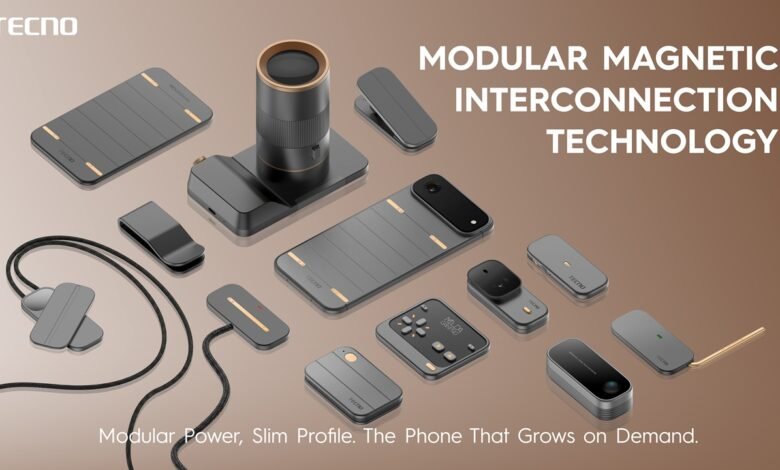
TECNO’s ecosystem currently features around ten magnetic modules, including:
- A slim POWER BANK module that effectively doubles usable battery life
- An ACTION CAMERA module for creators
- A TELEPHOTO LENS module that uses the phone’s display as a live viewfinder
- Off-grid communication tools
- Additional lifestyle-focused add-ons
Unlike simple snap-on accessories, these modules connect through a hybrid system:
- A precision rectangular magnetic array
- Pogo-pin connectors for low-heat power transfer
- Wireless data transmission via Wi-Fi, Bluetooth, and mmWave
The pairing process is automatic. Snap it on, and it works.
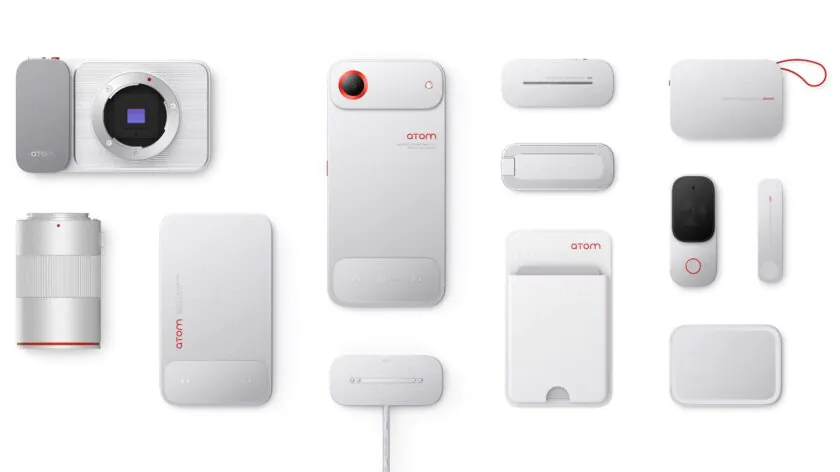
The back of the phone is divided into eight modular zones, subtly guiding placement without ruining the aesthetic. Two design versions are being showcased:
- ATOM Edition – Silver aluminum with subtle red accents
- MODA Edition – A more “geek-inspired” aesthetic
Both share the same modular foundation.
TECNO’s bigger philosophical play
This isn’t just about accessories. Leo Li, TECNO’s Product Head of Modular Magnetic Interconnection Technology, framed it as something much bigger:
“We believe the ultimate goal of technology is not to create a static masterpiece, but to offer an extension of human freedom. By pioneering this modular architecture, we are breaking the constraints of fixed hardware and returning the power of choice to the user.”
In theory, instead of permanently carrying bulky hardware you rarely use, you carry only what you need for that day.

Photography shoot? Snap on the telephoto module.
Traveling off-grid? Add the communication module.
Heavy workday? Attach the power bank.
The phone evolves with you.
Will it actually land in Kenya and Africa?
Let’s be real: modular phones have a history of failing. From the LG G5’s “friends” to Moto Mods, the “extra cost for extra parts” model is a tough sell. However, TECNO has a secret weapon: Transsion’s massive footprint in Africa.
Still, this is not where experimental smartphone concepts typically launch. Our market rewards value, durability, battery life, and aggressive pricing. Modular ecosystems introduce new questions:
- How much would modules cost?
- Would retailers stock them?
- What happens if a module gets discontinued?
- Would consumers trust a proprietary ecosystem?
Historically, Africa hasn’t been the testing ground for bleeding-edge smartphone experiments. And yet Africa is TECNO’s biggest market.
While this is currently a long-term design thinking project (read: a concept), TECNO’s recent track record of actually bringing MWC concepts to shelves (like the Spark SLIM) suggests we shouldn’t rule it out.
Even if we never see this exact 4.9mm modular slab in Kenyan stores, elements of this system, be it magnetic expansion, snap-on AI tools, battery extensions, or creator modules, could trickle down into future Phantom or Camon devices.
Will TECNO’s modular smartphones finally succeed where others failed? Let us know in the comments.