

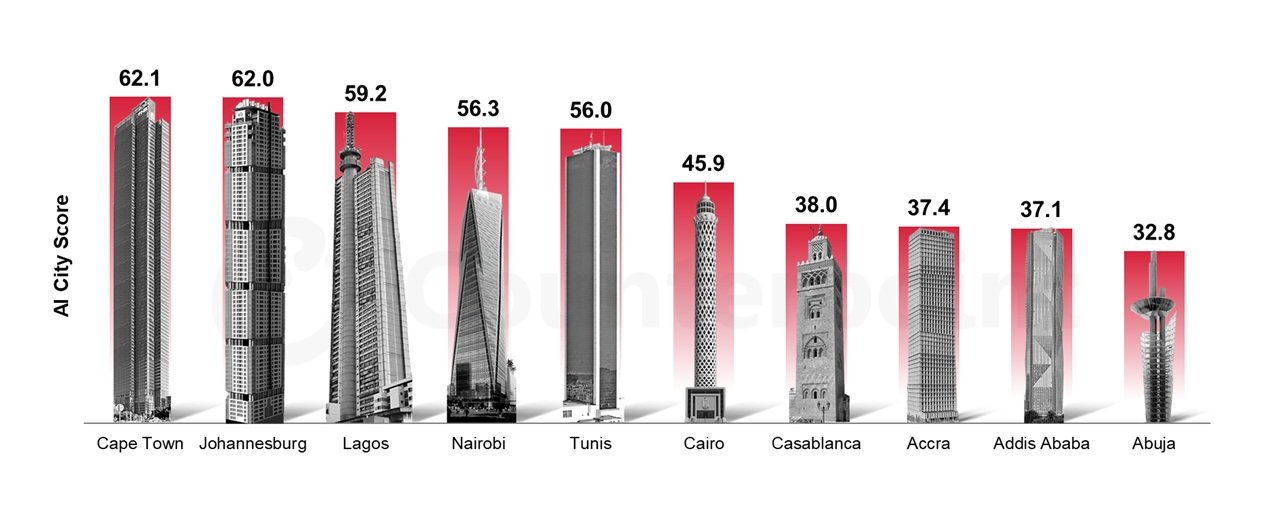
Nairobi’s reputation as the Silicon Savannah has received significant validation in the latest Counterpoint Research 2026 Africa AI Cities Index. The report, which analyzes the adoption and development of Artificial Intelligence across the continent’s most significant metropolitan areas, ranks Nairobi as the 4th leading AI hub in Africa.
The index is topped by South African giants Cape Town and Johannesburg, with Lagos taking the third spot. Tunis rounds out the top five.
Nairobi’s high ranking is attributed to its robust regulatory initiatives and the concentrated strength of its Silicon Savannah AI cluster. The Kenyan government’s proactive stance on national AI policies has created a fertile ground for startups and international investors alike.
However, the report suggests that while Nairobi is a leader in policy and startup activity, it faces stiff competition from the south. This ranking follows a trend we observed mid-last year, where South Africa was already leading the continent in embracing AI within the workplace, driven by high corporate integration and early infrastructure investments.
A key highlight of the Counterpoint report is the massive boom in the data center sector. Africa’s capacity is expected to nearly triple over the next five years, jumping from 827 MW to 2.4 GW. Major players like Microsoft, Google, and Huawei are the primary drivers of this expansion, focusing on R&D facilities and training programs.
Despite this growth, Research Director Marc Einstein warns of a “connectivity bottleneck.” Currently, only 2% of African mobile users are connected via a 5G network. Furthermore, even with the planned tripling of data center capacity, the entire continent will still have less supply than the city of London alone.
For Nairobi to climb higher, the report suggests that improving energy infrastructure and communication networks must remain the top priority for the Kenyan government.
The report also highlights the rise of “Sovereign AI”, a movement where African governments aim to build locally owned infrastructure to ensure native languages (like Swahili) are incorporated into AI models.
This push for localized, high-performance AI comes at a time when hardware accessibility is becoming a hurdle. The industry is witnessing the end of cheap phones. The high-performance chips required to run sophisticated AI on-device are driving up manufacturing costs, potentially creating a digital divide in markets like Kenya where price sensitivity is high.
While Cape Town currently holds the crown due to its status as a startup hub and the presence of companies like Cassava Technologies and Teraco, the race is far from over.
“AI city development in Africa is immense,” says Marc Einstein. “With Africa being the youngest continent with a median age of 19, the emphasis is now on training this youth for an AI-driven future.”
For Nairobi, the challenge for 2026 and beyond will be translating its strong regulatory framework into more physical infrastructure, specifically data centers and 5G penetration, to ensure the Silicon Savannah doesn’t just talk about AI, but powers it for the entire region.
Top 10 Africa AI cities rankings (2026):
- Cape Town
- Johannesburg
- Lagos
- Nairobi
- Tunis
- Cairo
- Casablanca
- Addis Ababa
- Accra
- Dakar
Source: Counterpoint’s 2026 Africa AI Cities Index