
If you spend any time on tech social media in Kenya, you have likely noticed a recurring theme: the Samsung Galaxy A-series is everywhere. They are the undeniable heavyweights of the streets right now, and the numbers finally back up the chatter.
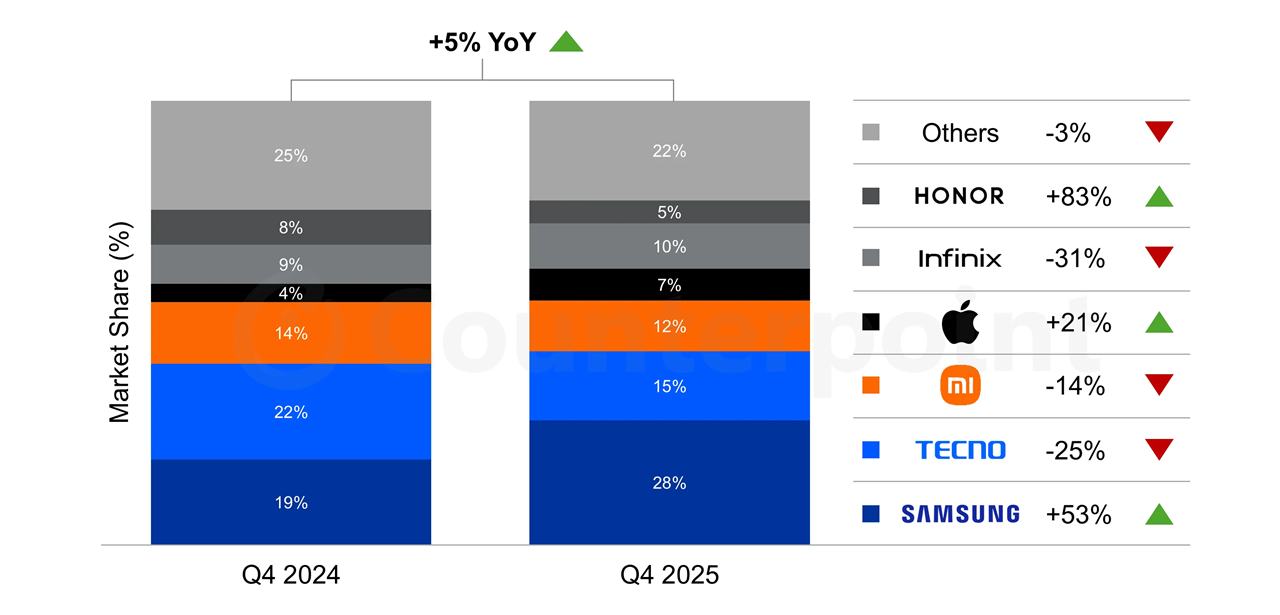
According to the latest Q4 2025 Market Monitor report from Counterpoint Research, Samsung just pulled off a masterclass in regional dominance. The tech giant leapfrogged its rivals, skyrocketing from a 19% market share in Q4 2024 to a commanding 28% in Q4 2025. This massive 9% jump firmly dethrones TECNO, the continent’s historical budget kingmaker.
Samsung surges as rivals stumble
The Middle East and Africa (MEA) smartphone market grew 5% overall in Q4 2025, but the spoils of that growth were fiercely one-sided.
Samsung recorded a staggering 53% year-over-year growth. Meanwhile, the former market leader TECNO watched its share plummet from 22% down to 15%. Xiaomi also felt the squeeze, dropping from 14% to 12%, and Infinix took a heavy hit, sliding from an 8% share down to 5%.
According to Counterpoint Research, Samsung reclaimed the top spot by “strategically front-loading to hedge against rising component costs.” Chinese OEMs like Transsion (TECNO and Infinix) and Xiaomi hit a brick wall due to global memory shortages, causing severe shipment declines just as Samsung flooded the market.
While established markets like Kenya, South Africa, and Nigeria continue to anchor the region’s premiumization, Counterpoint notes that 5G adoption is rapidly accelerating in emerging markets like Jordan, Egypt, and Sierra Leone.
How Samsung hacked the price-sensitive market
For years, Samsung relied solely on its premium brand cachet, a strategy that historically struggled against the aggressively priced, spec-heavy offerings from TECNO and Infinix in Africa. Today, Samsung has completely flipped the script through lethal budget positioning.
Here is exactly how they are winning the streets:
- The status upgrade (sub-KES 15,000): The Galaxy A06 and the new Galaxy A07 completely dominate this tier. These devices serve as the ultimate gateway for consumers migrating from feature phones or older budget Androids. Buyers get the prestige of the Samsung badge as a status symbol without the flagship price tag.
- Owning the mid-range (KES 20,000 – KES 30,000): This price bracket used to belong entirely to TECNO and Infinix. Now, the Galaxy A1x family has set up camp and refused to leave. Samsung packs these phones with premium-like features, including vibrant AMOLED displays that easily outshine the LCD panels historically found in this segment.
- Unmatched longevity: Samsung is offering up to 6 years of OS updates on devices like the A16 5G. Absolutely no one else in this price category provides that level of software support, transforming a budget phone into a long-term investment.
Distribution and the Lipa Mdogo Mdogo advantage
A great phone means nothing if buyers cannot easily find it or afford it. Samsung solved both problems simultaneously.
Samsung devices are ubiquitous. You can walk into major carrier shops like Safaricom and Airtel, or visit your local street vendor, and find a Galaxy A-series device front and center. Furthermore, the aggressive integration of the Galaxy A06 and A07 into “Lipa Mdogo Mdogo” (pay-as-you-go) financing schemes removes the friction of upfront costs.
As Counterpoint accurately points out, “the premiumization trend was the main driver for the premium segment growth, especially with the wide availability of several financing options and trade-in programs.”
Samsung didn’t just win Q4 2025 by accident. They combined aggressive inventory management with irresistible software promises, strategic pricing, and massive financing distribution. If TECNO and Xiaomi want their market share back in 2026, they have a massive mountain to climb.