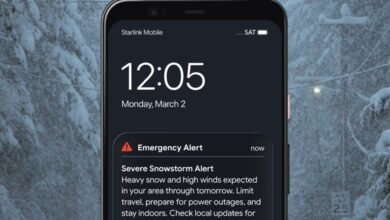


The space race for smartphone connectivity is officially heating up across Africa. While 2026 was already poised to be the year African telcos ramped up satellite integrations to kill dead zones, a surprise frontrunner has emerged. Beating the highly anticipated rollout from Airtel Africa, MTN Zambia has announced it is the first African operator to successfully complete field testing of Starlink’s Direct to Cell service.
According to a statement released by the carrier, the field test wasn’t just a basic ping to orbit. MTN Zambia managed to pull off the transmission of the country’s first-ever data session and fintech transaction using its own spectrum paired with Starlink’s satellite constellation.
This means a user was able to process a Mobile Money (MoMo) transaction completely off the traditional terrestrial grid. The carrier confirmed that the service will soon grant customers access to WhatsApp voice and video calls, the MoMo App, navigation, and weather applications in the remotest of areas where currently terrestrial service is unavailable.
The technology doesn’t require specialized hardware or bulky antennas. As MTN Zambia explains, “Starlink Direct to Cell works with existing LTE/4G-compatible devices wherever there is a clear view of the sky,” with the satellites essentially acting like a cellphone tower in space.
The operator plans to roll out the commercial service in the coming weeks, pending regulatory approval, bringing coverage to notoriously difficult-to-reach areas like game parks and rural regions surrounded by water bodies.
This rapid deployment by MTN steals a bit of thunder from Airtel Africa. Back in May 2025, Airtel signed an initial infrastructure agreement with SpaceX, which was later expanded in December 2025 to explicitly bring Starlink Direct-to-Cell to its 174 million customers across 14 African markets.
Airtel’s rollout was broadly slated to begin in 2026, starting with basic text and data before eventually scaling up to high-speed broadband with next-generation satellites. By pulling off this successful test and promising a commercial launch in the coming weeks, MTN Zambia has officially claimed the bragging rights for the continent.
Here’s the full statement:
MTN Zambia Achieves First in Africa by Completing Starlink Direct to Cell Testing

FOR IMMEDIATE RELEASE Lusaka, 6th March 2026 – MTN Zambia and Starlink have entered a strategic partnership and are proud to announce that MTN Zambia is the first African operator to successfully complete field testing of Starlink’s Direct to Cell service.

This involved the transmission of the first-ever data session and fintech transaction in the country through the use of MTN Zambia’s spectrum and Starlink’s satellite constellation. These milestones pave a path forward to commercial service in the coming weeks subject to regulatory approval.

This service will enable customers to gain access to data, voice and video through supported applications, even in the remotest of areas where currently terrestrial service is unavailable. This service will include WhatsApp voice and video calls, along with access to the MoMo App, MyMTN App, navigation and weather applications with more launching in the future.

Starlink Direct to Cell works with existing LTE/4G-compatible devices wherever there is a clear view of the sky, enabling seamless connectivity in some of the most remote locations. Starlink Direct to Cell satellites act like a cellphone tower in space with the most advanced phased array antennas in the world connecting seamlessly across the Starlink network over lasers to any point in the globe, enabling network integration similar to a standard roaming partner.

Starlink Direct to Cell satellite connectivity means MTN Zambia will expand coverage to the most remote areas, such as the game parks and rural areas surrounded by water bodies and rivers will be covered.

We would like to acknowledge the unwavering support from the Ministry of Technology and Science and our regulator Zambia Information and Communication Technology Authority (ZICTA) for the guidance throughout this process.

//Ends//
Safaricom’s alternative route
While MTN and Airtel are focusing on beaming signals directly to smartphones to bypass terrestrial limitations, other major players like Safaricom are taking a markedly different approach to the satellite boom.
Safaricom, via its parent companies Vodacom and Vodafone, has also been busy striking orbital deals. Late last year, Vodacom partnered with Starlink for satellite broadband across its African footprint. Just this week, Vodafone Group inked a similar deal with Amazon Leo to integrate Amazon’s low-Earth-orbit constellation into its infrastructure.
However, Safaricom and Vodacom are primarily utilizing these services for satellite backhaul. Instead of bypassing cell towers to connect straight to a user’s phone, they are using satellites to connect people in remote areas to 4G and 5G networks, especially in areas where laying fiber-optic cables is too expensive or physically impossible. This strategy strengthens and expands the carrier’s existing terrestrial network rather than introducing a direct-to-device service.
MTN and Airtel are racing to put a satellite connection directly in your pocket, while the likes of Vodafone/Vodacom are using the stars to supercharge their towers. With MTN Zambia targeting a launch in the coming weeks, it looks like the era of zero dead zones in Africa is finally arriving.