
If you thought today’s news about Airtel Africa testing satellite-to-phone messaging was a big deal, buckle up. While being able to send a WhatsApp text from the middle of the Chalbi Desert is a massive win, it’s only the beta phase of what’s coming next.
Airtel’s CEO, Sunil Taldar, dropped a teaser that has been echoing through the tech halls: the shift toward Starlink Mobile V2 technology. This isn’t just a minor software update; it’s the hardware jump that will turn your everyday smartphone into a full-blown satellite phone, capable of native voice calls and high-speed broadband.
“Looking ahead, we are equally focused on the next horizon, launching voice calling and expanded broadband capabilities via Starlink Mobile V2 technology,” Airtel Africa said in a statement.
Here is what the “next horizon” actually looks like.
From light data to high-speed broadband
Right now, the testing we’ve seen in Kenya is restricted to light-data applications. It works, but it’s narrow. You can send a text or process an Airtel Money transaction because those require very little bandwidth. You can make a WhatsApp call or send a message over Facebook Messenger.
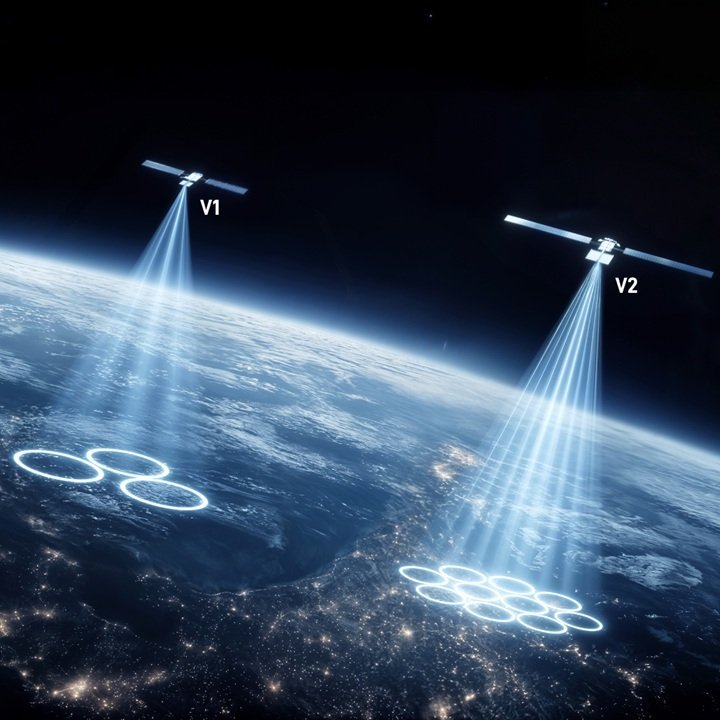
However, Starlink Mobile V2 changes the math. SpaceX is currently deploying these much larger “V2 Mini” (and eventually full V2) satellites, which are equipped with massive, advanced phased array antennas.
- The 20x speed boost: The goal for V2 is to offer data speeds up to 20 times faster than the current generation.
- Targeting 150Mbps: SpaceX is aiming for peak speeds of 150Mbps per user for this next-gen Direct-to-Cell service. To put that in perspective, that’s faster than so many home fiber connections currently available in Nairobi.
- Native voice calling: The most anticipated feature is native voice calling. This means you won’t need an app like WhatsApp to make a voice call; your phone will simply use the satellite as a cell tower in space to complete a standard voice call to any number.
No special hardware, no extra effort
The beauty of the Starlink V2 tech—and what I find most impressive as a tech enthusiast—is its transparency. Usually, satellite tech requires a “Thuraya” handset or a bulky external antenna.
With Starlink Mobile V2, the complexity is all on the satellite side. SpaceX has designed custom silicon that allows these satellites to communicate using the same LTE/4G and 5G frequencies your phone already uses. When you walk out of range of an Airtel mast, your phone will seamlessly hand over to a satellite beam. You won’t even have to toggle a switch.
We often talk about connectivity in terms of urban speeds, but for Airtel’s 14 markets across Africa, this is about sovereignty over geography.
Whether you’re a tourist in a remote national park, a farmer in a deep rural pocket, or a truck driver on a long-haul cross-border route, the “No Service” bars on your phone have always been a safety risk and a business barrier. By moving toward V2 technology, Airtel is essentially promising that the 50% of landmass in Africa that is currently not covered by terrestrial towers will effectively disappear from the offline map.