


Just days after the historic acquisition of a controlling 54.08% stake in Nation Media Group (NMG) by Tanzanian billionaire Rostam Aziz, another legacy media giant is fighting for its life. The Communications Authority of Kenya (CA) has officially received the green light from the Communications and Multimedia Appeals Tribunal to revoke the broadcasting licenses of six Standard Media Group stations.
The stations on the chopping block are some of the most recognizable frequencies and channels in the country: Vybez Radio, Berur FM, Radio Maisha, Spice FM, KTN Burudani, and KTN News.
The CA’s justification? A KES 48.87 million debt
According to the official press release from the CA, the revocation stems from a prolonged failure by the Standard Group to clear KES 48,874,524.10 in regulatory arrears. This figure is broken down into KES 13.88 million in unpaid license fees and KES 34.99 million in Universal Service Fund (USF) levies.
The regulator maintains that it exhausted all administrative avenues. The CA issued Notices of Contravention between December 2023 and January 2024, followed by License Revocation Notices in September 2024. Despite Standard Group attempting to lean on a December 2024 payment plan which the CA argued was breached, the Tribunal ruled that the authority was completely justified in pulling the plug.

Standard Group strikes back, vows not to be silenced
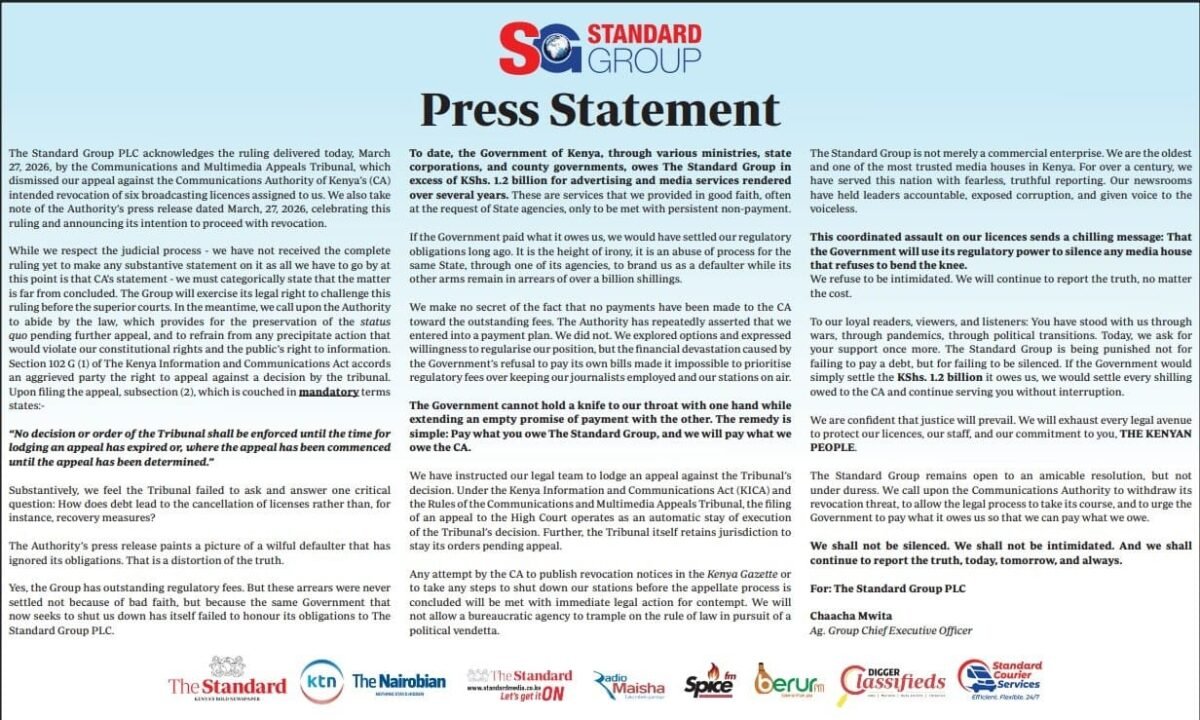
Standard Group is not taking this lying down. In a fiery rebuttal, the media house didn’t deny the regulatory debt but pointed to a glaring hypocrisy: the government itself currently owes Standard Group over KES 1.2 billion in unpaid advertising and media services.
If the state honored its debts, the media house argues, this KES 48.8 million regulatory fee would be pocket change. Standard Group framed the CA’s move as a coordinated assault, stating, “The Government cannot hold a knife to our throat with one hand while extending an empty promise of payment with the other.”
They have already filed a notice of appeal in the superior courts, relying on Section 102 G (1) of the Kenya Information and Communications Act (KICA) to preserve the status quo pending the appeal. Their statement closed with a defiant promise: “We shall not be silenced. We shall not be intimidated. And we shall continue to report the truth, today, tomorrow, and always.”
Here’s the full press statement:
As someone who covers the intersection of tech, media, and infrastructure here in Kenya, watching the rapid destabilization of our core media houses is deeply concerning. The timing couldn’t be more profound. We are barely digesting the Aga Khan Fund’s exit from NMG after 66 years, handing over the reins to Rostam Aziz in a deal that has already sparked massive debates about editorial independence and media capture in East Africa. And now, the potential blackout of half of Standard Group’s broadcast portfolio? You really have to wonder when the bleeding stops for legacy media.
But beyond the corporate boardroom drama and tribunal rulings, there’s a massive cultural loss at stake here. Radio is still the undisputed king of media consumption in Kenya, and we’re going digital. If the CA successfully shuts down these frequencies, the loss of urban radio will be a devastating blow, particularly for young people. Vybez Radio and Spice FM aren’t just frequencies; they are cultural hubs. Spice FM has practically redefined morning political and social discourse for the urban demographic, while Vybez has been a staple for the youth.
Standard Group has undeniably struggled over the last few years, but weaponizing regulatory fees while sitting on over a billion shillings of unpaid government debt feels like a targeted chokehold. We’ll be keeping a very close eye on the appellate courts to see if the status quo holds, or if our airwaves are about to get significantly quieter.