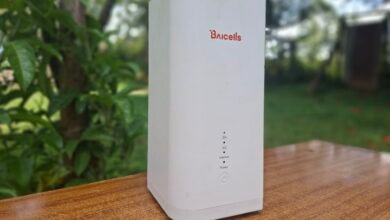



A year ago, Faiba was already Kenya’s best-performing fixed internet provider. This year, the rankings show that it is not even close.
According to the latest annual barometer from nPerf, a French independent internet performance measurement platform, Faiba topped every major performance category for fixed internet in Kenya for the first time. Download speed, upload speed, web browsing, YouTube streaming. All Faiba. The operator’s overall nPerf score jumped from 53,975 to 67,150, a gap so wide that second-placed VGG Connect trails by nearly 8,000 points.
The most striking figure is download speed. Faiba averaged 62.68 Mb/s across the 12-month period from April 2025 to March 2026. That is an 89% year-on-year improvement. Last year’s report had Faiba at around 33 Mb/s, and the year before that, roughly 28 Mb/s. The trajectory is steep and sustained. Upload speeds (44.42 Mb/s) and YouTube streaming (69.47%) were also the best in the field.
But the more interesting developments this year are happening below Faiba on the table.
Kenya Fixed Internet Rankings
Overall nPerf Score (nPoints) — April 2025 to March 2026
The new names on the board
If you followed last year’s nPerf rankings, you will notice two ISPs have disappeared. Telkom Kenya and Mawingu are no longer in the report. In their place sit VGG Connect and Airtel. nPerf only includes providers with a test share above 5%, so the most likely explanation is that Telkom and Mawingu’s user bases on the nPerf platform shrank below that threshold, while VGG Connect and Airtel crossed it.
VGG Connect’s appearance is particularly notable. This is Vijiji Connect Ltd, a Nairobi-based fibre startup founded in 2018 that primarily serves Nairobi, Kiambu, Meru, and Muranga counties. It deploys fibre using Kenya Power poles. And somehow, this relatively small operator finished second overall with 59,321 nPoints, ahead of Safaricom, Zuku, and Airtel.
How? Latency. VGG Connect recorded a staggering 14.20 ms average latency, the best in the sector for what nPerf says is the fifth consecutive year. To put that number in context, Airtel’s average latency was 50.15 ms. VGG Connect’s network is more than three times as responsive. A full 97% of its latency test results fell in the “correct” or “excellent” bracket. For gamers, remote workers on video calls, or anyone running real-time applications, that kind of responsiveness matters enormously.
The trade-off is raw speed. VGG Connect’s download speeds averaged just 21.36 Mb/s and uploads came in at 21.49 Mb/s. That puts it near the bottom on throughput. But the nPerf score is calculated on a logarithmic scale that weighs multiple factors, and VGG Connect’s exceptional latency, combined with decent browsing and streaming scores, was enough to earn it the number two slot. It is worth noting VGG Connect actually held the top overall position last year with 60,566 points. Faiba’s surge is what pushed it down, not any decline in its own performance.
Safaricom holds steady, Zuku and Airtel improve
Safaricom remained third with 55,978 nPoints. No dramatic movement, but steady improvement. Upload speeds rose 25% to 26.82 Mb/s, and YouTube streaming performance (67.95%) was nearly as good as Faiba’s. With roughly 34% of Kenya’s fixed internet market by subscriptions, Safaricom has the largest user base, and its 41% share of nPerf tests reflects that. Its five-year trend line points consistently upward.
Zuku came fourth at 53,181 nPoints. The standout was a 39% jump in download speeds to 35.35 Mb/s, its best showing in that category. Upload speeds and latency were middling, but the operator is clearly investing in speed improvements.
Airtel is the most complicated story. It finished last at 41,438 nPoints, but posted the largest upload speed improvement of any operator: a 61% year-on-year surge to 22.56 Mb/s. That is real infrastructure investment showing up in the data. The problem is latency. At 50.15 ms, Airtel has the slowest response times in the market. During busy hours (6 PM to 11 PM), its download speed drops to just 16.93 Mb/s. Until Airtel addresses that latency gap, the rest of its improvements will struggle to move the needle.
The evening slowdown nobody talks about
One of the more useful things about the nPerf report is its breakdown of busy hours versus idle hours. Between 6 PM and 11 PM, when most households are streaming, browsing, and working, speeds drop noticeably across every provider.
Faiba goes from 66.23 Mb/s during idle hours down to 51.32 Mb/s during peak times. That is still excellent, but it is a 22% drop. Safaricom drops from 35.04 to 31.09 Mb/s. VGG Connect falls from 22.64 to 18.78 Mb/s. Airtel’s evening speeds land at a modest 16.93 Mb/s.
These busy-hour figures are arguably more representative of what subscribers actually experience on a typical evening. If you are trying to stream a film or join a video call after work, the idle-time averages are not the numbers that matter.
How Your Internet Slows Down After 6 PM
Download speeds during Idle Hours vs Busy Hours (6 PM – 11 PM)
What it all means
Kenya’s fixed broadband sector is unambiguously improving. All five operators in the nPerf barometer recorded higher scores than the previous year, confirming a market that is maturing and investing in better infrastructure. Sébastien de Rosbo, nPerf’s CEO, described the sector as entering a new phase of maturity.
But the data also reveals persistent gaps. Over half of Airtel’s download speed tests fell below 10 Mb/s. Even for Faiba, one in five users experienced speeds in that low bracket. And the fact that Faiba accounted for just 12% of the test sample, while topping every category, raises a legitimate question about whether its smaller, potentially more urban user base skews the averages favourably compared to Safaricom’s much broader reach.
The competitive dynamics have shifted. Faiba is pulling away. A Nairobi startup with exceptional network responsiveness has quietly climbed to second place. And two providers that featured in previous years’ rankings have fallen off entirely. Kenya’s fixed internet market is not just getting faster. It is being reshaped.