

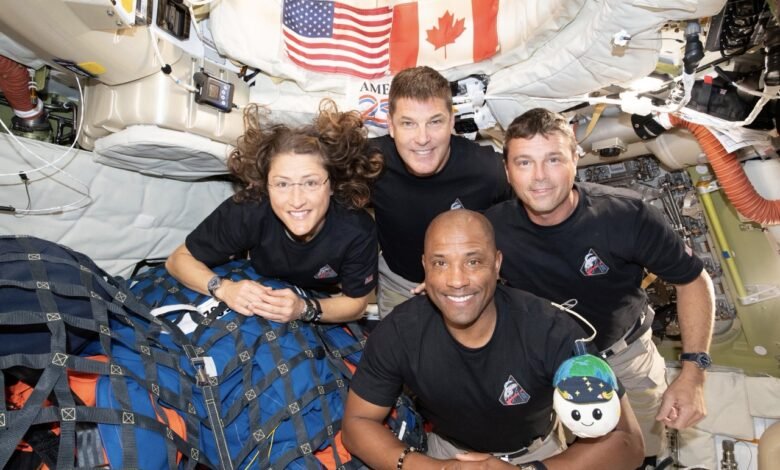

Four astronauts are hurtling towards Earth tonight at the end of a historic 10-day journey that took them around the Moon and back. NASA’s Artemis II crew is scheduled to splash down in the Pacific Ocean off the coast of San Diego at approximately 8:07 p.m. EDT (that’s 3:07 a.m. East Africa Time on Saturday, April 11).
If you are reading this and wondering what all the fuss is about, here is the short version: no human beings have travelled this far from Earth, or visited the Moon’s neighbourhood, since the Apollo 17 mission in December 1972. That was 53 years ago. Before smartphones. Before the internet. Before almost all of us were born.
Who is on board?
The crew consists of NASA astronauts Reid Wiseman (commander), Victor Glover (pilot), and Christina Koch (mission specialist), along with Canadian Space Agency astronaut Jeremy Hansen. Glover is the first Black astronaut to travel to the Moon. Koch is the first woman. Hansen is the first Canadian.
What did they actually do up there?
Artemis II launched on 1 April from Kennedy Space Centre in Florida aboard NASA’s massive Space Launch System rocket. Over the following days, the Orion spacecraft (which the crew named “Integrity”) performed a series of burns to break free of Earth’s orbit and set course for the Moon.
On Monday, 6 April, the crew shattered the record for the farthest distance humans have ever travelled from Earth, reaching 252,756 miles (over 406,000km) out, surpassing the mark set by Apollo 13 in 1970. They flew within roughly 6,500 kilometres of the lunar surface and became the first people to observe the Moon’s far side with their own eyes. The crew also witnessed a solar eclipse from space and captured stunning “Earthrise” and “Earthset” photographs.
The mission’s primary purpose was to test Orion’s life-support, propulsion, navigation, and thermal systems in a deep-space environment. Think of it as a full dress rehearsal before NASA attempts to actually land astronauts on the Moon in 2028.
The science of getting home alive
Re-entry is, by every measure, the most dangerous phase of the mission. The Orion capsule will hit Earth’s atmosphere at a predicted speed of roughly 38,400 km/hr. To put that in perspective, a bullet from an AK-47 travels at just over 2500km/h. Orion will be moving roughly 15 times faster than that.
At about 75 miles above Earth’s surface, friction with the atmosphere generates extreme heat. Within seconds, superheated plasma builds around the capsule and exterior temperatures soar to around 3,000 degrees Celsius. This is hotter than the surface of some stars. For about six minutes, starting at approximately 7:53 p.m. EDT, the crew will enter a communications blackout as that plasma blocks all radio signals.
The heat shield on the bottom of Orion is made from a material called AVCOAT, designed to gradually burn away (a process called ablation) and carry the heat away from the capsule. Notably, NASA modified Orion’s descent profile for this mission to reduce heat shield stress, after greater-than-expected erosion was observed during the uncrewed Artemis I flight in 2022. Future missions will fly with redesigned heat shields.
Once through the worst of re-entry, Orion will jettison its forward bay cover, deploy drogue parachutes near 6,700 metres, and then unfurl three enormous main parachutes at around 1,800 metres. These parachute sequences will slow the craft from about 480 km/h to 210 km/h, and finally to just 27 km/h for splashdown. The entire descent from about 122,000 metres to the ocean takes roughly 13 minutes.
After splashdown
Within two hours of landing, recovery teams will extract the crew from Orion using U.S. Navy helicopters and fly them to the USS John P. Murtha, which is already stationed at sea off the California coast. After medical evaluations on board the ship, the astronauts are expected to arrive at NASA’s Johnson Space Centre in Houston later on.
How to watch from Kenya (and anywhere else)
NASA’s live coverage begins at 6:30 p.m. EDT on Friday, April 10 (1:30 a.m. EAT, Saturday). You can watch on NASA’s YouTube channel, or on NASA TV. If you are staying up late or waking up early, splashdown itself is expected at about 3:07 a.m. EAT.
What comes next: the Artemis roadmap
Artemis II is not the destination. It is the test that proves the vehicle works. Here is where NASA is heading:
Orion spacecraft orbited the Moon over 25 days and returned. Tested the Space Launch System rocket and heat shield. No crew on board.
Four astronauts flew around the Moon and back over 10 days, travelling 1.1 million km. Set a new record for the farthest humans have been from Earth: 406,700 km. Splashdown expected 3:07 a.m. EAT, 11 April.
Crew will dock Orion with one or both commercial lunar landers (SpaceX Starship HLS and Blue Origin Blue Moon) in low Earth orbit. A critical rehearsal before attempting a Moon landing.
Two astronauts will descend to the lunar south pole for roughly one week. The first humans on the Moon since Apollo 17 in 1972. They will collect samples and study water ice in permanently shadowed craters.
Another crewed landing with initial base camp infrastructure. Annual missions planned afterwards, building towards a permanent human presence on the Moon and eventual crewed missions to Mars.
Artemis III, now scheduled for mid-2027, has been reconfigured as an orbital test mission. Instead of landing on the Moon, the crew will practise docking Orion with commercial lunar landers built by SpaceX and Blue Origin in low Earth orbit. The actual return to the lunar surface is now planned for Artemis IV in early 2028, when two astronauts will descend to the Moon’s south pole for the first crewed landing since 1972. Annual missions are planned after that, building towards a permanent lunar base.
Tonight, though, the focus is simpler: getting four people home safely. As pilot Victor Glover put it during a call from space this week, the data and stories are extraordinary, but first comes the small matter of riding a fireball through the atmosphere.
This is history.