
After years of leaning on mobile growth and testing the waters with wireless home internet, Airtel Kenya now appears to be making a serious move into fixed broadband. Fresh details seen at the Africa Connect Summit in Nairobi suggest the telco has quietly begun pushing fibre internet under the XStream Fibre brand, with both FTTH (Fibre-to-the-Home) and FTTB (Fibre-to-the-Business) offerings already being shown off publicly, even though the service still appears absent from Airtel Kenya’s main official channels.
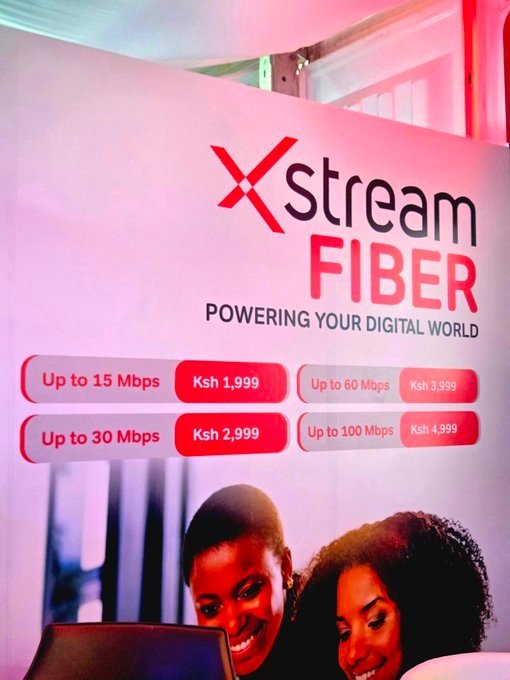
For months, Airtel had only hinted that fibre was part of its broader expansion plans. Now, the company’s summit stand appears to confirm that this is no longer just a future ambition. Based on the promotional material on display, Airtel’s new XStream Fibre packages are structured as follows:
- Up to 15 Mbps for KES 1,999
- Up to 30 Mbps for KES 2,999
- Up to 60 Mbps for KES 3,999
- Up to 100 Mbps for KES 4,999
The branding on the display also carries the tagline, “Powering your digital world,” suggesting Airtel is positioning this as a mainstream home and business connectivity product.
What makes this especially interesting is that the pricing lands squarely in the most commercially relevant part of Kenya’s fixed internet market. Fixed internet subscriptions in Kenya reached 2,461,981 by the end of December 2025, while fibre optic subscriptions stood at 1,378,198. The strongest demand lies in the 10-30 Mbps and 30-100 Mbps ranges, which is exactly where Airtel’s new plans fall. In other words, Airtel is not entering blindly. It seems to be targeting the market’s sweet spot.

This also means Airtel is stepping into a crowded field. Safaricom remains the biggest player in fixed internet, followed by Faiba and Zuku, while estate-focused challengers like Vilcom, Savanna Fibre, and VGG Connect have also been building relevance by moving faster and pricing more aggressively in select neighbourhoods.
Still, Airtel’s advantage is obvious: unlike smaller fibre providers, it already has a massive mobile subscriber base, an established retail footprint, Airtel Money, and a growing app ecosystem it can use to cross-sell home broadband. That gives it a much easier path into Kenyan homes and small businesses.
Airtel is slowly turning itself into a much more complete connectivity player. It already competes hard on mobile data and home wireless. Adding fibre to the stack brings it closer to the full-service model that has helped Safaricom dominate for years. Even without an official flashy launch, these newly surfaced XStream Fibre plans suggest Airtel Kenya’s fixed broadband push is very real and already underway.
What remains unclear for now is coverage, installation terms, router fees, and whether these plans are already live for retail sign-ups in multiple areas or still limited to select zones. Until Airtel Kenya publishes the service on its official channels, that part remains blurry. But from what has now surfaced publicly, the company’s fibre era in Kenya has clearly begun.
NOTE: Comparing Airtel’s speeds and costs above to Safaricom’s new speeds and costs, you see Safaricon’s recent changes give it an upper hand.







Join the discussion