


Jeff Bezos’ satellite ambitions have finally reached the Communications Authority of Kenya. Amazon, through its local subsidiary Amazon Kuiper Kenya Limited, has formally applied for a Network Facilities Provider (NFP) Tier 2 licence — the same regulatory category that lets a company build and operate countrywide communications infrastructure, including satellite systems with regional spectrum allocation.
If approved, the licence would clear Amazon to roll out its low-earth orbit (LEO) satellite broadband service in Kenya, putting the world’s richest man’s space project squarely in the same arena as Elon Musk’s Starlink, which has been operating locally since July 2023.
From Project Kuiper to Amazon Leo
A quick note on the name. The Kenyan entity is registered as “Amazon Kuiper Kenya Limited”, but globally the service is no longer called Project Kuiper. In November 2025, Amazon retired the Kuiper code name and rebranded the network as Amazon Leo, a straightforward nod to the low-earth orbit shells the satellites occupy between 590 km and 630 km above the planet. The original “Kuiper” name was a tribute to the Kuiper Belt, the icy band of objects that sits beyond Neptune. The local Kenyan corporate name appears to predate the rebrand, which is why the older “Kuiper” branding still shows up on the application paperwork.
Amazon plans to deploy a constellation of 3,236 satellites in total. As of late April 2026, the company has launched roughly 270 production satellites — well behind Starlink’s nearly 9,000 — and is racing against a US Federal Communications Commission deadline that requires half the constellation in orbit by July 2026. Amazon has already filed for an extension on that deadline.

What a Tier 2 NFP Licence Actually Does
This is the part that matters for Kenyans. The CA’s Tier 2 NFP licence is a heavyweight authorisation. It allows the holder to build and operate communications infrastructure across the entire country using any technology, including satellite. It is valid for 15 years, attracts a one-off operating fee of KES 15 million plus an annual fee that is the higher of KES 800,000 or 0.4% of gross turnover, and requires the licensee to issue at least 30% of its shares to Kenyans within three years.
CA procedure now requires Amazon’s name to be published in the Kenya Gazette, after which there is a 30-day window for any interested party — local ISPs, Starlink, civil society, anyone — to lodge objections. Only after that window closes can the regulator’s board consider final approval.
How the Speeds Actually Stack Up Against Starlink
This is where things get interesting, and where I want to flag one nuance the press materials gloss over.
Amazon Leo’s hardware lineup has three terminals. The Leo Nano is the entry-level dish for portable use, rated up to 100 Mbps. The Leo Pro is the residential and small-business workhorse, rated up to 400 Mbps download. The Leo Ultra is the enterprise flagship, rated at up to 1 Gbps download and 400 Mbps upload simultaneously, thanks to its full-duplex phased-array design. Amazon has said internal lab tests have hit 1.8 Gbps in single-terminal conditions, which is likely where the higher figures sometimes quoted come from. The published commercial spec, however, is 1 Gbps.
Compare that with Starlink in Kenya today. The standard residential plan advertises 25 to 220 Mbps, with most users falling in the 50 to 150 Mbps band. Starlink’s higher-tier Performance Kit can reach around 400 Mbps. Median real-world download speeds in Kenya were around 47 Mbps in May 2025, according to Ookla data — well below the headline range — though latency improved significantly after Starlink switched on a Nairobi point of presence in January 2025.
So on paper Amazon Leo’s terminals are faster, especially on the upload side. Starlink’s standard kit tops out at roughly 5 to 20 Mbps upload. Leo Ultra promises 400 Mbps upload. For anyone running a business, livestreaming, or backing up large files, that upload gap is the real story.
Why Vodafone — and Therefore Safaricom — Matters
Amazon’s roll-out plan in Africa leans heavily on a partnership signed with Vodafone Group in March 2026. Under that deal, Vodafone will use Amazon Leo satellites to backhaul 4G and 5G base stations in remote regions, starting in Germany before progressively rolling out across Africa through Vodacom Group, Vodafone’s pan-African subsidiary.
Here is the local twist. Vodafone is the largest single shareholder in Vodacom. Vodacom in turn holds about 35% of Safaricom. Walk that ownership chain and you arrive at a striking outcome: Safaricom’s ultimate parent group has signed a deal to use Amazon Leo for cellular backhaul in remote Africa. The two companies many Kenyans assumed would be on opposite sides of any satellite-versus-fibre fight may end up partnered behind the scenes, with Amazon Leo helping Safaricom extend mobile coverage into places where laying fibre is uneconomical.
Where Starlink Sits Right Now
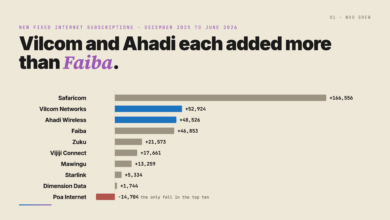
Starlink’s growth in Kenya has been bumpy. According to the latest CA Sector Statistics Report data, Starlink had around 17,066 subscribers in Kenya as of March 2025, down from 19,146 the previous quarter, before climbing back to 19,470 by September 2025. That places it ninth among Kenyan ISPs with about 0.9% market share — small in volume terms but dominant within satellite specifically.
Starlink also faces a CA deadline of 30 April 2026 for in-person identity verification by all subscribers, part of a wider tightening of satellite oversight. By the time Amazon Leo’s service goes live in Kenya, it will be entering a regulatory environment that has visibly hardened.
What Happens Next
Three things to watch. First, the Gazette publication and the 30-day objection window. Second, whether Amazon Leo can deploy enough satellites globally to actually offer commercial service in Kenya within the one-to-two-year window the ICT principal secretary mentioned earlier this year. And third, pricing. Amazon has said its standard Leo Pro terminal costs less than $400 to manufacture, which suggests room to undercut Starlink’s hardware pricing if the company chooses to.
For Kenyan consumers and small businesses, the real prize from this competition is downward pressure on satellite internet pricing, which has been the single biggest barrier to mainstream adoption.






Join the discussion