

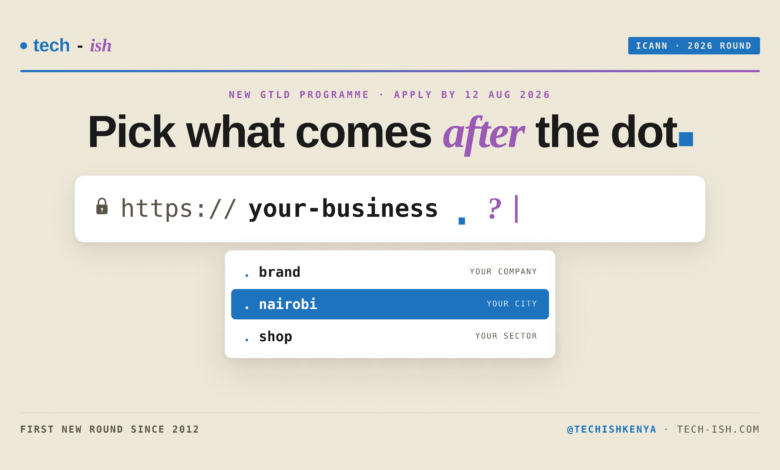
The Internet Corporation for Assigned Names and Numbers (ICANN), the global non-profit that coordinates the internet’s address system, has confirmed that its New gTLD Programme: 2026 Round is now accepting applications. The window closes on 12 August 2026.
This is a big deal, but only if you understand what is actually being offered.
What is a gTLD, in plain terms
A generic top-level domain, or gTLD, is the part of a web address that comes after the last dot. In tech-ish.com, the .com is the gTLD. In nation.africa, the .africa is the gTLD. We’ve explained before how many Kenyans still default to typing .com or .co.ke and struggle when a website lives on a less familiar extension like .africa or .garden. That gap in awareness is part of the backdrop for this whole conversation.
What ICANN is opening now is not a chance to buy a domain name like yourbusiness.com. It is a chance to apply to operate the part after the dot. If approved, you would run a registry: a business that controls who can register names under your extension, what they pay, and what the rules are.

The 2012 round, the last time ICANN opened this process, produced more than 1,200 new gTLDs. Some were brand-controlled, like .google and .bmw. Some were geographic, like .berlin and .tokyo. Others were generic terms anyone could register under, like .shop, .app and .pizza.
What it actually costs
The press release ICANN sent out talks about benefits but skips the price. The price matters. The base application fee for the 2026 round is USD 227,000, roughly KES 29.3 million at current rates. That is up from USD 185,000 in the 2012 round, a 22.7% increase, according to ICANN’s published guidance.
That figure is just the evaluation fee paid to ICANN. It does not include the technical infrastructure (a registry service provider), legal counsel, the trademark clearinghouse fees for .brand applications, or the annual fixed fee of USD 25,750 (roughly KES 3.3 million) that registries pay ICANN once they are operational. Industry estimates put the realistic five-year cost of running a generic gTLD at between USD 650,000 and USD 1.2 million.
For a Kenyan organisation, there is a meaningful concession. The Applicant Support Programme (ASP) was designed for applicants from developing economies, and Kenya qualifies. The ASP offers a 75% to 85% reduction on the base fee, bringing the entry cost down to as low as USD 34,050 (roughly KES 4.4 million). The programme also includes pro bono legal and consulting support, training, and bid credits if an applicant ends up in a contention set, which is when two or more applicants apply for the same string.
There is a catch. The ASP is capacity-limited. ICANN has indicated support for about 40 qualified applicants this round, and roughly 75 to 97 applications were submitted during the ASP window, which closed earlier than the main gTLD window. So if a Kenyan organisation has not already gone through ASP, the discount route is largely closed for this round.
What’s new in 2026
A few things are different from 2012.
The 2026 round will accept gTLD applications in 27 different scripts, including Arabic, Chinese, Devanagari and Thai. Internationalised Domain Names (IDNs) let speakers of non-Latin languages use the internet in their own scripts, both before and after the dot. For a continent like Africa, where script diversity is real but underrepresented online, this expansion matters more than the marketing language suggests.
ICANN has also pre-evaluated registry service providers, the backend operators that actually run the technical infrastructure. In 2012, every application carried its own technical evaluation, which slowed everything down. Now applicants partner with an already-vetted RSP, which should make the process faster and cheaper.
There is also a new replacement string option, which lets applicants nominate an alternative string upfront to avoid auctions if multiple applicants chase the same name.
Should a Kenyan business actually apply?
For most Kenyan businesses, the answer is no. The cost is high, the operational obligations are real, and running a registry is a long-term commitment, not a marketing exercise. The 2012 round saw a wave of .brand applications from large global corporations, and many of those domains have seen modest real-world usage.
For a small handful of organisations, it could make sense. A major bank or telco that wants tight control over its digital identity could justify a .brand application. A community or county government with cultural and economic critical mass could consider a geographic string. A serious infrastructure business that wants to operate a generic registry (say, an African-focused .africa-style play, though that string is already taken) might find the economics work.
The honest read is that the 2012 round was dominated by applicants from the Global North. Africa was barely represented. The ASP exists precisely because ICANN wants to fix that, but the structural barriers, capital, expertise, time, remain steep. Whether the 2026 round shifts that pattern is one of the more interesting things to watch.
How to actually apply
The window is open now and closes on 12 August 2026. Applications are submitted through the TLD Application Management System (TAMS). ICANN publishes an extensive Applicant Guidebook, which runs to over 440 pages, plus FAQs, user guides and webinars on the 2026 Round resources page.
Approximately two months after the window closes, ICANN publishes a public list of all applicants and the strings they applied for. The evaluation, contention resolution and contracting then play out over the following years, with the first new gTLDs from this round expected to go live from 2027 onward.
The bottom line
If you run a business in Kenya and you saw “new domain extensions” in a headline somewhere and got excited, the practical message is simple. You cannot rush out and register yourname.kenya today. What is open is a heavyweight, expensive, multi-year process to operate a domain extension, aimed at large brands, governments, communities and registry businesses. For everyone else, the more useful thing to track is which new extensions get approved over the next two years, because those are the ones that will eventually show up in the URLs around you.







Join the discussion