
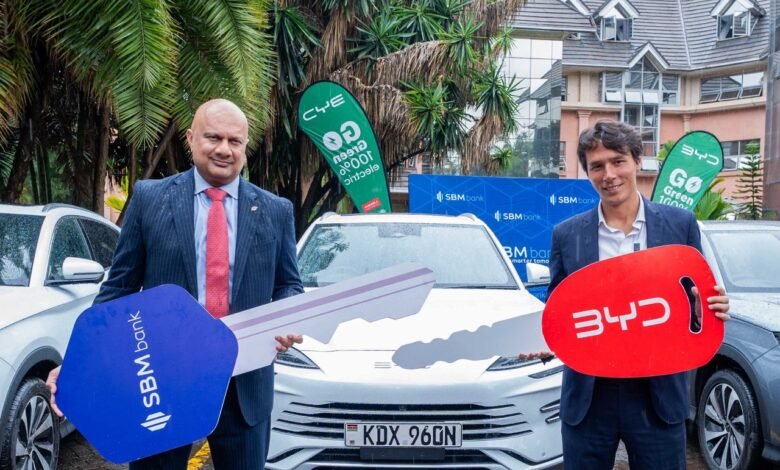
SBM Bank Kenya took delivery of five plug-in hybrid BYDs in Nairobi this week, but the more telling number wasn’t five. It was a billion. Alongside the handover, the lender announced a KES 1 billion Green Finance Facility that will run for the next 12 months, aimed at giving consumers and businesses credit to buy electric and hybrid vehicles. The fleet is the showroom. The billion is the actual product.
The vehicles, one BYD Shark 6 plug-in hybrid pickup and four Sealion 6 plug-in hybrid SUVs, were handed over by BYD by CFAO Mobility Kenya. Crucially, SBM Bank doesn’t own them. Avenue Lease & Rentals E.A bought the cars and is leasing them to the bank. SBM separately put KES 45 million into modernising its own logistics around the deal.
That structure matters more than the BYD badges. A Sealion 6 retails in Kenya for around KES 6.86 million and a Shark 6 for around KES 7.47 million, going by current dealer pricing. Buying five outright is a balance-sheet event most Kenyan companies don’t want, especially for a fast-moving asset class where battery technology, residual values, and software keep shifting. Leasing converts that capital expense into a monthly operating cost. It also dumps the resale-value risk onto the leasing company. For an EV, where nobody is quite sure what a five-year-old battery will be worth, that risk transfer is the whole point.
This is also the first significant corporate fleet deployment of the Shark 6 and Sealion 6 in Kenya. Tech-ish covered the Shark 6’s consumer launch in September 2025, backed by NCBA financing through CFAO’s leasing arm Loxea. That deal targeted individual buyers with up to 90% financing over 60 months. The SBM-Avenue arrangement is the corporate twin of that move: same vehicles, different buyer, different financing structure. For BYD by CFAO, the message to other Kenyan corporates is straightforward, you can run these on a lease, not a purchase order.

Avenue Lease itself is worth flagging. Unlike Loxea, which sits inside CFAO, Avenue is an independent Kenyan leasing house that has historically focused on conventional fleet, equipment, and asset finance. Its decision to enter EV leasing, through a partnership with CFAO, signals that the third-party leasing market in Kenya is starting to take EVs seriously as a leasable asset class. That’s a quieter shift than a launch event, but a more durable one.
A note of caution sits inside the announcement, though. SBM didn’t lease pure electric cars. It leased plug-in hybrids, which still burn petrol once the battery is depleted, typically after 70 to 100 kilometres of electric range. In a country where Kenya had more than 24,700 EVs registered by early 2026, a 31-fold jump from 2022 levels, and EV-linked electricity consumption climbed to 8.43 million kWh in 2025, the charging infrastructure is genuinely growing. But it’s still concentrated in Nairobi. PHEVs are the pragmatic middle path for corporates that need range certainty on a Mombasa run.
SBM Bank also isn’t moving alone. NCBA has financed Shark 6 purchases. Equity Bank rolled out school-bus financing through CFAO. Stanbic recently launched 100% solar financing for homes and SMEs. Kenyan banks are quietly turning into the country’s loudest climate actors, partly because the financial sector earns from any transition that requires capital, and partly because regulators and global investors are watching. SBM’s KES 1 billion, set against the bank’s KES 444.2 million 2025 net profit, is real money and a real bet. Whether the facility is fully drawn down inside 12 months will tell us how big the actual demand for EV credit in Kenya has become.





Join the discussion