
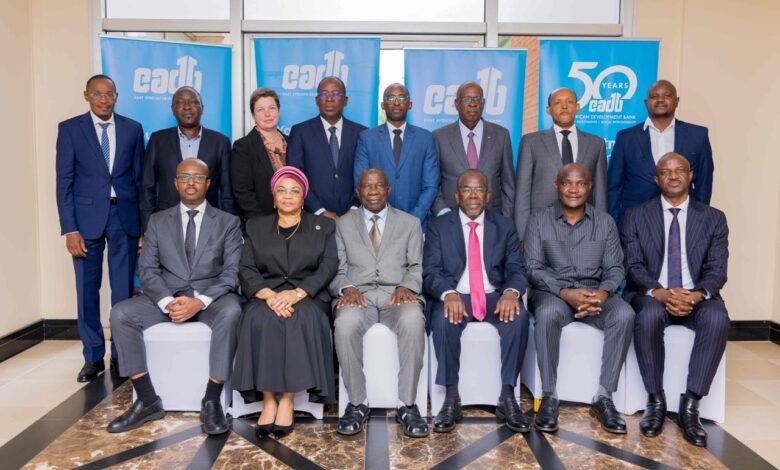
The East African Development Bank (EADB) has set up a USD 13 million fund (about KES 1.68 billion) targeted exclusively at enterprises run by women and young people in Kenya, Uganda, Tanzania and Rwanda. The announcement was made on Monday in Kampala during the bank’s Governing Council meeting, and it lands at the same time the bank reported its strongest financial year in recent memory.
For readers unfamiliar with EADB, a quick grounding helps. The bank is a regional development finance institution, not a commercial bank you can walk into. It was originally set up in 1967 under the first East African Community and re-established in 1980 after that bloc collapsed. It is owned by the four member states, plus institutional shareholders including the African Development Bank. Its job is to lend to businesses and projects that drive socio-economic development, often in sectors where commercial lenders consider the risk too high or the returns too slow.
What the fund actually is
The USD 13 million pool will not be lent directly by EADB to individual entrepreneurs. Instead, it will be channelled through partner financial institutions, which in practice means commercial banks, microfinance institutions and possibly SACCOs that already have the branch networks and credit-scoring infrastructure to assess small borrowers. EADB provides the liquidity at concessional terms. The partner institutions handle the customer-facing lending and absorb a share of the risk.
This is the standard “wholesale” model for development banks, and it matters because it determines who actually gets the money. If the partner institutions are conservative, the cash flows to slightly larger, slightly more established businesses, not to the kiosk owner or the 24-year-old fintech founder still in pre-revenue mode. EADB has not yet named which partners will distribute the fund, and that is the detail worth watching.
According to the outgoing Council Chairperson Hon. Matia Kasaija, the bulk of the fund will come from EADB’s own profits, with the bank instructed to top it up by mobilising additional capital from development partners over time.
Why the numbers behind this announcement matter
EADB’s profit before tax for the year ended December 2025 rose to USD 16.93 million, up from USD 11.20 million the year before. That is a 51% jump. Loan disbursements grew by 140%, and outstanding loans at year-end were 52% higher than the previous year.
For context, when the same Governing Council met in March 2025, the bank’s flagship SME programme was a USD 50 million facility that had created roughly 18,000 jobs over five years. The new women and youth fund is smaller in absolute terms but more narrowly targeted, and it represents EADB choosing to ring-fence capital for a demographic that commercial lenders across the region consistently underserve.
The funding gap here is not theoretical. The African Development Bank estimates early-stage African businesses face an annual funding shortfall of around USD 194 billion, which is close to 7% of the continent’s GDP. We’ve previously unpacked how Kenyan startups in particular remain starved for local capital, with most growth-stage funding still coming from foreign investors whose appetite swings with global conditions.
The leadership reshuffle
The Kampala meeting also marked a generational handover. Hon. Yusuf Murangwa, Rwanda’s Minister of Finance and Economic Planning, takes over as Chairperson of the Governing Council from Uganda’s Kasaija. Murangwa is an interesting appointment. He is a statistician by training, with a Master’s from Cardiff University, and ran Rwanda’s National Institute of Statistics for over a decade before being moved to the finance ministry in 2024. He has been vocal about using artificial intelligence and big data in public-sector decision-making, which suggests the bank may push harder on data-driven lending and impact measurement during his tenure.
Uganda’s Permanent Secretary for Finance, Dr. Ramathan Ggoobi, takes over as Chairperson of the Board of Directors for a two-year term. He replaces Tanzania’s Dr. Natu Mwamba.
What to watch next
The fund’s real test is execution. We have seen this script before, both inside and outside the development banking world. Earlier this year we covered how the Stanbic Foundation trained more than 100,000 women-led MSMEs in financial literacy before lending to them, on the principle that capital injected into an unprepared business simply produces defaults. Equity Group and AGF separately committed up to USD 500 million for MSME financing in 2025, with women and youth as priority segments.
The lesson from those programmes is that the size of the cheque matters less than the structure around it. Three things will determine whether EADB’s USD 13 million actually moves the needle: how strict the eligibility criteria are, whether partner banks pair the loans with technical support, and how quickly the bank can attract co-financing from development partners to scale the fund past its initial size.
For now, what entrepreneurs in Nairobi, Kampala, Dar es Salaam and Kigali should take away is straightforward. A new dedicated pool of concessional capital exists for them. The application channels will run through commercial partners, not EADB directly. And the details on who those partners are, and what their terms look like, are the next thing to ask about.





Join the discussion