
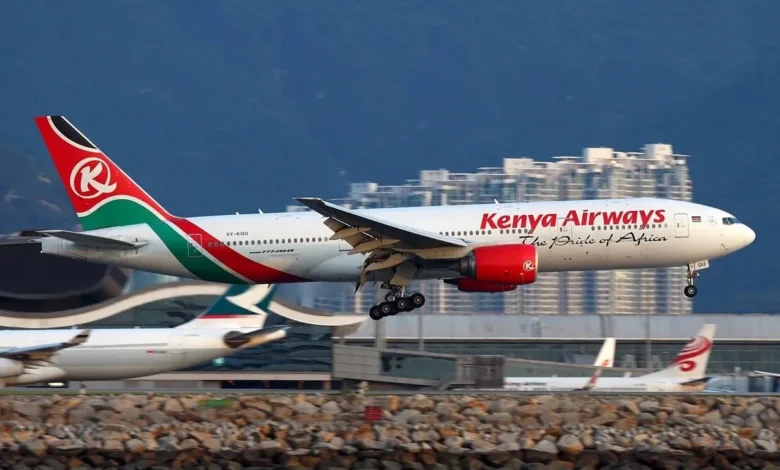
Kenya Airways and Rubis Energy Kenya have signed a Memorandum of Understanding to develop what they say will be Africa’s first dedicated sustainable aviation fuel (SAF) refinery. The proposed facility will be based in Nairobi and is expected to produce lower-carbon aviation fuel from local waste feedstocks, including used cooking oil, waste animal fats, and other vegetable oils.
The agreement was signed on May 10, 2026, in the presence of President William Ruto and French President Emmanuel Macron during the Africa Forward Summit. According to the announcement, the project investment is estimated at between €60 million and €70 million, with planned production capacity of 32,000 tonnes.
The refinery will use modular technology from Dragonfly, a clean energy company that builds smaller-format refineries for Sustainable Aviation Fuel, commonly known as SAF, and Hydrotreated Vegetable Oil, also known as renewable diesel. Dragonfly says its modular approach allows refineries to be located close to both feedstock sources and fuel customers.
In this case, the planned location near Jomo Kenyatta International Airport is important. JKIA is Kenya’s main international aviation hub and a major fuel consumption point. Kenya Airways says the airport currently consumes about 2.9 million litres of jet fuel every day. Building SAF production close to the airport would allow Kenya Airways to reduce its reliance on imported sustainable fuel, while also using existing Rubis infrastructure for fuel logistics.

SAF is not a completely different fuel that requires a new generation of aircraft. It is a lower-carbon jet fuel made from approved feedstocks such as used cooking oil, waste animal fats, agricultural residues, and other renewable sources. Once certified, it can be blended with conventional jet fuel and used in existing aircraft engines and airport fuelling systems. The International Air Transport Association says SAF can reduce lifecycle CO2 emissions by up to 80 percent compared to conventional jet fuel, depending on the feedstock and production pathway.
That is why airlines are paying attention. Aviation is one of the harder sectors to decarbonise. Electric aircraft are not yet practical for long-haul commercial aviation, and hydrogen aviation still faces major infrastructure and technical challenges. For airlines using today’s aircraft, SAF is one of the few realistic near-term options for cutting emissions without replacing entire fleets.
Kenya Airways has already been moving in this direction. In 2025, the airline worked with KLM and other aviation stakeholders on a regional SAF policy roadmap for Africa. The Nairobi SAF Policy Roadmap called for stronger policy support, local production, certification frameworks, blending mandates, and incentives to help scale SAF use across the continent.
Kenya Airways has also tested SAF in actual operations. In October 2025, the airline completed a Nairobi-Cape Town flight using 50 percent SAF attributes under a mass balance system, with the fuel derived from hydroprocessed esters and fatty acids feedstocks such as used cooking oil. S&P Global reported that the airline was working with government agencies, local innovators, IATA, SkyTeam, and AFRAA to establish domestic SAF production capacity.
The new MoU with Rubis and Dragonfly therefore moves the discussion from policy and trial flights toward possible local industrial production. If the refinery is built, Kenya would not only be importing finished SAF. It would be trying to produce part of the aviation fuel supply locally from waste materials.
That could have several benefits. The most obvious is emissions reduction. The second is supply security. Global SAF supply is still limited and expensive. Reuters reported that even with expected production growth, SAF still represented a very small share of total airline fuel consumption. For African airlines, relying entirely on imports could make SAF adoption slower and more expensive.
The third benefit is industrial development. Rubis says the project will focus on technology transfer and local skills development so that the facility and its associated supply chains can be operated and managed by Kenyans. If implemented well, that could create opportunities beyond the refinery itself, including feedstock collection, quality control, logistics, certification, and fuel distribution.
This part matters because a SAF refinery is only as strong as the supply chain feeding it. If the Nairobi facility depends on used cooking oil, animal fats, and vegetable oil waste, Kenya will need reliable systems for collecting and verifying those feedstocks. The process will also need proper sustainability checks to ensure the project does not create new environmental problems while trying to solve aviation emissions.
We have already seen how waste collection is becoming a major part of the biofuels economy. We previously covered Tagaddod’s $26.3 million raise to build a digital supply chain for biofuels and aviation fuel across Africa and the Middle East. That kind of supply chain thinking will be important for Kenya too, especially if SAF is to move from pilot projects to reliable commercial production.
For Kenya Airways, the business case is also clear. Fuel is one of the biggest costs in aviation. A local SAF facility will not automatically make fuel cheap, but it could give the airline more control over long-term supply, sustainability reporting, and future compliance as global aviation rules tighten. This is especially relevant for an airline that is still rebuilding its financial position. We have already covered how some of Kenya Airways’ recent recovery needs to be understood carefully, especially where currency gains and operational improvements are both part of the picture.
Still, this project should be understood as a plan, not a completed refinery. An MoU is an important first step, but it is not the same as financial close, construction, certification, and commercial supply. The project will still need local planning approvals, investment execution, feedstock agreements, and regulatory clearance. Dragonfly says the facility can be brought online within 24 months after all required local planning approvals are received.
That timeline is ambitious, but the direction is clear. Kenya Airways wants local SAF supply. Rubis wants to play a role in lower-carbon fuel infrastructure. Dragonfly wants to prove that smaller modular refineries can work closer to both waste feedstocks and aviation fuel users.
If delivered, the Nairobi refinery could make Kenya one of the more important SAF test cases in Africa. The key thing to watch now is whether the partners can move from announcement to execution. For Kenya’s aviation sector, the real milestone will not be the signing ceremony. It will be the first certified litres of locally produced SAF delivered into the fuelling system at JKIA.









Join the discussion