
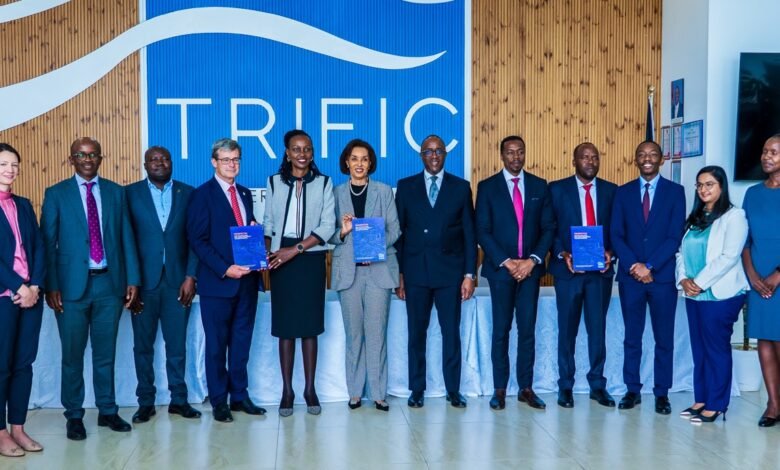
Centum’s services-focused special economic zone at Two Rivers has opened a KES 4.8 billion (USD 37.3 million) income real estate investment trust, and it is unusual for two reasons. It pays investors in US dollars, and it is marketed as green. Both features are rare on the Nairobi Securities Exchange, and together they make this one of the more interesting capital markets products Kenya has seen in years.
The vehicle is run by the Two Rivers International Finance and Innovation Centre, known as TRIFIC, the only privately owned, services-focused special economic zone in Nairobi. It sits on 64 acres inside the wider 106-acre Two Rivers development in Gigiri, near the diplomatic blue zone. The offer opened on 13 May 2026 and closes on 12 June. Allotment to successful investors happens on 15 June, with refunds the following day, and the units list for trading on the NSE’s Main Investment Market Segment on 23 June.
Let’s unpack what is being sold, and to whom.
What an income REIT actually is
A real estate investment trust, or REIT, lets many investors pool money to own income-generating property without buying a building outright. An income REIT, or I-REIT, is the version built specifically for rental income rather than development profit. Under Capital Markets Authority rules, an I-REIT must pay out at least 80% of its net profit to unit holders as dividends, and those dividends are tax-exempt. That payout rule is the whole appeal. You buy units, the buildings collect rent, and most of that rent flows back to you.
In this case the underlying asset is the TRIFIC North Tower, a commercial building offering more than 16,000 square metres of lettable space. The press release puts it at 92% leased to multinational service-exporting firms. Proceeds from the REIT fund the acquisition of that tower and the development of further green-certified towers in the zone, where demand has pushed planning for a second building.
The two features that make this different
The first is currency. Almost every Kenyan REIT and most local savings products are denominated in shillings. This one pays in dollars. By issuing the I-Reit in dollars, Centum is targeting external investors who may have been wary of a shilling-denominated Reit on fears of exchange losses when converting the income distribution. For Kenyan investors, a dollar yield is a hedge. If the shilling weakens, your income holds its value in hard currency. Centum has previously indicated it is paying investors a dollar return of about eight percent on the facility, and it matches this by signing tenants to long-term, dollar-based leases with built-in annual rent increases, so the money coming in and the money going out are in the same currency.
The second is the green label. Proceeds go exclusively into commercial towers built to international sustainability standards. This is partly substance and partly positioning. Green-certified buildings can command better rents and attract the kind of multinational tenants who have their own environmental reporting obligations. It also opens the door to impact-focused investors who screen for sustainability.
Who can buy, and for how much
This is where the story matters for regular readers. Existing Kenyan REITs have largely been gated. The existing Reits are exclusively marketed to a class of buyers known as professional investors, who are high-net-worth individuals or institutions whose minimum investment in the Reit is Sh5 million. That KES 5 million floor put them out of reach for almost everyone.
TRIFIC’s offer is unrestricted, meaning it is open to both institutional and retail investors. The minimum subscription is KES 129,000, or USD 1,000. KCB Investment Bank, the transaction advisor and lead placing agent, frames this as bringing the product within reach of ordinary investors. That is fair relative to a KES 5 million gate, though KES 129,000 is still a meaningful sum for most Kenyan households. Call it accessible to the salaried middle class and the diaspora, rather than truly mass-market.
The track record worth knowing
Kenya’s REIT history is a cautionary one, and any honest writeup has to say so. The country’s first listed REIT, ILAM Fahari (formerly Stanlib Fahari), listed at Ksh 20 per unit at its IPO in 2015 and currently trades at approximately Ksh 6, a 70% decline for original investors. It eventually delisted from the main market in February 2024 and restructured onto the NSE’s Unquoted Securities Platform. The product class has struggled to win retail confidence.
TRIFIC’s pitch is that its structure is different. The income is dollar-based and contractually escalating, the anchor tower is already mostly leased, and the tenants are export-oriented firms paying in hard currency. Centum, which holds an 80.5% stake in TRIFIC, also brings a real estate track record that includes the Two Rivers Mall and over 2,000 residential units across Kenya and Uganda.
The expansion has been building for a while. In June 2024, TRIFIC secured USD 47.5 million in mezzanine funding from Vantage Capital, Africa’s largest mezzanine fund manager, to fit out the North Tower and develop further towers. We have followed Kenya’s broader real estate and capital markets story closely, and this REIT is best read as the next stage of that long-planned Two Rivers build-out rather than a standalone event.
What to actually watch
For a prospective investor, three things decide whether this works. First, occupancy. A REIT lives or dies on rent collection, so the durability of that 92% lease rate and the quality of the export-focused tenants matter more than any marketing line. Second, the real dollar yield after costs, which you should read from the prospectus rather than from headline figures. Third, liquidity once it lists on 23 June, because thin trading has hurt past Kenyan REITs and makes it hard to exit.
This is a genuinely novel product for Nairobi, and a lower entry point than anything comparable before it. It is not a savings account. Read the prospectus, understand that property income can fall as well as rise, and treat the dollar yield as the reason to look closely rather than a guarantee.
The offer prospectus and subscription details are available through KCB Investment Bank, the lead placing agent. For the wider context on Kenya’s REIT market and how listed property funds have performed, see the Capital Markets Authority and the Nairobi Securities Exchange.








Join the discussion