

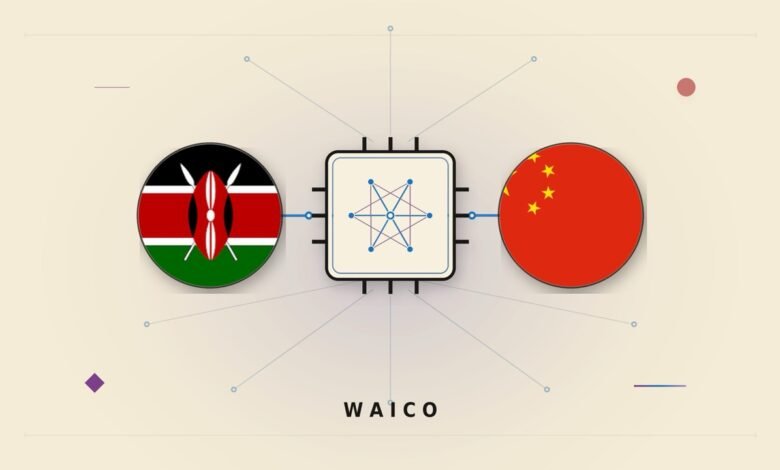
Kenya has become a founding member of a new China-led organisation for governing artificial intelligence. On 16 July, Information, Communications and the Digital Economy Cabinet Secretary William Kabogo signed the agreement establishing the World Artificial Intelligence Cooperation Organization (WAICO) in Shanghai, on behalf of the Republic of Kenya. Twenty-nine governments signed in total.
Here is what that body is, in plain terms. WAICO is an intergovernmental organisation, which means its members are national governments rather than companies, universities, or individuals. It will be headquartered in Shanghai. It sits outside the United Nations system, so it is a new forum China has built rather than a department of an institution that already exists. Its stated job is to coordinate how countries develop and regulate AI, with a stated focus on getting the technology to poorer countries that do not have a frontier AI industry of their own. Chinese Foreign Minister Wang Yi signed for China. UN Secretary-General António Guterres attended the ceremony, though attending is not the same as the UN endorsing the body.
The list of who signed tells you a lot about what WAICO is. No G7 country signed. The United States, the United Kingdom, Japan, Canada, and European Union member states are all absent from the founding roster. Ten African countries are in: Kenya, Algeria, Cameroon, Congo, Ethiopia, Lesotho, Mozambique, Senegal, South Africa, and Zambia. The rest are mostly states with close trade or technology ties to Beijing, among them Russia, Belarus, Serbia, Pakistan, Indonesia, Kazakhstan, Brazil, and Venezuela. China first proposed the organisation at last year’s World Artificial Intelligence Conference, and the signing happened on the eve of this year’s edition.
Kabogo gave his reasons for signing. He said Kenya joined because it sees AI as something that should benefit ordinary people rather than a small number of rich countries and large companies. He pointed to uses such as giving farmers crop advice in local languages, speeding up patient assessment in healthcare, and letting local developers reach computing power and AI models at lower cost. He tied the decision to Kenya’s record in mobile money and to the National AI Strategy 2025-2030, which the government launched in March last year with the aim of making Kenya Africa’s leading AI hub. We looked at that same strategy when Kenya opened talks with OpenAI about a Nairobi academy, and when a Nairobi forum asked whether Africa can move from using AI to actually building it.

At the conference the next day, President Xi Jinping set out what China is putting on the table. Over five years, China plans to provide 5,000 training places for people from developing countries, set up AI cooperation centres with regional blocs including the African Union, and roll out a Chinese AI weather early-warning system to about 30 countries. Kabogo said Kenya hopes to send around 100 young professionals for training in China and then use them as trainers across the country’s digital hubs.
There are reasons to be careful about how much of this changes on the ground. The world already has AI principles, national laws, and several diplomatic forums on the subject, including summits hosted by the United Kingdom, South Korea, France, and India that leaned towards managing the risks of advanced systems. What has been missing is agreement on who gets to set the rules. The Diplomat, in its analysis, reads WAICO as China moving from stating principles for AI governance to building a permanent institution that can put those principles into practice. It also notes that many WAICO members already take part in China’s Digital Silk Road or Belt and Road technology programmes, so in part the body formalises relationships that were mostly there already.
For Kenya, the questions we raised about hosting the country’s tourism data on a single foreign cloud apply here too. Deeper AI cooperation with China means decisions about where data sits, whose technical standards apply, and who controls the tools. Kenya has leaned in several directions at once. It has courted OpenAI and Google, runs long-standing Huawei training programmes, and is building AI-ready data centres at home. Joining WAICO is another line in that balancing act, not a switch away from Western partners.
For now, WAICO is a signed agreement, a headquarters in Shanghai, and 29 members. Whether it becomes a body whose rules other countries follow, or one more forum among many, depends on what it actually produces and whether members agree to be bound by any of it. The specific things to watch are whether WAICO publishes real rules or model agreements, which country hosts the African cooperation centre China has promised, and whether the training places and cheaper computing access Kenya is counting on actually arrive. Kenya has secured a seat. The body it has joined has not yet done anything binding.







Join the discussion