

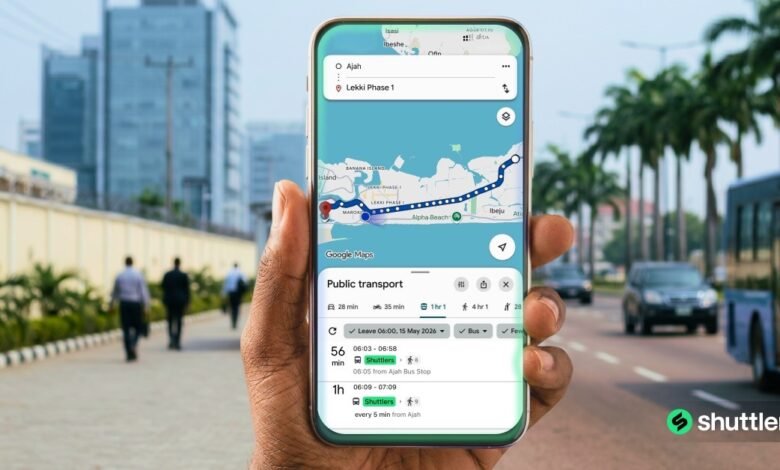
Shuttlers, the Lagos-based shared transport company, has announced two things at once. It says it has completed its 10 millionth journey since launching, and that it is now an official transit partner inside Google Maps in Nigeria. From now on, a commuter searching for directions in Maps can see a Shuttlers route as one of the travel options, then tap through to the Shuttlers app to book and pay for a seat.
It is worth being precise about what this integration is, because the wording in mobility announcements often does more work than the technology does. Google Maps is not selling Shuttlers tickets. What Shuttlers has done is feed its route and schedule data into Google’s Transit Partner programme, the same pipeline that lets you see a city bus or train inside Maps. Google surfaces the route. The booking still happens on Shuttlers. To qualify, the company had to shape its route data and real-time operations to match Google’s partner requirements, which is a real engineering and operational bar, not a marketing badge.
What Shuttlers actually is
Shuttlers was founded in 2016 by Damilola Olokesusi, who remains chief executive, and Akachukwu Okafor. The idea is simple to describe and hard to run. Instead of hailing a single car or fighting for space in an informal minibus, professionals book a seat on a fixed route that runs at a fixed time, on a clean bus, with live tracking and digital payment. Companies can cover the fare for staff, split it, or leave employees to pay per trip.
According to the company, it now serves about 30,000 active users and roughly 11,000 daily riders, running more than 430 buses across over 1,000 itineraries in Lagos, Abuja and Port Harcourt. It claims a 99% trip completion rate and a 99.94% incident-free record across its history. It says the average rider saves between 60% and 88% against ride-hailing and recovers 8 to 12 hours a month otherwise lost to gridlock. These are Shuttlers’ own figures, so treat them as the company’s account rather than audited numbers. The financial backing is more concrete. Shuttlers raised $1.6 million in 2021 and a further $4 million in 2023, for around $5.6 million disclosed to date. It has also begun moving its fleet to compressed natural gas and electric buses, which it says cut emissions by up to 60% against diesel.

The reason it could get onto Google Maps at all is the part Kenya should pay attention to.
A map is only as good as the service beneath it
A transit map needs three things to be useful: where a vehicle goes, when it goes, and the confidence that it will actually be there. Shuttlers can supply all three because it built them first. Fixed routes, fixed departure times, a guaranteed booked seat. Once that structure existed, putting it on a map was the easy final step.
Nairobi did this in the opposite order, and the result is instructive. Kenya’s matatus have been on Google Maps since 2015, when the Digital Matatus project, a collaboration between the University of Nairobi, MIT, Columbia University and the design firm Groupshot, mapped roughly 130 routes and nearly 3,000 stops and fed them to Google. It was the first time an informal transit system anywhere had been made navigable inside Maps. On paper, Nairobi was years ahead of Lagos.
In practice, it does not work well, and the reason is structural rather than technical. The project team said as much when they built it. The data points a normal transit map relies on simply do not exist for matatus. There are no real timetables, no service frequencies, no fixed departure times. Fares move with demand, weather and police activity. Routes and stops shift on the day. So when Maps shows you a matatu line, it is showing you roughly where a matatu travels. It cannot tell you when one will come, whether there is a seat, or that the stage you are walking to will have a vehicle at all.
That is the gap every Nairobi commuter already knows in their body. You get to the stage and wait for the matatu to fill before it moves. It leaves on the driver’s judgement, not a schedule. It drops people at shifting points. Sometimes the stage Maps sent you to is simply empty. None of that is Google’s failure. Maps is faithfully drawing a system that has no schedule to draw. You cannot map your way out of disorder. You have to fix the service, and then map it.
Swvl tried to be that fix, and we watched it fall apart
Kenya has already lived through one attempt to build the structured layer Shuttlers is built on. Swvl arrived offering fixed routes, fixed times and booked seats, the same promise. For a while it worked, and it felt like the matatu might finally meet a serious challenger.
It did not last. Swvl’s collapse had two layers. The bigger one was financial and global. The company listed on the NASDAQ through a SPAC at a $1.5 billion valuation in 2022, then lost almost all of that value, laid off staff in waves and pulled out of multiple countries. Kenyan intra-city and inter-city rides were paused in June 2022, with the company itself blaming the global downturn. The smaller layer was local, and we saw it on the ground. We already documented how Swvl drifted into becoming the very matatu industry it set out to disrupt, with a buggy app, an eroding premium promise, and an early suspension by the NTSA over licensing. The lesson is not that the model is doomed. Shuttlers is running the same model and is still here. The lesson is that the structured layer is fragile, and it dies if either the business discipline or the regulator gives way.
The rest of Kenya’s unfinished map
The matatu is the loudest example, but the same gap shows up across Kenyan transport.
You still cannot book the SGR from Google Maps. The Madaraka Express is booked through a USSD code, the Kenya Railways portal, or a counter, and Maps plays no part. That is partly because the termini sit far from where people actually are, at Syokimau outside Nairobi and Miritini outside Mombasa, and partly because Kenya has no proper urban commuter rail woven into city life for Maps to surface in the first place. There is route data to show, but little dependable scheduled service to book.
Cycling tells a quieter version of the same story. Google Maps offers bicycle directions in around 30 mostly Western countries, and Kenya is not one of them. That feature leans on data about dedicated cycling lanes and infrastructure, and Kenya has barely designated any. The absence on the map reflects an absence on the ground. (Worth noting for accuracy: Google does support motorcycle and boda routing in Kenya, so the gap is specific to bicycles.)
Where the optimism actually lives
The encouraging part is that Kenya is fixing one piece of this faster than almost anywhere on the continent. Electrification is real here. BasiGo deployed its 100th electric bus across Kenya and Rwanda in August 2025 and is targeting 1,000 by 2027, with the first buses fully assembled in Kenya entering service late that year. Crucially, it has pulled the SACCOs in, with operators like Super Metro, Citi Hoppa, OMA Services and Rembo running electric buses on ordinary commuter corridors. That is the hard institutional work of changing what the matatu sector drives.
So the vehicles are improving. The operator SACCOs are becoming better. The missing layer is the one Shuttlers just demonstrated. Take those organised operators and electrified routes, attach real schedules and bookable seats to them, and feed that structured data to Maps. Then the map finally tells the truth, because there is a dependable service underneath it.
That is the practical thing to take from Shuttlers’ announcement. Getting onto Google Maps is not the achievement. It is the reward for building a transport service that runs on time, holds a seat for you, and shows up where it says it will. Lagos built the service and then mapped it. Nairobi mapped the chaos and is still waiting for the service. Kenyan operators and regulators have to get order right.








Join the discussion