

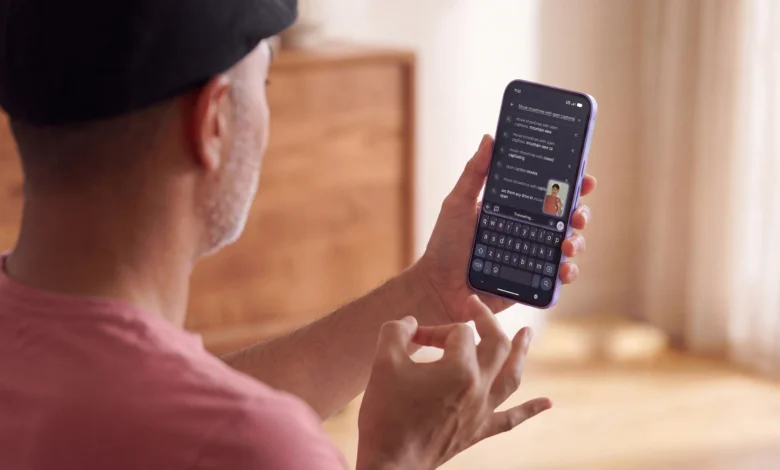
Google has put a sign language translation model inside the new Pixel 11 Series. The model is SL2T, short for sign-language-to-text, and Google DeepMind announced it on 12 August alongside the Pixel 11 series. The model can understand American Sign Language through the camera and write out what’s being signed in plain English.
Currently, it supports American Sign Language (ASL)
How it works
You point the phone at yourself, sign, and the words appear as text.
It runs in two apps.

The first is Gboard, Google’s keyboard. So one can use Sign Language to Text anywhere where typing is supported. Be it a Google search, a WhatsApp message, a document, a prompt to Gemini.
The second is Live Transcribe, Google’s free app that captions speech on screen for deaf and hard of hearing users. Live Transcribe already turned other people’s speech into text. Now the deaf user can answer by signing rather than typing, and show the result to the person in front of them. On the Pixel 11 Pro Fold that text also appears on the cover screen, so the hearing person reads it without the phone changing hands.
Google DeepMind calls this the sign language equivalent of voice dictation, and says its testers found signing faster than typing English.
Why this is harder than speech to text
Voice dictation writes one language down in that same language. ASL is a full language with its own grammar and vocabulary, not English performed with the hands, so going from ASL to written English is translation.
The other half is vision. Meaning in a sign language comes from hands, arms, torso, head and face moving at once, at speed. That is why sign language gloves, an idea that keeps resurfacing, never worked. Gloves read finger positions. They cannot read a raised eyebrow, which in ASL can turn a statement into a question.
Running locally on device
For security, the model runs on the device. MediaPipe Holistic turns each video frame into 130 coordinates covering face, body and hands. Only those coordinates go to Google’s servers, and the video is discarded on the phone. In the joint impact report published with the launch, Google says it keeps no logs of inputs or outputs unless the user joins an evaluation study.
Google trained SL2T on more than 100,000 hours of data across more than 50 sign languages, about a quarter of it ASL. On the FLEURS-ASL benchmark it scores 70 BLEURT, a machine translation score where higher means closer to a human translation, which Google calls the highest reported figure on that test.
Google says do not use it in a hospital or a courtroom
Google wrote that report jointly with the AI Sign Language Advisory Committee, a body it convened that includes the US National Association of the Deaf, the World Federation of the Deaf and Rochester Institute of Technology’s National Technical Institute for the Deaf.
The report bans specific uses outright: healthcare and emergency medicine, police interrogations and court proceedings, classroom instruction and academic assessment, job interviews and disciplinary hearings, and benefits decisions. Google and the committee state that SL2T does not meet the legal standard for reasonable accommodation under the Americans with Disabilities Act. The concern the committee raised directly is that agencies, hospitals and employers will drop paid human interpreters because software is cheaper. SL2T translates in one direction only, cannot ask a speaker to clarify, and carries no professional accountability.
The report also lists what still goes wrong. The model invents text when a second person walks into frame or when the signer pauses to think. It distorted multi-digit numbers, at one point turning the Maine area code 207 into 2007. It misses grammar carried by facial expression. Clips are capped at 60 seconds and it remembers nothing between clips. It was never trained or tested on signers under 18.
What this means in Kenya
Very little for now, for two separate reasons.
The first is language. Kenyan Sign Language grew out of two schools for deaf children in western Kenya in the early 1960s and developed on its own. Linguists comparing the two vocabularies found KSL and ASL share between 13% and 22% of cognates. A KSL signer using this feature is signing at a model that was not built to read them.
The second is hardware. Google does not sell Pixels in Kenya. As we covered when the prices went official, the base Pixel 11 starts at $899, roughly KES 116,000 before shipping, duty and importer margin, and stock arrives through independent importers weeks after the US release. Local retailers do stock Pixels, usually well above that conversion. Google’s launch footnote says the Gboard feature is available “for select countries and languages”. There’s no full list yet.
Kenya is not short of the legal case for this technology. The Constitution requires the State to promote Kenyan Sign Language under Article 7(3)(b), and Article 120 makes KSL an official language of Parliament alongside Kiswahili and English. The Persons with Disabilities Act 2025 requires national and county governments to place enough KSL interpreters in health institutions. The Kenyan Sign Language Bill, 2023, which would create a council to register interpreters and require sign language insets on TV news, passed the National Assembly with amendments on 24 June 2026.
The 2019 census counted 918,270 Kenyans with a disability, 16.7% of whom reported difficulty hearing, roughly 153,000 people. That only includes those who answered “a lot of difficulty” or “cannot do at all”. The Kenya National Association of the Deaf puts the deaf and hard of hearing population at about 2.7 million, the figure quoted in Parliament and most local reporting. The two measure different things, and the gap is part of why interpreter planning here is so hard.
But we have local solutions
Signvrse, a Nairobi startup, built Terp 360, which takes speech and text and produces Kenyan Sign Language through animated avatars. It is the mirror image of what Google shipped. We wrote about founder Elly Savatia when he was shortlisted for the Royal Academy of Engineering’s Africa Prize, which he went on to win in October 2025 along with £50,000. Savatia told TechCabal that signing back into text was on his roadmap and technically harder. That is what Google has now shipped.
Kenyan researchers have also built KSL training data using the same pose-tracking method Google relies on, including 20,000 KSL recordings converted into anonymised MediaPipe coordinates in a 2025 Data in Brief paper, and the AI4KSL project’s 14,000 glossed sentences and 20,000 signed videos.
What to watch
Google says more devices and more sign languages are coming and gives no dates. Its own report lists expanding data collection to other sign languages as a long-term research goal rather than a scheduled release. Three things are checkable from here: whether Google names any African sign language in its next SL2T update, whether the Kenyan Sign Language Bill gets signed, and whether Pixel 11 units arrive prices within reach of the people who would use this.


Join the discussion